Northwest Michigan fruit update – June 23, 2026
 Print
Print Email
EmailSweet and tart cherries are beginning to color, and strawberry harvest is ongoing.
Weather report
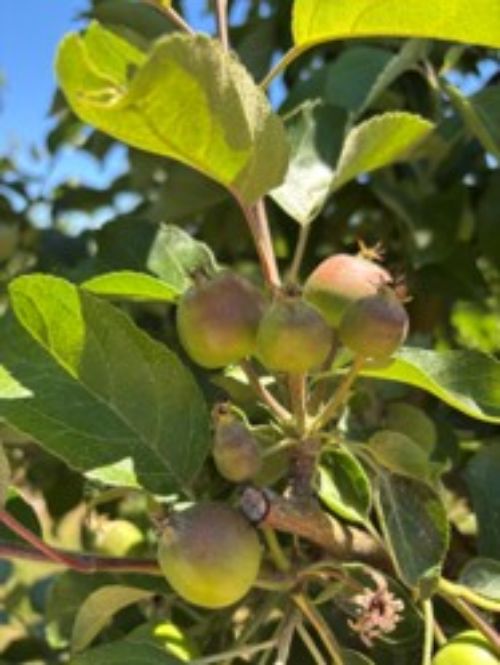
Cool weather continues across the region. We have had lots of sunshine, but the daytime temperatures rarely get out of the 60s. Evenings have also been cool, and overnight temperatures have been in the 50s. The overnight low for June 24 is predicted to be 48 degrees F. This forecast is predicted to change early next week, and real summer-like weather will replace these cool conditions. At the NWMHRC, we have accumulated 1113 growing degree days (GDD) base 42 and 620.8GDD base 50. Our 36-year averages are as follows: 1126DD base 42 and 644.4GDD base 50. This spring has seemed quite cool compared to recent years, but our average growing degree day accumulations are relatively spot on for our long-term averages. We had rainfall on June 17 and 18: 0.58 inch and 0.21 inch respectively. Even though those rain events were less than a week ago, it seems dry out and we could use more rain. There is rain in the forecast for tomorrow, June 24, and they are predicting a quarter to a half inch of rain for most of Michigan.
Andresen’s forecast is predicting the change in cool weather to hot weather starting next Monday. This hot weather will be just in time for the Fourth of July. Cool weather will continue this week and into the weekend. A warm front will enter the state, and temperatures are predicted to reach into the 80s and maybe even 90s in more southerly parts of the state.
Crop report
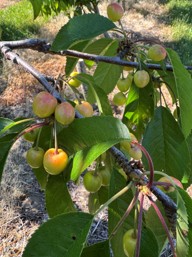
Orchards are looking lush with the rain and cool temperatures. We have significant leaf growth, and trees look healthy. Both tart and sweet cherries are starting to color. We have significant color on early sweet cherry varieties, and the Black Pearl at the NWMHRC are really red. Other sweet cherry varieties are also coloring, and depending on the crop load, trees with a light crop are showing considerable color. Montmorency tart cherries are at 14mm. Balaton fruit is at 13mm. Sweet cherries are just larger than the tarts, and they range from 13-15mm depending on variety. The Michigan Cherry Committee released their estimates for Michigan: 40 million pounds for NW, 4 million pounds for WC, and 2 million pounds for SW. There is no cherry crop in Utah. New York and Pennsylvania also have very few cherries this year. The Washington estimate is 20 million pounds. The Wisconsin estimate is 11 million pounds. Although the crop is light in SW Michigan, they are estimating harvest to begin in that region on June 28.
Apples at the station are also sizing. There is some variability in development and crop across our blocks, but in general, our Galas are at 26mm and Honeycrisp is at 28mm. The thinning window is closed for most growers in the region. There may be still some growers in the far north where thinners still may work, but for most growers, thinning with chemical applications is over. We have been evaluating our thinning, and for the most part, the crop looks adequately thinned in most blocks. We applied two thinners this season because the first round of thinners did not seem to be working. We also have some blocks that have considerable size differentials in the clusters where there are 10-15mm differences between king fruit and some of the lateral fruit. The small fruitlets do not seem to come off when we shake the branch. Growers should be thinking about NAA applications for return bloom in Honeycrisp. Dr. Griffith is recommending these treatments for growers to try:
- 10 ppm NAA at 30, 45, and 60 DAFB
- 150 ppm ABA at 30 DAFB
- 10 ppm NAA at 30, 45, and 60 DAFB + 150 ppm ABA at 30 DAFB (so NAA and ABA are tank- mixed at 30 DAFB)
Disease report
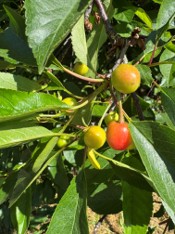
Apple scab. Southwest Michigan called the end to primary scab on June 4. The Ridge called the end to primary scab two weekends ago (June 13). They have not caught scab spores after the last two-night rains in WC Michigan, so they have not called the end in that region yet. RimPro is calling the end to primary, and Enviroweather is saying that 98% of the scab spores have been dispersed. I feel confident that primary is over, but if growers are nervous, one more rain event tomorrow should seal the deal. We have only had three scab infections this spring that registered on Enviroweather, and the last one was the recent rain event of June 17.
Cherry Leaf Spot. The CLS model on Enviroweather shows that we had a light infection for this disease on June 17. Unlike scab, there is no primary season for leaf spot, and growers will need to protect new tissue from this fungus throughout the growing season. In most cases, we cover through harvest, and many growers do one post harvest application for leaf spot. This cool weather is ideal for copper use as sometimes hot weather can cause phytotoxicity with copper fungicides. Copper is a good product for resistance management, and these materials are rated excellent from our efficacy trials. The best coppers in our trials have been the following: Badge, Cuprofix, Champ, ChampION and Kocide. There are a lot of new leaves/foliage in the orchard, and growers need to be applying a fungicide to control leaf spot. We want to delay infection as long as we can because early leaf spot infections can lead to early defoliation, and we need all the leaves we have to ripen the crop this season.
Powdery Mildew. Unlike other fungal pathogens, PM thrives in hot and dry conditions. This recent weather pattern is perfect for PM as this fungus grows well when temperatures are between 60-80F. This fungus does not need rainfall to infect as humidity and/or dew can result in a PM infection. Once this disease infects the leaves, a white mycelium appears on the foliage. Once this mycelium is visible, there are no fungicides that can eradicate PM. Growers must treat this disease preventively. Luna Sensation, Merivon, Torino, Pristine, Flint Extra and Cevya are all rated excellent for PM.
Apple PM has also been on the rise in Michigan orchards. Growers need to treat for this disease earlier in the season, and because we do not have hot conditions at tight cluster, many growers may not put a material targeting PM into the tank until later in the season. Luna Tranquility, Merivon, Inspire Super, and Miravis are all rated excellent in the E-154 guide.
Insect report
With the recent cool weather, we had fewer insects in our traps this week.
Codling moth. We set the codling moth biofix for May 26, 2026. Based on the Enviroweather codling moth model, we are at 20% of egg hatch on June 19. We caught our lowest numbers of moths in our traps this week. This low trap count indicates the end of the first generation although we do not typically have two distinct generations in northern Michigan—we typically see overlap between generations.
Plum Curculio. This insect is active when early evenings are warm with some moisture. Since it has been cool, the activity of PC has slowed. This pest may have another quick flush of activity with the warm up predicted next week, but in many cases, PC threat will be reduced as this pest only has one generation, and the adults that will overwinter do not lay eggs in the fruit.
At this time in the season, cherry growers should be using the neonicotinoid and indoxacarb (Avaunt) chemistries as these materials are not effective at controlling SWD. Imidan and pyrethroids are rated excellent for SWD, and neonicotinoids are only rated as fair against this pest. To make the most out of a cherry insecticide program, the more broad-spectrum materials, like pyrethroids and Imidan, should be used later in the season to do double duty on these two pests. The time is coming for SWD control, and these two materials will work against late season PC.
Obliquebanded leafroller. We have had many reports of OBLR larvae in both apple and cherry orchards. OBLR is a threat to apples as a direct pest; the larvae feed on leaves and fruit in summer and fruit in fall. In cherries, OBLR does not feed on fruit, but they can cause damage to cherry leaves, which can result in defoliation. The greater concern of OBLR in cherries is the threat as a contamination pest, as they can be found in cherry tanks if present in trees at harvest.
We are starting to catch adult OBLR in our traps last week and again this week. This means the larvae that overwintered are pupating, and adult moths are in the orchard. Growers that have had issues with this pest in cherry need to be aware of the adults mating and laying eggs as the resulting larvae are the ones that can infest tanks at harvest time.
Black Stem Borer. We caught 0 BSB this week and last week.
American Plum Borer. APB numbers are much lower this week than last week, as to be expected as this pest has two generations per season. Lesser peach tree borers are also down this week. Altacor is a good material for trunk sprays in sweet cherry because Lorsban is no longer registered in this crop. Lorsban can still be used in peaches and tart cherries, but growers should check with their processors before applying in bearing blocks.
Spotted Wing Drosophila. We caught 38 adult SWD flies in our traps at the NWMHRC this week. We have caught them earlier in past years, but growers need to remember that there is little relationship between trap catch and infestation. Just because we are catching adults in traps, there is no indication that there will be larvae in fruit. Although sweet cherries and in some cases, tart cherries are starting to color, but the fruit is still not susceptible to SWD infestation.
Rose Chafer. This light tan beetle has a darker brown head and long legs emerges during June feeds on tree fruit crops. Sightings of these insects have increased in the past weeks throughout the fruit growing regions of Michigan, and growers should be vigilant if they have crops on sandy soils, where this pest is usually more of a problem. Female beetles lay groups of eggs just below the surface in grassy areas of sandy, well-drained soils. Rose chafer larvae spend the winter underground and move up in the soil to pupate in the spring. A few weeks later they emerge from the soil and disperse by flying. There is one generation per year.
Male beetles are attracted to females, and they congregate on plants to mate and feed. Feeding can continue for three weeks. This pest is most problematic on young trees as sometimes the numbers can be so large, the feeding can result in defoliated trees. Insecticides are only fair to good against this pest because of their ability to reinfest an orchard. Materials that are rated ‘good’ against rose chafers are as follows: Diazinon, Sevin, Assail, Besiege and Lambda-Cy.
Horticulture
Thinning. The window for thinning has closed. Gala are at 26mm and Honeycrisp are at 28mm—both of which are too big to thin.
Green Leaf Loss. Some growers have contacted us about green leaf drop in tart cherry. We hypothesize that this loss is from cherry yellows virus, likely as a result of the long cool spring. There is nothing growers can do about the drop, unfortunately. Most of the leaves are green but sometimes leaves have a brown blotch on the green tissue.
This work is supported by the Crop Protection and Pest Management Program (grant no 2024-70006-43569) from the USDA National Institute of Food and Agriculture. Any opinions, findings, conclusions, or recommendations expressed in this publication are those of the author(s) and do not necessarily reflect the view of the U.S. Department of Agriculture.