Northwest Michigan fruit update – May 5, 2026
 Print
Print Email
EmailThe cold weather pattern continues across northwest Michigan as fruit crops slowly inch forward out of dormancy. Frost is in the forecast.
Weather report
It seems like spring will never come to northern Michigan. We continue to see cold days and cold nights across the region. We have been hovering around the 50-degree mark for many days, and we did hit a high of 70.5 degrees Fahrenheit on April 27. The following day was 65 F, but then after the third day, we saw a daytime high of 45.6 F. Those 40-degree daytime highs continued through the weekend, and we had a cold night Friday into Saturday morning, May 1-2, where the Northwest Michigan Horticulture Research Center Enviroweather station hit a low of 28.7 F. We had reports of colder temperatures across the region. The East Leland weather station hit a low of 23 F and remained in the mid-20s for 9 hours with no wind. The weather forecast is predicting two more nights of frosty conditions in northern Michigan this week. We are not out of the woods yet for cold temperatures.
These weather conditions seem more normal for a Michigan winter and into the spring where cold weather dominates, and we come out of dormancy slowly. However, we have sustained some particularly cold temperatures at some sites in the region, and growers are evaluating potential damage. We looked at our blocks across the station yesterday afternoon, and the results are variable. There are differences in amounts of damage in sweet cherry by variety. Our tart cherries look worse this week than they did when we evaluated damage after the April 20 frost/freeze event. However, we can find viable flowers across most of our blocks, so if the old adage remains true and we have 20% viable flowers in a Montmorency orchard, we can still result in a full crop—we are going with it.
Additionally, most of our bud selections are from the ground where we can reach. As with many cold events, lower buds fare worse where the cold air pools compared to tops of the tree canopy. Again, we will have to wait to see what the rest of the week brings for weather. The current forecast is not ideal for honey bee flight, and sweet cherries are just starting to open. Hopefully, the weather will be warmer this weekend and blossoms will open just in time for bees to fly happily at 60 F.
Despite how this weather feels for us, especially those that are regularly attending spring sporting events, we are ahead of our 37-year average, but not by much. We have accumulated 284.9 growing degree-days (GDD) base 42 and 122.1 GDD base 50 in 2026. Our average GDD accumulations at the Northwest Michigan Horticulture Research Center are 244.9 GDD base 42 and 103.9 GDD base 50. We had just under a quarter inch of rain on April 24 and April 28. We had marginal rains, less than 0.05 inches, on May 3, 4 and 5. There were reports of lightning in locations across the region on May 4.
According to Jeff Andresen, PhD, we are stuck in a typically unwanted pattern of cold weather for spring. There is a trough of air that is allowing cold Canadian air to come down into Michigan and further south. This weather pattern is more common in March when it is expected to be cold than May when temperatures are typically warmer. This pattern is also bringing dry conditions and will remain for the rest of the week: cold and dry. By the weekend, there will be a marginal let up in the cold, and daytime highs could hit 60 F based on the Traverse City, Michigan, forecast.
There will be little to no precipitation for the next seven days. However, the three-to-four-week forecast is predicted to change. Andresen says we will start to see warmer temperatures that will be warmer than normal; this new weather pattern will also bring more moisture. Think spring—late May!
Crop report
Cool weather continues to hold back crop development. Of course, crops continue to advance, but they are moving at a slow rate with the cold temperatures. We did hit a high of 74 F at the Northwest Michigan Horticulture Research Center yesterday, and we observed a lot of honey bee activity, both at the hive and at the few open sweet cherry flowers. However, the remainder of the week does not look good for pollination, and we anticipate honey bee activity will be low. We are hopeful for a warmup that will open sweet cherry blossoms, which will coincide with increased honeybee activity.
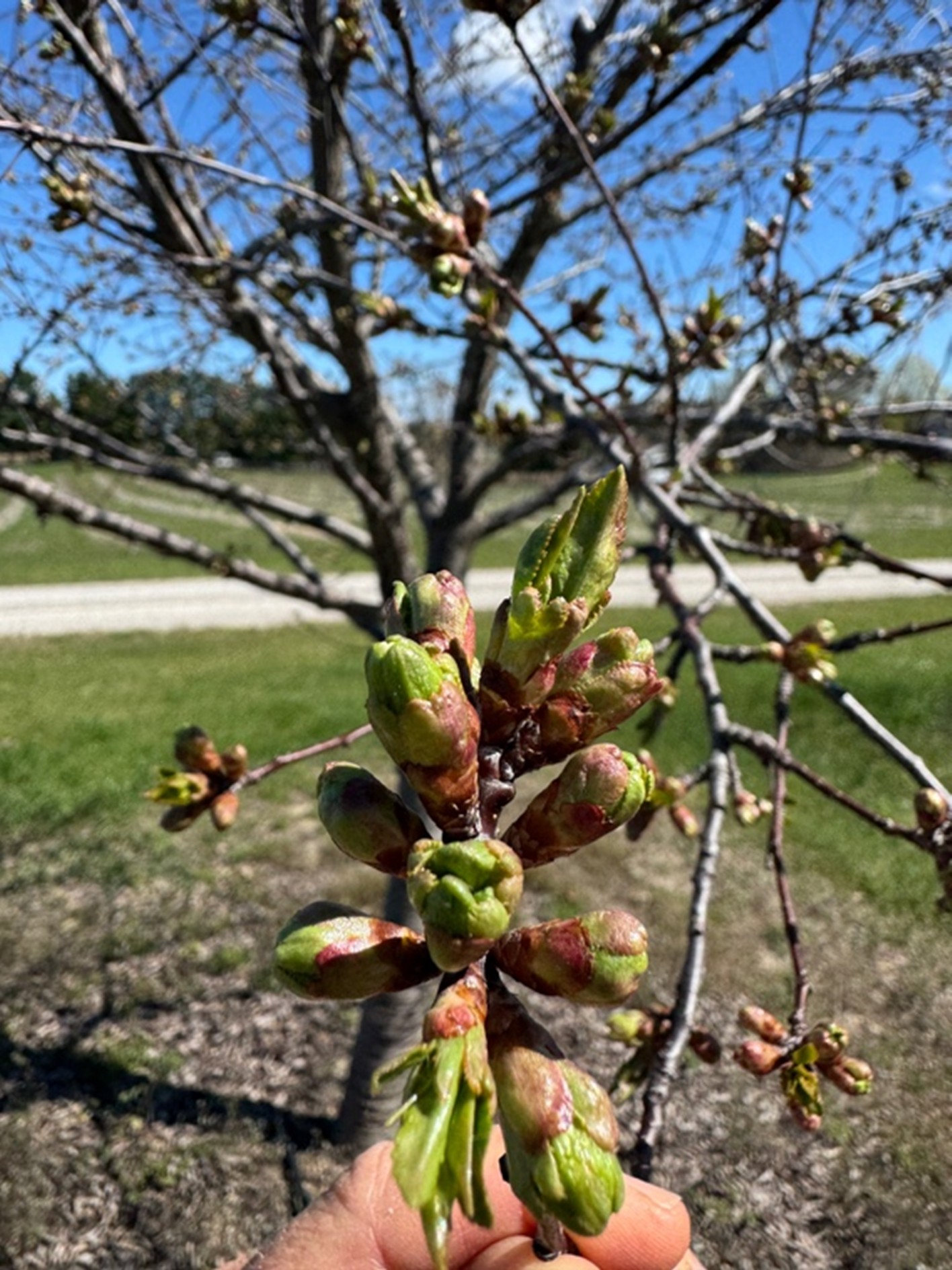
There is not a great change in phenology for any of the crops this week compared to last. Both tart cherry varieties are at some stage of tight cluster and very little movement from last week. Potomac and Bartlett pears are at green cluster.
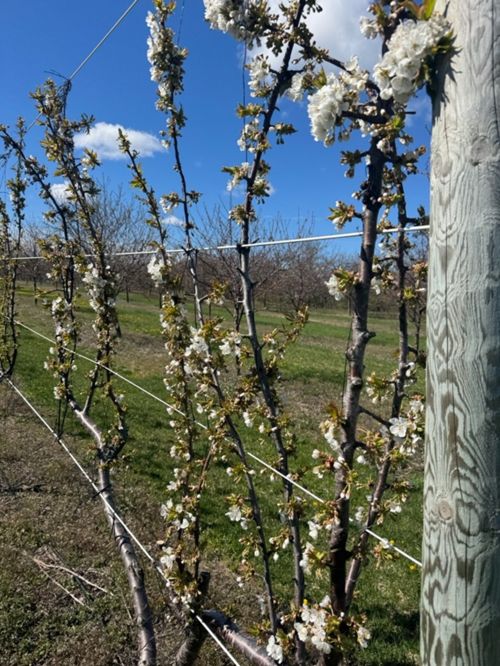
There is a slight differentiation in sweet cherry between varieties: Emperor Francis is at early white bud, Gold at early first bloom, and bud burst in Ulster. Just south of the research station, there are sweet cherries starting to open, and blossoms are visible from the road at 55 mph. We have Burgundy Pearl planted at high-density, and we see 25% bloom on those trees pruned to a UFO.
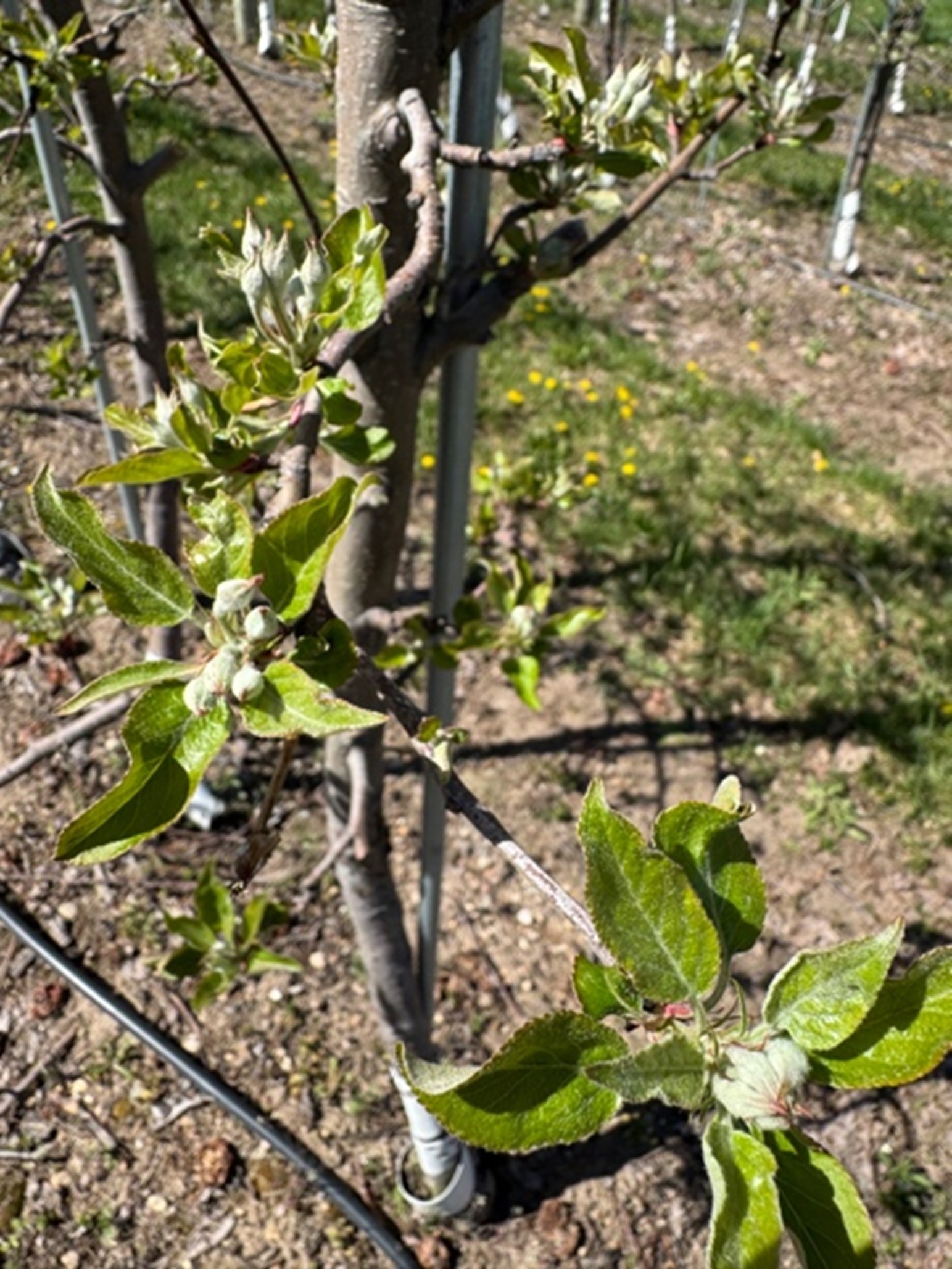
Gala apples are at late tight cluster, and we recorded them to be at tight cluster last week. Honeycrisp are at tight cluster.
In southwest Michigan, there is some damage in juice and wine grapes, and there will be a lighter crop for 2026. Peaches are at shuck split. Sweet and tart cherry are both at shuck split, and the overall cherry crop will be. The apple crop in the southwest is looking good. Pears are at 10 mm.
In west central Michigan, the first cherry leaf spot sprays will be applied this weekend. They are also anticipating king bloom to be open this weekend. Freeze damage to buds is still being evaluated, but tart cherries seemed to have been impacted the most. The apple crop on the Ridge is still looking good despite some cold weather in mid-April.
Disease report
Apple scab is still a disease of most importance right now. We are in the early stages of management, and with the cold weather and little new tissue, growers can take a bit of a breath for scab control. There is also no rain in the forecast, and the next seven days are predicted to be dry. However, if it does warm this weekend, we will see new growth, and this tissue will need to be protected before the next rain event.
With temperatures anticipated to warm and as we approach pink, the numbers of apple scab spores that will be released with the next rain event will be more significant, and growers will need to be on top of scab control. EBDCs and captan are good broad-spectrum materials for early in the season. Scala and Vanguard are also good materials that move systemically in the plant; these two fungicides have good activity in cooler weather, so early spring is the best time to use these two materials.
American brown rot is also on the minds of sweet cherry growers as bloom is upon us. We have limited materials for American brown rot later in the season when the sugars start to accumulate in the fruit and the fruit become more susceptible to American brown rot infection. The current concern is with the potential for infection during bloom resulting in blossom blight symptoms. The potential for blossom infection in Michigan is typically held in check by cooler weather as the optimal temperature for infection is between 72 and 77 F, and spore production is greatest between 59 and 74 F.
We have struggled with American brown rot control in recent years, and there are likely mummies present in most sweet cherry blocks this spring. The American brown rot fungus overwinters in fruit mummies from the previous season and will sporulate from these mummies, producing conidia that are disseminated by wind and rain. With leftover mummies in orchard blocks, there is a risk of higher inoculum loads in orchards.
Another important aspect of American brown rot blossom infection is this new infection enables the fungus to re-establish itself in orchards this year. Since the American brown rot fungus is a prolific sporulator, blossom infection will serve to increase orchard inoculum loads to critical levels—a much harder fight to control this disease later in the season as fruit ripens.
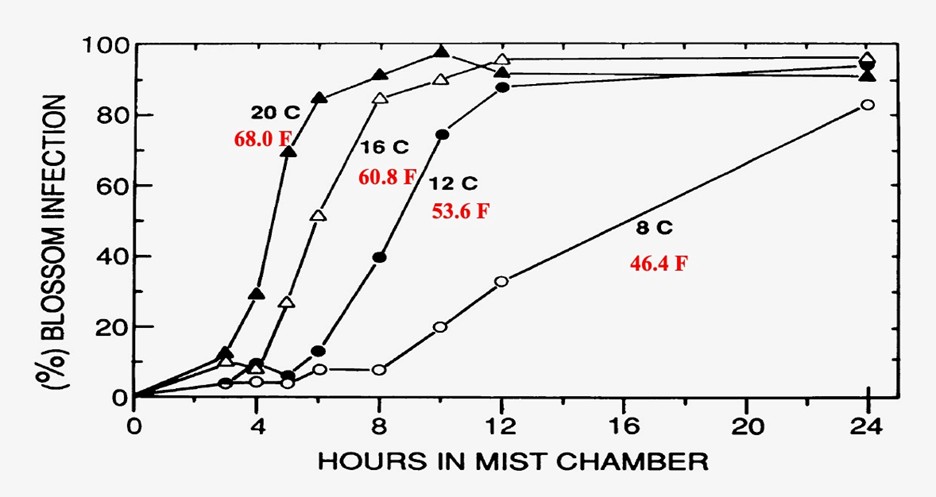
However, growers should remember that favorable conditions for American brown rot blossom infection include relatively warmer temperatures with some rain. There is little to no rain in the forecast. Based on the below graph, at cool conditions (around 45 F), we would need 10 hours of wetting to get 20% American brown rot infection. With little to no rainfall in the forecast and the cool temperatures, the data suggest we do not need to spray for American brown rot blossom infection. However, if the forecast does change, and the percentage of rain increases (currently a 45% chance in Traverse City), growers will need to modify this recommendation and apply a Rovral fungicide to protect blossoms.
Additionally, if growers have orchards with slow drying conditions, there is a higher chance of American brown rot blossom infection if the wetting period is prolonged. This graph provides an excellent overview and a rule of thumb for growers to gauge when to apply a blossom spray to prevent early season American brown rot. Because Rovral can only be used prior to petal fall and to minimize the potential for resistance with fungicides targeting fruit rot later in the season, this fungicide is recommended for blossom blight control at 2 pints per acre. Watch the weather forecast for a warmup and rain, but at this time, the current weather conditions do not favor an American brown rot blossom blight infection.
Insect report
Insect activity remains low with our cool weather. We caught green fruitworm again this week and our first black stem borer, only one, at the Northwest Michigan Horticulture Research Center. With the cool weather in the forecast and potential damage to the cherry crop, bee activity will be critical to pollinate the crop, especially if fewer flowers are viable. Growers may consider increasing the number of hives per acre to maximize the potential to pollinate a short crop. We will also have to rely on our native pollinators this season as they often fly at cooler temperatures than our managed honey bees; these native pollinators may be critical to providing pollination services this year if the weather continues to be cool.
Horticulture report
Sweet cherry growers are considering ReTain applications this season. ReTain is a plant growth regulator (PGR) that has been shown to extend flower viability in cherries by reducing ethylene production in cherry flowers and delaying flower and stigmatic senescence. Due to this effect, flowers that last longer have a higher likelihood to be successfully pollinated, and increased pollination results in a higher yield. Research has shown that ReTain works best if used before poor pollinating conditions, including wet and windy weather or low honey bee activity, or on varieties that tend to be shy bearing. We are currently in a situation where we have cold conditions, and we are likely to have less bee activity until the temperatures warm. Another consideration is that PGRs are only active when temperatures are above 60 F; these materials will provide no activity when temperatures are cold.
ReTain will only work on select varieties. We have seen good activity on Regina and Balaton. However, we have seen activity only when ReTain is applied early. The earlier the application, the better. Our data shows good activity at popcorn to first bloom, and once bloom is 30% and above, the effectiveness decreases. The rate for sweet cherry is one pouch per acre (up to two), and the cost is about $400 per pouch this year. Keep an eye on bloom and if the weather warms, consider if a ReTain application is needed this year.
This work is supported by the Crop Protection and Pest Management Program [grant no 2024-70006-43569] from the USDA National Institute of Food and Agriculture. Any opinions, findings, conclusions, or recommendations expressed in this publication are those of the author(s) and do not necessarily reflect the view of the U.S. Department of Agriculture.