Not ready for no-till? Exploring the reduced tillage spectrum
 Print
Print Email
EmailWhile regenerative practices aim to improve soil, water, nutrient cycling and biodiversity—and strengthen farmer and community well-being—they also come with challenges. Learn key insights on how to navigate and implement these different principles.
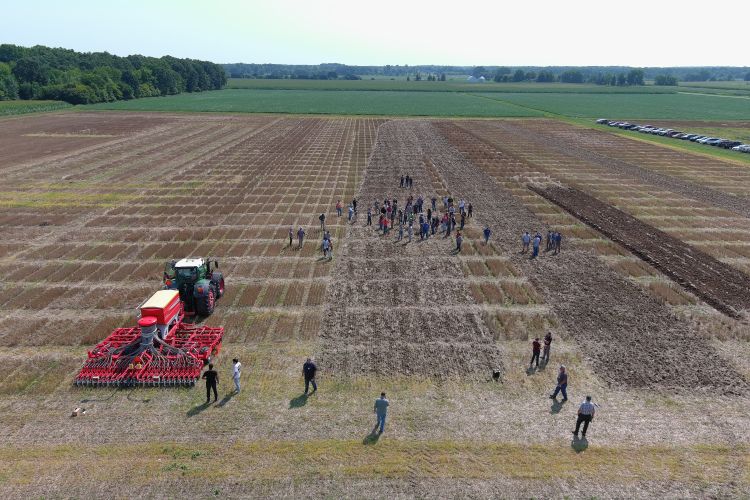
In February 2026, Michigan State University Extension partnered with the MSU Center for Regenerative Agriculture to offer a special webinar series on regenerative agriculture. These sessions brought together farmers, educators and landowners who are interested in healthier soils, stronger farms and more resilient rural communities.
The series introduced six key principles that help guide regenerative agriculture. These principles focus on things like keeping living roots in the soil, minimizing soil disturbance, increasing plant diversity, integrating livestock, and understanding your unique farm context. One important message from the series was clear: regenerative agriculture is not one size fits all. Every farm is different. Climate, soil type, crops, livestock and personal goals all matter. The goal of the webinar series was not to tell farmers exactly what to do, but to share ideas, examples and research to help guide decisions.
Tillage and soil health
Jodi DeJong-Hughes, tillage Extension Specialist from University of Minnesota Extension, led a February webinar to ask the age-old question: to till or not to till. Reducing tillage is a fundamental way to maintain soil structure, minimize soil compaction and increase water infiltration. Intensive tillage breaks apart these aggregates, increases runoff risk and reduces macropore space, which is responsible for 70% of water infiltration. With a wide range of equipment and management considerations, reducing tillage can be customizable for each farm and does not have to be a daunting task.
Tillage types and minimizing soil damage
Different tillage types mix and distribute the soil in different ways. Tillage intensity is rated by how much and how deeply equipment inverts, lifts, fractures, mixes or compresses soil while in the field. Tillage equipment is generally categorized into two groups: disks or points and shanks. Points and shanks lift and separate the soil while disks invert and mix the soil.
Inverting, or flipping over, the soil can be the most intensive form of tillage. This is why Jodi encourages farmers to consider options other than disking if their goal is to maintain soil aggregates. A vertical tillage tool with coulters, for example, can still clear the soil surface but works shallower than a disk. Chisel plows can vary widely in terms of their aggressiveness. By changing the point (straighter, narrower and less shovel-like points are less aggressive than twisted, wider and curved points), using straight coulters, or changing the gang angle (less than a 5% angle), farmers have options to reduce the degree and depth of soil disturbance without buying a completely new piece of equipment.
Another option to reduce soil disturbance would be to use strip tillage. By only tilling areas to be planted and leaving the row spaces undisturbed, most of the field’s aggregates and macropores remain intact. However, using strip tillage requires even chaff distribution from the previous harvest for maximum effectiveness.
Tillage options and yields
Yield impacts are one of the biggest concerns when adopting a new management practice, which is why research is important for identifying overall trends and best management approaches. Jodi summarized results from several studies conducted in North Dakota and Minnesota examining how different tillage systems affect soybean, corn, and sugarbeet yields. Across these studies, soybean yields were generally not significantly influenced by tillage type. For corn, no-till systems sometimes showed lower yields in individual trials; however, when reduced tillage systems were compared to conventional tillage, yield differences were typically not significant. Similarly, in sugarbeet production, using strip-tillage instead of more aggressive tillage methods such as disk ripping or chisel plowing did not affect sugarbeet root or sugar yield.
Cost of different tillage methods
Jodi also highlighted how accounting for equipment costs, fuel and time per acre is just as important to consider when reducing tillage as yield. Reducing tillage tends to decrease overall costs and time. Using the University of Illinois’ FarmDoc resources, Jodi provided estimated costs (including diesel costs, labor costs and new equipment overhead), fuel use, and field time for completing the following tillage activities per 1,000 acres:
For soybeans per 1,000 acres in 2023
|
|
Cost |
Fuel used |
Hours to till |
|
No-till planter |
$23,300 |
500 gal |
0 |
|
Field cultivator (1 pass) |
$35,000 |
1000 gal |
23 |
|
Speed disc |
$39,600 |
1000 gal |
30 |
|
Strip tillage |
$49,200 |
1200 gal |
32 |
For corn per 1,000 acres in 2023
|
|
Cost |
Fuel used |
Hours to till |
|
Strip tillage |
$49,200 |
1400 gal |
44 |
|
Chisel Plow and Field cultivator |
$68,100 |
1900 gal |
79 |
|
Disc Rip and Field Cultivator |
$85,200 |
3400 gal |
108 |
If you are curious about regenerative agriculture and options for reducing tillage, watch the full webinar session below.