Oak wilt management in chestnut orchards
 Print
 Email
Lessons learned from oak wilt in forest settings can help inform chestnut growers of potential management options in orchards.
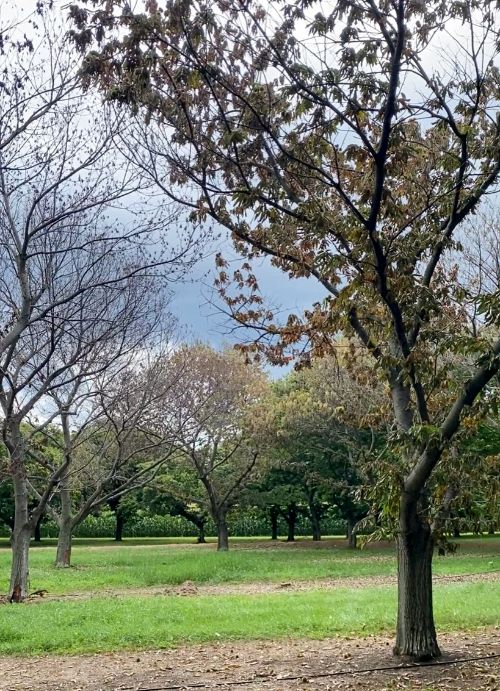
In fall 2022, Michigan State University Extension personnel confirmed the first record of chestnut trees infected with oak wilt in Michigan. Rapid decline and death of multiple, mature chestnut trees was observed in 2022 and the following year. Since then, oak wilt has been documented in additional chestnut orchards around the state.
Although there is little research published about oak wilt in chestnut, there is a substantial volume of research on oak wilt in oak species. This information can help inform chestnut management while researchers work to better understand how the fungus behaves in chestnuts and refine management recommendations.
Growers who suspect they may have oak wilt are encouraged to submit samples to the MSU Plant and Pest Diagnostics lab. Rapid diagnosis of oak wilt is critical to limiting spread.
Disease cycle
The following disease cycle is based on research with oaks but may also shed light on the behavior of oak wilt in chestnuts. Oak wilt primarily affects trees in the red oak group (e.g., northern red oak, black oak, pin oak, northern pin oak), as well as live oaks (e.g., Texas live oak). These oak species typically die within two to three months of infection, and in as little as three to five weeks after symptom onset. White oaks can be infected, but they generally tolerate the infection for several years prior to succumbing to the disease. Many white oaks may even survive infection entirely. Both oak and chestnut are members of the family Fagaceae, so it is perhaps not surprising that oak wilt can also infect chestnut trees.
Oak wilt is caused by the Bretziella fagacearum fungus. Oak wilt can spread overland or underground. Overland spread occurs when tiny nitidulid sap beetles (also known as picnic beetles), pick up viable spores from a mycelial mat formed by the oak wilt fungus. A mycelial mat is the reproductive fungal tissue produced by B. fagacearum. Mycelial mats grow beneath the bark on oaks that have recently died from oak wilt and are most common in late spring or early summer. Mycelial mats emit a fruity odor that is highly attractive to insects, including picnic beetles. The outer bark will crack over the mycelial mat, allowing the sap beetles to access and feed on the mat. Fungal spores adhere to the exoskeleton of the beetles.
These same beetles are attracted to sap oozing from a wound on a healthy oak or chestnut tree. When beetles contaminated with fungal spores feed on the sap exuding from a wound on a healthy tree, they inadvertently vector the spores and the tree becomes infected. Any wound deep enough to expose sapwood, such as pruning or storm damage, leaves trees vulnerable to infection when picnic beetles are active. Once the fungus is introduced into a wound, it grows into the sapwood of the tree, clogging the xylem vessels that transport water from the base of the tree to the canopy. Meanwhile, the tree attempts to defend itself from the infection by actively blocking the same vessels further decreasing the trees ability to take up water. Eventually, the tree can no longer transport water, so it wilts and dies. Oaks infected in the spring can die within a few weeks. Trees infected in the fall may not die until the following year.
Sap beetles are most abundant and active from spring to early summer, which is also when mycelial mats on dead trees are most abundant. Therefore, activities that may wound trees, including pruning, should be avoided from April 15 through July 15 to reduce the risk of overland transmission and new oak wilt infections. Unavoidable or accidental wounds from storms, lawn equipment, or other activities should be painted with a pruning sealer or latex paint as soon as possible. Sap beetles may detect and visit new wounds within only a few minutes.
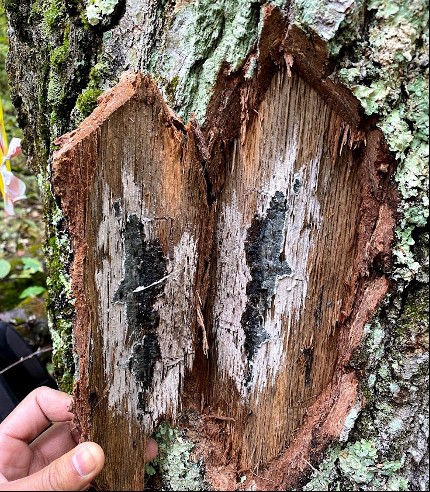
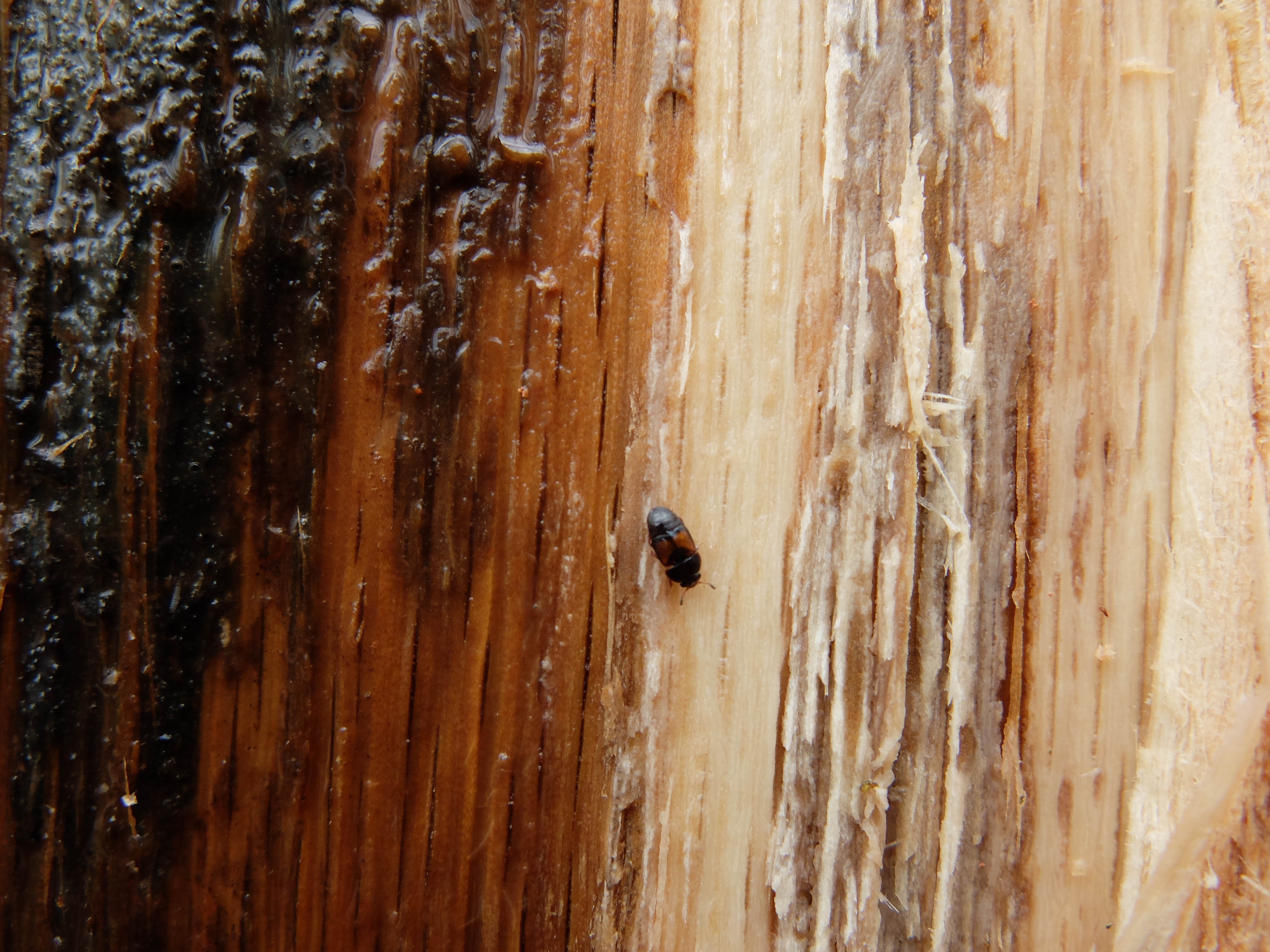
Transporting wood from oaks that have been killed by oak wilt during the past year can introduce the disease into new areas. Mycelial mats might grow on firewood or logs from trees killed by oak wilt earlier in the season or during the previous year. Dry wood with sloughing bark (i.e., older than one year) or completely debarked wood does not contain enough moisture for the oak wilt fungus to survive and is safe to move. Similarly, wood from trees that did not die from oak wilt can be safely transported.
The second way that oak wilt spreads is below ground, through root grafts between a healthy tree and a tree infected or killed by the fungus. Root grafting, a natural phenomenon, occurs when adjacent or nearby trees of the same or closely related species form physical connections between their roots. Root grafts allow trees to exchange water, carbon and nutrients. A tree killed by oak wilt can become the center of a disease outbreak, resulting in expanding pockets of dead and dying trees.
It is estimated that 90% or more of trees that succumb to oak wilt are infected via root graft transmission. When oak wilt is detected, management usually involves disrupting the connected roots. This can be achieved by excavating deep trenches and removing infected oaks plus removing a buffer of apparently healthy trees to limit disease spread.
Once trees are infected with oak wilt, they cannot be saved. Managing an outbreak of oak wilt early and effectively, as described below, can prevent additional oaks from becoming infected and dying.
Scouting
Growers can scout for oak wilt within their chestnut orchards and in any adjacent oak stands. Look for trees that have recently died or are declining. For reference, refer to the Michigan Department of Natural Resources (MIDNR) interactive map highlighting locations where oak wilt has been confirmed in Michigan. This map only shows detections that were officially confirmed as oak wilt and is not a complete listing of all oak wilt locations.
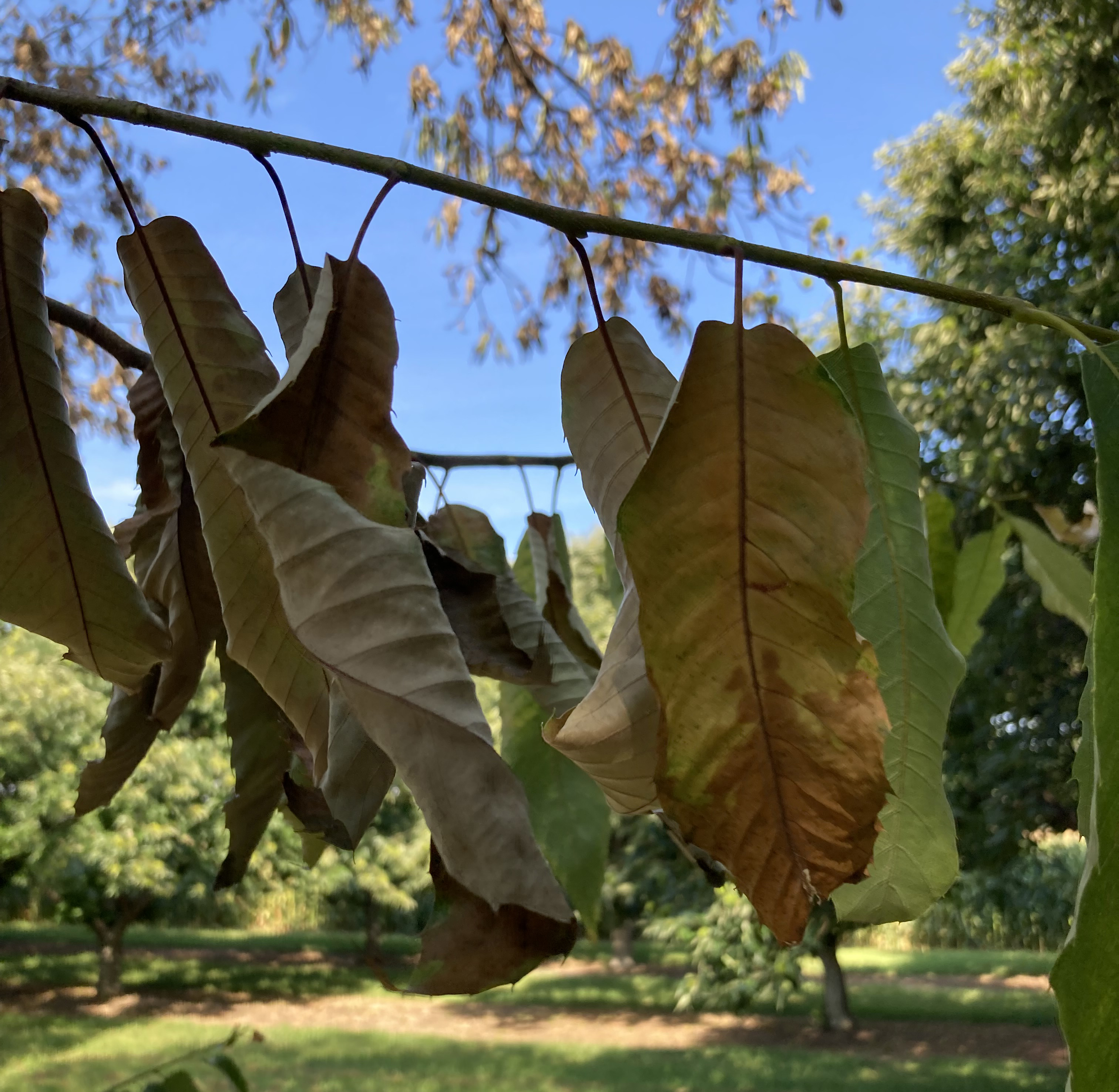
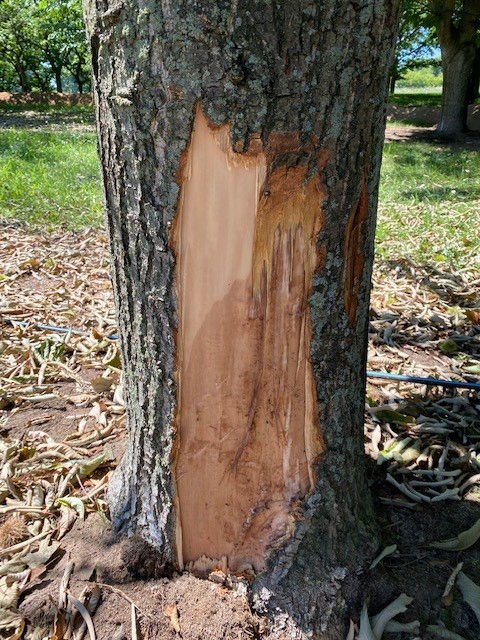
An infected tree is often first noticed when leaves on at least one branch wilt. The leaves will become light green during the summer before progressing to yellow, brown, and then dropping prematurely. The presence of dark streaking under the bark on branches and on the outer sapwood of the trunk are common symptoms of oak wilt. However, the only way oak wilt can be confirmed is either by observing a mycelial mat forming under the bark or, more commonly, by testing material in a laboratory.
To date, mycelial mats have only been found on oak trees. Whether they will form on chestnut trees is not yet known. Growers who suspect they may have oak wilt affecting their chestnut tree may send a sample to MSU Plant and Pest Diagnostics following. The guidelines for collecting and submitting samples are available online.
Management
There are currently no published guidelines for oak wilt management in chestnut. However, options for managing oak wilt in oaks provide a baseline approach for managing this fungus in chestnut trees. As research progresses, management tactics will continue to be refined for chestnut orchards. The general approach to oak wilt management is described in detail below and includes the following methods.
Prevention
- Limit pruning to the dormant season only.
- Paint any unavoidable wounds (e.g., wind or mechanical damage) with common latex paint or pruning paint.
- Practice good sanitation with equipment and handle potentially infected trees carefully.
Mitigation
- Trenching is typically needed to limit underground spread via root grafts in orchards with active infections.
- Cull symptomatic trees and apparently healthy, root-grafted trees to contain spread of the fungus.
- Although fungicides are used to protect oak trees in landscapes, no products are currently labelled for edible chestnut production. Use of fungicide products for trees in chestnut orchards is experimental but could presumably delay or prevent infection of chestnut trees. In accordance with current labels, edible chestnuts cannot be harvested from trees injected with fungicides.
Prevention and a quick response are critical when it comes to oak wilt management. The key to preventing overland spread of oak wilt is to avoid wounding trees, particularly between mid-April and mid-July. This is when the risk of overland spread from sap beetles vectoring the fungus is highest. During this period, mycelial mats with viable spores are especially common and contaminated sap beetles can be most abundant and active.
While the risk for overland transmission diminishes by mid-July, overland infections can still occur through the summer until the first hard freeze in fall. Consider restricting pruning and other activities that could wound oak or chestnut trees, even accidentally, to winter when trees are dormant and beetles are not active.
Sanitation is an important consideration for oak wilt management. While it is unlikely that tools, clothing, shoes, equipment, or soil spread the oak wilt fungus, it is best to implement practical sanitation practices (e.g., cleaning pruners between trees). The fungus can form mycelial mats on wood from oak trees that were recently killed by oak wilt, including standing dead trees. Whether mycelial mats can form on chestnut trees is not yet known. Therefore, it has not been established whether oak wilt-killed chestnut trees are a contamination source for overland infections.
To err on the side of caution, it is best not to let any material from trees killed by oak wilt in the past year, such as large branches, logs, or firewood, remain standing or lie in place. Harvested trees from infected stands should either be immediately processed into lumber, thoroughly debarked, mulched, burned, or tightly covered by tarps to prevent beetles from visiting the wood. When burning infected material, simply scorching the entire outer surface of the wood will prevent mycelial mat formation. Cutting up logs or processing them into firewood will help material dry more quickly, presumably reducing the risk of mycelial mat formation.
Nevertheless, material from infected trees that is cannot be debarked, burned, or chipped should be covered by a tarp for a year. Cover the wood with the tarp completely and ensure that no surface of the wood is exposed. Bury the edges of the tarp under soil and completely encircle the wood to ensure the little sap beetles cannot get to it for one year. Monitor the tarp periodically to ensure it remains in place.
In chestnut orchards where oak wilt is confirmed, growers may consider plowing or trenching to disrupt root grafts between trees and prevent belowground transmission of oak wilt. Plow lines or trenches should be 4–5 feet deep. Install plow lines around a group of trees that includes those currently affected and a buffer of adjacent trees to help ensure the infection is contained. The spread of the infection via grafted roots is typically beyond the extent of the visible, above-ground symptoms. In other words, potentially root-grafted trees should be treated as if they are diseased. While they appear healthy, they may already be infected via root grafts. If left untreated, they will likely still die of oak wilt, thus allowing the disease to persist longer and spread further.
To estimate which asymptomatic trees are likely to be grafted to the symptomatic trees and/or infected, begin by identifying a disease pocket. It is best to wait until September or October to ensure the survey captures as many infected trees as possible (some may not visibly wilt until late summer). Marking a pocket too early in the season may underestimate the size of the infection center.
First, measure the diameter at breast height (DBH) in inches of the symptomatic or dead tree, then measure the DBH of a nearby, apparently healthy tree, and sum to two diameters together for the “combined DBH” (Table 1). If you are using a standard tape measure, then you will need to convert circumference of the trunk to diameter. Diameter is equal to the circumference divided by 3.14 (pi). Special diameter tapes are made and sold by forestry supply companies with these converted units pre-marked.
Next, measure the distance between the two trees in feet. Refer to Table 1 to determine whether the asymptomatic tree is likely inside the disease pocket. Table 1 provides two values, indicating a 95% & 99% probability of a tree surviving one more year. A distance equal to or less than the 99% value means the tree is likely within the pocket and should be treated as an infected tree.
Proceed around the pocket, conducting this measurement for any apparently healthy trees in the vicinity of the wilting trees. Use different colors to mark the trees within the 95% & 99% boundaries. Note that the nearest diseased tree will change as you move around the pocket. A given tree may be within the prescribed distance of a larger stem that is farther away versus a smaller stem which is closer and more visible.
Ideally, two trenches or plow lines will need to be installed: the first will completely encircle the 95% probability trees, and the second will encircle the entire pocket by navigating around the 99% probability trees. The resulting lines will form a doughnut shape with the doughnut portion containing the 99% probability trees and the hole consisting of both the diseased and 95% probability trees.
The most aggressive approach is to then remove all trees within the pocket and treat the stumps with herbicide. To spare the 99% probability trees, felling and cut stump treatments can be limited to trees that have recently wilted and the 95% trees. If so, the residual trees should be closely monitored for symptom development.
An alternative to felling trees involves culling trees by girdling them around the trunk and applying herbicide to the cuts. This tactic involves cutting two rings around the circumference of the trunk, about 6 inches apart. Cut through the outer bark and inner bark (phloem) but less than 1” into the sapwood. Immediately apply herbicide to the cuts. The MI DNR uses 25% triclopyr ester with 75% surfactant, such as bark oil. Always follow the herbicide label to ensure efficacy and legal use of the chemical. Closely monitor the treatment for at least 5 years in case of failure.
The cut stump and girdling treatments may be applied without trenching, but they will be more effective when combined with root graft disruption. When combining treatments, only cut or girdle trees after installing the trench. Otherwise, work from the outer portion of the pocket inward toward the infection center. Wood from asymptomatic trees that have been cut or girdled will not support mycelial mats and does not have to be treated as contaminated, whereas wood from symptomatic and dead trees needs to be handled as such.
Table 1. Combined diameters at breast height (DBH) in inches with corresponding tree distances in feet that constitute a 95% and 99% probability that an asymptomatic tree in proximity to a diseased tree will survive for one year. (Adapted from Bruhn et al., 1991).
|
Combined DBH |
95% Confidence Interval |
99% Confidence Interval |
|---|---|---|
|
Inches |
Feet |
|
|
2 |
3.9 |
5.1 |
|
4 |
7.8 |
10.2 |
|
6 |
11.6 |
15.3 |
|
8 |
15.5 |
20.4 |
|
10 |
19.4 |
25.5 |
|
12 |
23.3 |
30.6 |
|
14 |
27.2 |
35.7 |
|
16 |
31.0 |
40.8 |
|
18 |
34.9 |
46.0 |
|
20 |
38.8 |
51.1 |
|
22 |
42.7 |
56.2 |
|
24 |
46.6 |
61.3 |
|
26 |
50.4 |
66.4 |
|
28 |
54.3 |
71.5 |
|
30 |
58.2 |
76.6 |
|
32 |
62.1 |
81.7 |
|
34 |
66.0 |
86.8 |
|
36 |
69.8 |
91.9 |
|
38 |
73.7 |
97.0 |
|
40 |
77.6 |
102.1 |
|
42 |
81.5 |
107.2 |
|
44 |
85.4 |
112.3 |
|
46 |
89.3 |
117.4 |
|
48 |
93.1 |
122.5 |
When a single tree develops symptoms and is confirmed to be infected with oak wilt, it is likely a case of overland spread and may represent the first diseased tree in a new infection center. If so, a rapid response treatment may be readily implemented to help prevent further spread via root grafts. This treatment should be applied during the early stages of wilt. By the time a tree has lost all its foliage, the infection has likely moved into the root system. Apply the girdling treatment described above to the single tree. Do not fell the tree until the dormant season. Closely monitor the surrounding trees for symptom development during the rest of the season and in the following years.
The rapid response treatment may be implemented whenever a single, actively wilting tree is identified. All other treatments (i.e., trenching, tree removal and cut stump herbicide, or girdle-herbicide of entire disease pockets) are recommended for the late summer or fall, any time prior to the ground freezing.
There are currently no chemical management options to prevent or manage the overland spread of oak wilt. It is important to note that the sap beetles that vector oak wilt are native, very small, and many species are naturally present in the environment. For these reasons, it is not practical to prevent beetles from visiting wounded trees using insecticide treatments.
In oak trees, preventative injections of propiconazole or tebuconazole may protect non-infected trees from the underground spread of the fungus if applications are applied every two to three years. This treatment does not necessarily eliminate oak wilt from the site, and while it slows underground spread, it may not stop it.
Currently, it is not legal to inject fungicides in bearing edible chestnut orchards, and there is no data on the effectiveness of injections in chestnut. There is no way to save a tree infected with the oak wilt fungus.
Acknowledgements
This article is an updated version of the March 2023 article “MSU investigating oak wilt as the cause of sudden chestnut tree decline” by Monique Sakalidis, Erin Lizotte, Deborah McCullough and Daniel Guyer, Michigan State University.
This work is supported by the Crop Protection and Pest Management Program [grant no 2024-70006-43569] from the USDA National Institute of Food and Agriculture. Any opinions, findings, conclusions, or recommendations expressed in this publication are those of the author(s) and do not necessarily reflect the view of the U.S. Department of Agriculture.