


Perennial grass weed control in cool-season lawns
 Print
Print Email
EmailOne of these things is not like the others. Learn tactics for controlling perennial grass weeds in your lawn.
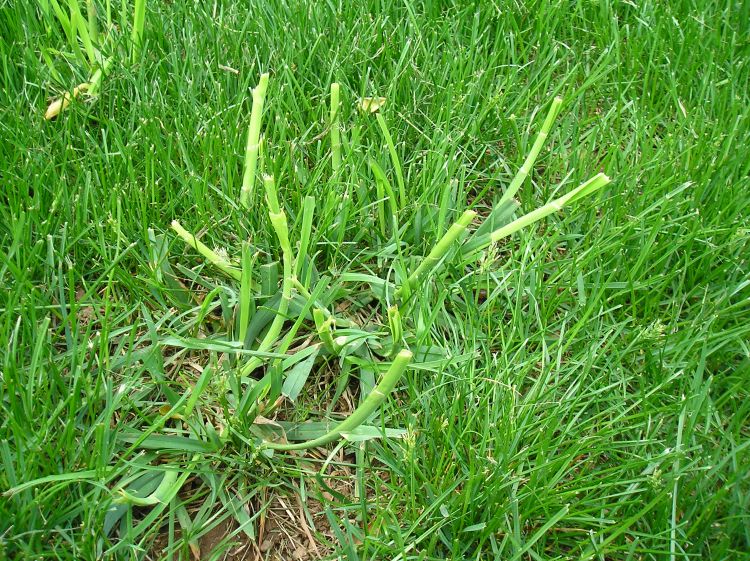
Many of the perennial grassy weeds we battle in Michigan lawns are cool-season species, just like our desired turf species, making selective control challenging.
Before looking at management options, please visit the “Pain in the Grass ID tool” to ensure your strategy targets the right species.
Non-chemical options
Mechanical removal may work, depending on the species and size of the infestation. Clumping grasses, like tall fescue and orchardgrass, are species where this can be most effective where feasible. Ensure you completely remove the crown(s) of these species to prevent them from regrowing. Grasses with stolons (e.g., creeping bentgrass and rough bluegrass) or rhizomes (e.g., quackgrass) present a challenge because it can be difficult but not impossible to remove those vegetative structures. Removing these grasses manually requires digging the holes larger than the infestation appears, with all above and below-ground material removed. Any remaining stolon or rhizome fragments will produce new plants (i.e., clonal propagation).
Cultural management approaches, like fertilizing and mowing frequently to favor the growth and vigor of your desired turf, are described by a former colleague, Ron Calhoun, PhD, in the Michigan State University Extension article, “Quackgrass control in turf.” I don’t buy the solarization option as viable, however.
Another strategy would be to tarp the affected area. Calhoun discusses this but mentions leaving the tarp on for only a week. Depending on the species, level of infestation, weather conditions, and even the color of the tarp you use, it will likely take longer than a week to kill vigorous grasses and their vegetative structures. Thick, dark tarps like black or silver tend to work faster for smothering plants than thin, light-colored tarps such as blue.
It would be a good idea to cover the area for a week or more then peel it back to see if any green material remains. If not, remove all or part of the tarp and wait a couple of weeks to see if anything starts to re-grow. If it does, put the tarp back down for longer and try again. If you are confident the weedy grass is dead, you can plan to replant.
Chemical options
Apart from creeping bentgrass and nimblewill, there are selective chemical control options that will only control (or suppress) that weedy grass and not impact your lawn. See more on controlling these two species at the end.
The easiest way to eliminate perennial grasses is to use herbicides that translocate within the plant to kill not only the top growth but also the roots (and rhizome system, if applicable). Historically, the non-selective herbicide active ingredient glyphosate has been recommended. However, it has been removed from residential-use herbicides at most retailers.
Fluazifop is one of the new ingredients poised as a replacement and can be found in Roundup Weed and Grass Control Exclusive Formula as one example. This herbicide specifically targets grass species and is rated as providing “good” control of creeping bentgrass and quackgrass, among others.
If this is a product you are interested in trying, note that it may take multiple applications spaced weeks apart under good growing conditions. There will be a waiting period between spraying this type of herbicide and reseeding based on the product used, so it is important to consult the label for specific details. The label is the law and must be consulted before using any pesticide to ensure efficacy and personal and environmental safety.
If you are interested in using glyphosate, generic products may still be available at stores like Tractor Supply Company or at local farm cooperatives. “Turfgrass Weed Control for Professionals,” published by Purdue University in collaboration with several other institutions, including MSU, recommends at least two applications of glyphosate to control tough perennial grass weeds, such as quackgrass. It notes that three or more may be needed depending on the level of establishment.
When using products containing glyphosate, there are a few important points to consider.
First, as with any pesticide, remember to read and follow all labeled instructions.
Second, glyphosate is a broad-spectrum herbicide, meaning it will injure or kill other plants contacted during application. Care is needed to avoid green plant material, exposed roots and injured bark of desired plants.
Third, glyphosate is relatively safe in the environment when used as labeled. It adsorbs strongly to soil in most cases (i.e., clay and organic matter), allowing even sensitive crops to be planted shortly after application. This means no carryover issues are expected.
Fourth, glyphosate alone can take up to 14 days to show full activity under ideal growing conditions. Retreatment of the area may be needed depending on the degree of infestation. Glyphosate is most effective for perennial control in the fall but can be applied anytime the plants are actively growing (temperatures consistently above 50 degrees Fahrenheit).
Finally, be sure that the product you choose has only the active ingredient glyphosate or glyphosate plus pelargonic acid or glyphosate plus diquat. Products with additional active ingredients may have other unwanted effects and may delay the planting of other plants in the coming seasons.
Creeping bentgrass and nimblewill chemical management
There are two tactics recommended in “Turfgrass Weed Control for Professionals” for controlling creeping bentgrass and nimblewill. One tactic involves using glyphosate, as mentioned above. The second tactic is repeated applications of the herbicide Tenacity (active ingredient: mesotrione).
The guide, as well as the herbicide label, recommends a few things to keep in mind when using Tenacity to control creeping bentgrass and nimblewill. Due to the repeat applications and level of detail needed, it may be easier to have these applications made by a professional lawn care company.
- Timing:
- Creeping bentgrass – Apply in late-summer (mid- to lower Michigan, late-August–September). Spring and summer timings applications are less consistent.
- Nimblewill – Applications can be made in spring (mid- to late April), in addition to the fall timing mentioned for creeping bentgrass.
- Sequential applications: Multiple applications are needed. Three applications at two-week intervals is recommended.
- Rate: Use the appropriate rate for your grass type; check the label on this to be sure. Using 5 fluid ounces per acre is generally safe for our cool-season species, but some Kentucky bluegrass can tolerate slightly higher rates. There is a yearly maximum of 16 oz/acre of Tenacity, so keep that in mind as you’re planning the sequential applications.
- Mowing height, creeping bentgrass only: Typically, we tell people to increase mowing height to more than 3.5 inches to help the lawn outcompete certain weeds, but the guide says it is easier to control creeping bentgrass if you have been mowing at a lower height.
- Adjuvant, creeping bentgrass only: Including ammonium sulfate is recommended to improve control (i.e., 17 lbs gal per 100 gal water, which equates to 77 grams per single gallon of mix).
- Surfactant: For both species, adding 0.25% nonionic surfactant is recommended (0.25 gal per 100 gal, which equates to 9.5 ml per single gallon of mix).
- Cultural practices: Raking to remove dead grass is recommended after the first application. Further, fertilize your lawn with a nitrogen fertilizer at recommended rates to promote the growth of the desirable grasses. Read more about lawn fertilization in “Fertilizing home lawns to protect water quality” by Kevin Frank, PhD.
The guide notes that just one season of these practices will not achieve complete control, because only a few plants surviving can reinfest your lawn. Complete eradication using either tactic is likely to take several years.
If you choose to chemically treat the area, be sure to leave several weeks under good conditions (i.e., warm enough for grass growth) before replanting to ensure that the perennial grass is indeed dead. It is often a good idea to water the area to encourage any growth. The last thing you want to do is realize you replanted too soon and the perennial grass weed comes back in your newly seeded area.
Moving forward
After you have achieved your desired level of control, the work is not over. You need to do two important things:
- Have a robust/vigorous stand of grass in your lawn to create an environment that outcompetes weeds. Practices could include reseeding areas where the grass stand is thin or has been removed, fertilizing the grass (early spring or early fall), watering when conditions are dry, and increasing your mowing height to about 3.5 inches; this last one will not help with all grassy weeds but will help with broadleaves and stress management.
- Look out for weeds emerging from seed. Some weeds can linger as seeds in the “seed bank” of the soil for decades! Controlling these weeds could include using a preemergence herbicide (e.g., crabgrass preventer) or manually removing emerged plants.
Visit the MSU Extension Turfgrass site for more information on lawn care.
Thank you to Thom Nikolai, Kevin Frank and Aaron Patton for their review.
This work is supported by the Crop Protection and Pest Management Program (grant no 2024-70006-43569) from the USDA National Institute of Food and Agriculture. Any opinions, findings, conclusions, or recommendations expressed in this publication are those of the author(s) and do not necessarily reflect the view of the U.S. Department of Agriculture.