pHix It! Getting substrate pH just right
 Print
Print Email
EmailSubstrate pH is one of the most important and often overlooked factors influencing greenhouse crop health. Learn the facts about what impacts pH for container production and adjustments you can make to get crop fertility just right.
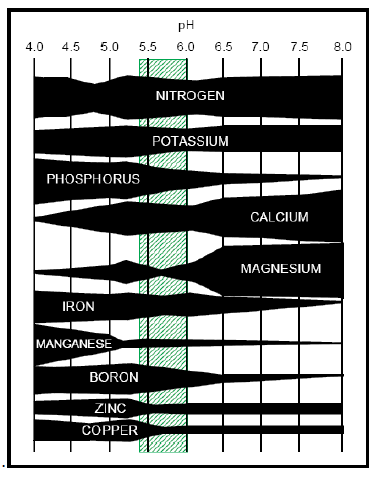
Substrate pH directly affects nutrient solubility, which determines how available essential nutrients are for plant uptake. Roots can only absorb nutrients that are dissolved in solution and pH controls whether certain nutrients stay dissolved or if they form other compounds, making them chemically unavailable for plant uptake. A classic way to visualize this is the nutrient availability chart seen in Figure 1, where most nutrients are optimally available within a moderate pH range (roughly 5.5–6.5). Outside this range, some nutrients become too available, leading to toxicity, or not available enough, leading to deficiencies.
Sounds simple enough, right? You just dial in the correct pH, apply some fertilizer and a beautiful, bountiful crop is the result. It would be nice if it were that easy, however, substrate pH is dynamic and changes throughout production. Let’s get into some chemistry for a moment to help understand why pH changes over time. Substrate pH is a reflection of the amount of hydrogen ions H+ dissolved in water. When certain chemical reactions take place, for instance, when dissolved alkalis (e.g., carbonate or bicarbonate) are introduced, the hydrogen ions present combine with the alkalis to form water and carbon dioxide. Or to put this chemically:
H+ + HCO3 → H2O + CO2
This type of reaction causes substrate pH to increase or become more basic. Similarly, when certain forms of nitrogen are used as fertilizer, namely ammonium sulfate (NH4)2SO4 or urea CO(NH2)2 based fertilizers, a chemical reaction takes place that causes pH to drift lower. The ammonium is converted to nitrate NO3- releasing hydrogen ions into solution. Chemically speaking:
NH4+ → NO3- + 2H+ + H2O
A chemical reaction also occurs with the sulfate to create sulfuric acid H2SO4 which further lowers pH.
Problems with pH extremes
High pH (too basic)
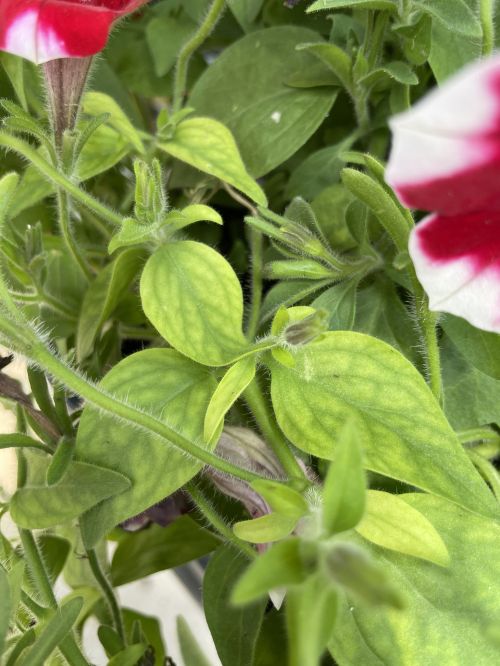
At high pH, generally between 6.5–7.0, micronutrients become less soluble and harder for plants to absorb. Most often iron, manganese and/or boron become deficient. Petunias provide a classic example of deficiency symptoms and are often touted as iron-inefficient, see photo 1. Even when enough nutrients are present in the substrate, they are inaccessible to the plants, which prefer to grow in more acidic conditions.
Low pH (too acidic)
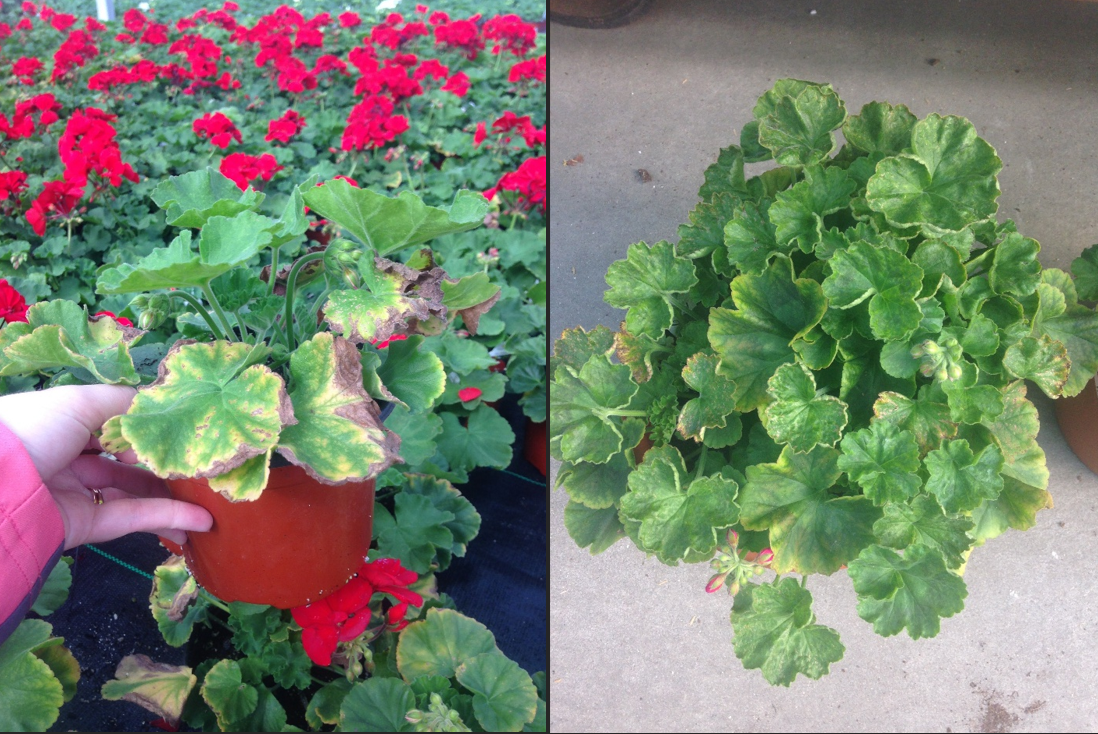
When substrate pH drops too low, typically below 5.0 for many crops, micronutrients such as iron (Fe), manganese (Mn), zinc (Zn), and boron (B) become more soluble. The classic example of this is with geraniums, see photo 2, also known as iron-efficient plants. They can more easily absorb iron, so when it is available in excess, this can lead to issues with toxicity.
The Goldilocks Zone: What pH is just right?
For most greenhouse crops, the goal is to maintain substrate pH in a range where nutrients are available—but not excessive. A general guideline is to target pH between 5.5 and 6.5, making adjustments for specific crops that fall into either iron-efficient or iron-inefficient groups. There is no universal pH target, since the ideal pH range is going to be crop-specific.
|
Crop Group |
Target pH |
Example Crops |
|
Iron Inefficient |
5.4–6.2 |
Bacopa, calibrachoa, diascia, nemesia, pansy, petunia, snapdragon, scaevola, vinca, |
|
General Group |
5.8–6.4 |
Chrysanthemum, geranium (ivy), impatiens, poinsettia |
|
Iron Efficient |
6.0–6.6 |
Geranium (zonal/seed), lisianthus, marigold, New Guinea impatiens |
What do toxicities and deficiencies look like?
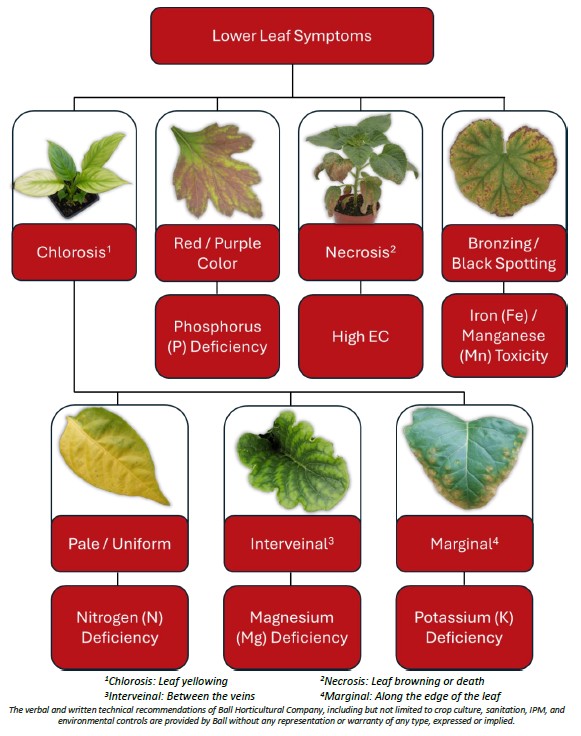
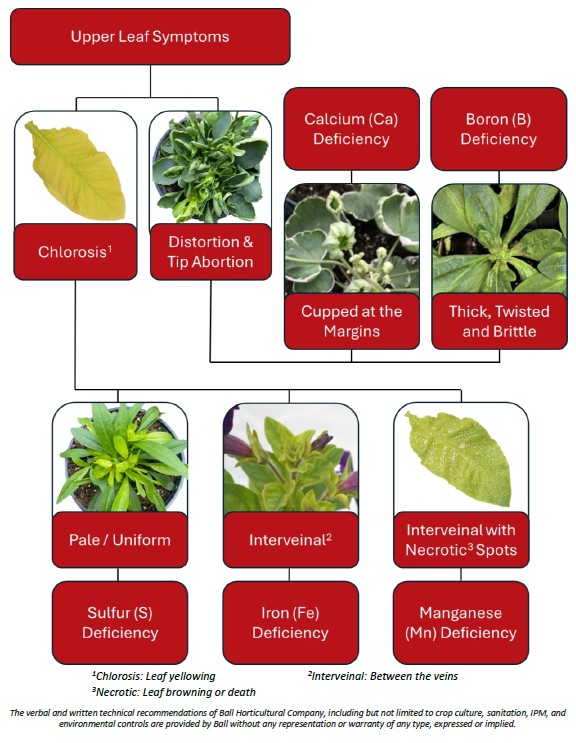
Before you turn to tissue and media testing, you might try to do a visual assessment of your crop to get an idea of the nutritional issue you’re dealing with. You’ll first want to determine if symptoms are appearing on lower leaves or upper leaves since certain deficiencies and toxicities will show up on different parts of the plant. You’ll also need to pay attention to the pattern in which the symptoms appear on the leaves. For instance, is there chlorosis or yellowing that occurs uniformly on the leaves, or only between the veins (interveinal) or on the leaf’s edge (marginal)? Figures 2 and 3 provide some examples of what to look for.
Why doesn’t my pH just stay put?
Three factors tend to influence how substrate pH changes, or drifts, over time. First is the starting pH of your substrate. Depending on the type of soilless media you use, your starting pH may be higher or lower. The composition of different components alter pH. Are you using a peat-based mix? Are you incorporating wood-fiber, or has limestone been added to the mix? Growing media components such as peat, coconut coir and bark tend to make the mix more acidic. Components like perlite and sand tend to be neutral. Limestone additions help to adjust highly acidic components and bring pH higher. Wood fiber and alternative substrates can influence the buffering capacity of the mix, altering how easy or difficult it is to adjust pH.
Besides the substrate itself, you must also consider your source water quality. Most growers are using surface water, well water or the city/municipal water supply as their water source. The source of your water greatly influences the amount of salt and/or alkalinity that you deal with. Some alkalinity is good since it adds to the buffering capacity of the container (80-120ppm CaCO3), below this level pH fluctuations can occur very rapidly. Most issues occur when a well-water source has high salts and/or alkalinity (120-500ppm CaCO3). Essentially, every time you water, you’re applying dissolved alkalis which raise pH, acting like liquid limestone.
The final factors that impact substrate pH are acid injection and fertilizer use. Growers can actively manage substrate pH using water treatment and fertilizer application. It’s recommended that when source water alkalinity is very high, a fertilizer injector is used to add acid to your water to reduce the alkalinity. Various types of acid can be used (sulfuric, phosphoric, nitric and citric) and the goal is to add enough acid to drop alkalinity to around 120ppm and reduce pH to 5.8. If alkalinity levels are elevated but not very high (150-250ppm CaCO3), it’s recommended to use an acidic fertilizer to keep substrate pH from drifting off target. Detailed information on selecting an appropriate fertilizer can be found in the article Nitrogen forms: Why they matter in soilless substrates.
Maintaining proper substrate pH requires continuous monitoring
If you’ve never thought much about your substrate composition, water source or fertilizer selection, but you want to produce a high-quality crop, here are some suggestions for where to make some changes. Ask for the guaranteed analysis of your potting media. Your supplier should be able to send you a report for each batch that tells you your starting pH. Think about where your water comes from. If your water source is a well, it’s recommended that you test your water alkalinity 1-2 times per year. Qualified nutrient diagnostic laboratories will provide the most accurate results, but home meters and kits can be useful for determining the approximate range. Know the fertility needs of your crop; is it iron-efficient, inefficient or general? Figure out your target substrate pH and do regular monitoring of substrate pH to see if you’re on track. The simple, non-destructive Pour-thru test is a great way to monitor pH and salt levels throughout the season. For more information on pour-thru testing, see the e-Gro article PourThru Method for Large Containerized Crops. Monitoring throughout the course of crop production, as opposed to taking a point sample, allows you to notice trends and take corrective action before nutritional problems occur.