


Q&A with Center for Good Food Purchasing Michigan Impact Manager, Melanie Tran
 Print
Print Email
EmailGet to know Melanie Tran, Michigan Impact Manager of the Center for Good Food Purchasing! Learn more details about the Good Food for Michigan project and upcoming opportunities.
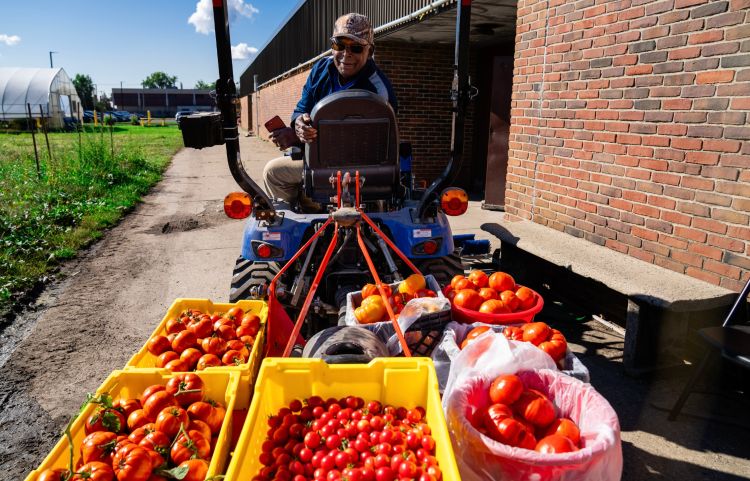
The Good Food for Michigan Project aims to expand the number of Michigan institutions purchasing local food, in order to benefit the health and well-being of people, animals, and the planet. By uplifting values-based procurement practices aligned with the Michigan Good Food Charter, this project will boost local agriculture economies and create long-term changes that support a healthier Michigan. Good Food for Michigan is a partnership between the Center for Good Food Purchasing, Michigan Department for Agriculture and Rural Development (MDARD), and Michigan State University Center for Regional Food Systems (CRFS).
In March 2026, May Tsupros, Director of Farm to Institution Programs at CRFS had a conversation with Melanie Tran, the new Michigan Impact Manager at the Center for Good Food Purchasing, to learn more about this project. Tsupros and Tran have worked in collaboration on several projects and will continue to closely partner with Michigan food systems to work across the state.
Melanie, tell us about yourself. What’s your background and what should people across the Michigan food system know about you and your passion around this work?

Tran: I am a Registered Dietitian who understands that so many of society’s challenges with good nutrition come back to food systems, food access, and inequities in the food and healthcare systems. Oftentimes, the field of nutrition is focused on the nutrients that are found in food that are crucial for what bodies need to work…but we don’t eat nutrients – we eat food! And it was food that brought me to the field of nutrition to start with, which is why I started to ask myself more questions about food and where it comes from, and what needs to happen before food is consumed. All those questions led me to a volunteer opportunity working in a greenhouse as a Dietetics student here at MSU, which led me to find the Sustainable Agriculture and Food Systems (SAFS) minor program, and cemented my interest in working at the intersection of nutrition, sustainability, and food systems. I went on to complete my Dietetic Internship at Western Michigan University that has a Sustainable Food Systems focus and completed my Master’s degree there.
Ever since then, I have chosen to pursue work that allows me to carve my own path in nutrition and dietetics with a food systems lens. Most recently I supported the 10 Cents a Meal program and farm to early care and education (Farm to ECE) initiatives at Groundwork Center for Resilient Communities where I worked closely with many of the same food systems partners I get to work with now!
I feel so fortunate to be working on the Good Food for Michigan Project and that I get to work with so many people who are committed to building more resilient food systems in Michigan that support farmers, food producers, and communities across the state.
We at CRFS are so excited to be partnering with the Center for Good Food Purchasing (The Center) on this new Good Food for Michigan Project! How will it work and what makes this project unique?
Tran: We are too! MSU CRFS has been a longstanding leader on food systems work in Michigan, and it was really important to the Center for Good Food Purchasing that we work with place-based partners who have deep knowledge and history of regional food systems as we start working more in Michigan. This project is an incredible opportunity to build on Michigan’s solid foundation of innovative food and agriculture work and farm-to-family access with tools like the Good Food Purchasing Program (GFPP). Our data-driven program is centered on the principles of Equity, Accountability, and Transparency, and analysis of how an institution’s purchasing aligns with five core GFPP values: Local and Community-Based Economies, Environmental Sustainability, Valued Workforce, Animal Welfare, and Community Health & Nutrition.
We are partnering with a select group of public institutions, like schools and hospitals, across the state to analyze their purchasing data through a baseline assessment and reassessment to track progress in shifting purchasing to align with those values. To support that shift, in between those assessments I’ll be working closely with institution leadership teams to develop action plans that help them serve healthy meals that fuel our local economies and communities. As a part of these partnerships these institutions will receive funding from Good Food for Michigan to invest in resources, equipment, and opportunities that will help them expand access to Michigan-grown and produced food.
We also will be providing additional technical assistance and resources to strengthen the local supply chain in collaboration with other interested Michigan institutions, food distributors, farmers, and producers . We are looking forward to collaborating with CRFS on much of that work.
What makes the Good Food for Michigan Project unique amongst other projects that the Center is participating in?
Tran: Good Food for Michigan is a huge opportunity for the Center for Good Food Purchasing to translate our resources and offerings to be used by wider audiences who are at various levels of engagement with values-based purchasing. We’ve worked for over a decade across the nation with institutions who are established with values-based purchasing and seeking assessments to track their progress. In Michigan, partnering with a state agency like MDARD offers a powerful framework for change – especially because of all of the other programming the Farm to Family program is investing in to support Michigan agri-food systems. We are looking forward to expanding the ways we are able to work with institutions and other food systems stakeholders to support more opportunities to learn about values-based purchasing and the Good Food Purchasing Program.
There have been many rapid changes in funding and policy, lately. Given so many unknowns affecting farming and food systems, what potential do you feel this program can have in shaping the Michigan food system today?
Tran: It has been a whirlwind, that’s for sure. This project has a ton of potential to build new momentum that utilizes Michigan’s experience supporting local and regional food systems to grow our Good Food ecosystem and drive more purchases of Michigan-grown and produced food across institutions. Over the years of working in the Michigan food system, I have been a part of so many conversations around the need for regional coordination, and I’m excited to help address that need in this role. We are looking forward to helping connect folks through value-chain coordination, building connections between buyers and suppliers, and supporting institutions in coordinating collective buying. We are also working to increase transparency of food purchases to help create awareness of where food is grown and produced! In a state with as much agriculture as Michigan, many institutions are already buying local food but might not always realize it or know where in the state the food came from. We want more Michigan institutions to know and be proud of the fact that they are supporting our local and regional food systems, help them build capacity to purchase more MI-grown and produced products, and reduce barriers to entry for local farmers and producers eager to feed our communities.
What are some unexpected discoveries (or unsung food system heroes) that you have uncovered since you started working in the Michigan food system?
Tran: One thing I have noticed about working in food systems is that there is no standard entry point. While there are people who have formally studied food systems and end up doing that work, there are an equal number of folks who have pivoted into food systems because they fell in love with it or had a personal connection that brought them to the work. I think that is amazing, and it brings together a lot of diverse, important perspectives to the field.
Can you give us a glimpse of some exciting stuff with the program in the near future?
Tran: Yes! Right now, we are finalizing partnerships with a select group of institutions who will be working with us to implement the Good Food Purchasing Program. These sites will go through our assessment process and receive funding that will allow them to make investments in their programs to increase their capacity to use more Michigan-grown and produced foods in their food service operations. In the coming months, we will also be rolling out resources and education opportunities to learn more about how to get involved in the Good Food for Michigan Project, along with highlights from Good Food champions leading the way in Michigan. The best way to stay updated on all the latest information is by signing up for the Good Food for Michigan newsletter.
Okay, here is a fun one: can you share a food memory from your past? Maybe one that gets to the core of why you are here today?
Tran: I see my life through food so it is hard to pick one! For me, it’s not one single memory or food moment that has brought me to where I am, but a collection of memories of the people, places, and feelings I felt in all of those moments involving food that have shaped my understanding of food, food systems, and nutrition. Some of those highlights include memories of growing up in my family’s restaurants, learning how to cook berry compote with my Uncle Richard, and the wonder I felt when I stood in a greenhouse in the middle of winter surrounded by food growing in the dirt.
Any final thoughts or words?
Tran: Everyone eats! Food tastes better when we are grateful for the care that goes into growing it, harvesting it, transporting it, stocking it, cooking it, all the way to eating it. Don’t forget that at every step of the way another person helped you eat.
Stay up to date with the Good Food for Michigan project by subscribing to their newsletter!
About Michigan Farm to Institution Network
The Michigan Farm to Institution Network (MFIN) helps people across the farm to institution supply chain learn, connect, and collaborate. Since 2014, we have provided a space for learning, sharing, and working together to help farm to institution programs grow in Michigan. Learn more: mifarmtoinstitution.org
About Michigan State University Center for Regional Food Systems
The Michigan State University Center for Regional Food Systems advances regionally-rooted food systems through applied research, education, and outreach. We do this by uniting the knowledge and experience of diverse stakeholders with that of MSU faculty and staff. Our work fosters a thriving economy, equity, and sustainability for Michigan, the nation, and the planet by advancing systems that produce food that is healthy, green, fair, and affordable. Learn more: foodsystems.msu.edu