Quick response critical to reducing impacts of manure spills
 Print
Print Email
EmailManure spills can happen despite the best prevention efforts. Understanding response procedures and reporting requirements can help safeguard water quality and reduce liability.
A manure hauler is traveling down the road with a tanker loaded with 10,000 gallons of liquid manure. His caution lights are flashing, and the slow-moving vehicle sign is visible on the back of his tanker. An oncoming vehicle is passing in a “no pass zone.” To avoid a head-on collision, the manure hauler swerves off the road. The impact causes the tanker to tip and fall sideways, spilling the entire contents of its manure onto the road and into a ditch. What steps should be taken to clean up the spill?
That was a question asked during two training meetings for manure applicators sponsored by Michigan State University Extension and Michigan Farm Bureau. A manure spill can happen during transport, land application, or while handling manure on the farm. While preventing spills remains the top priority, experts emphasize that a fast, organized response can greatly reduce environmental damage and regulatory consequences.
A manure spill is defined as any release of manure that has the potential to threaten surface water or groundwater. Training materials used in Michigan's manure hauler education program note that spills most commonly occur during transportation or field application, often because of equipment failure, driver error, distracted driving, or application mistakes.
When a spill occurs, responders are encouraged to follow a simple framework known as the "5 C's": Caution, Control, Contain, Comply and Clean Up:
- Exercise Caution at the scene. Assess the dangers of the spill. Is anyone hurt? Can the spill be controlled and contained in a safe manner?
- Control the spill by stopping the source. This may involve shutting off pumps, closing valves, stopping application equipment or preventing additional manure from escaping.
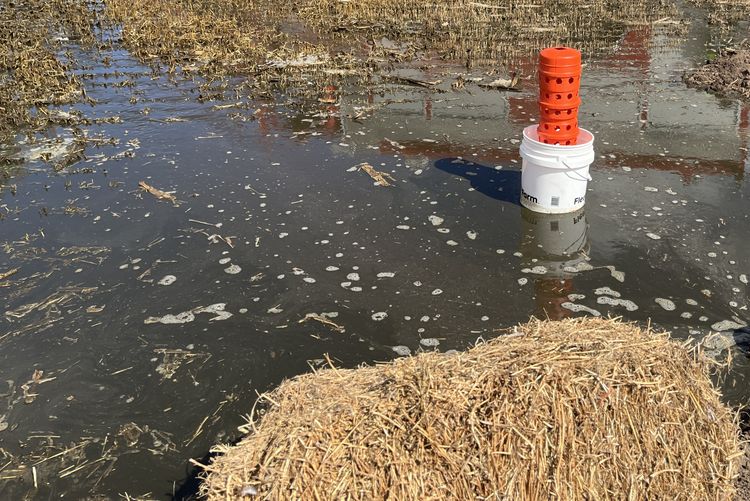
- Contain the spill by keeping manure from reaching streams, ditches, tile inlets, storm drains or other sensitive areas. Liquid manure moves surprisingly fast down slopes. Temporary berms made from soil, hay or straw can help limit movement. Multiple passes with a chisel plow perpendicular to the flow of manure will slow it down. A bottomless bucket shoved into the soil around a tile inlet will prevent manure from entering tile lines.
- Comply with reporting requirements. Prompt notification improves relationships with regulators. Agencies are generally more concerned about unreported spills than accidental spills that are being actively managed. Allowing a spill to remain unaddressed can lead to regulatory consequences. In the event of a manure spill, the phone sequence would be:
- Call local authorities by dialing 911
- If manure has not entered the waters of the state, call the Michigan Department of Agriculture and Rural Development Agriculture Pollution Emergency Hotline at 800-405-0101.
- If manure has entered the waters of the state, call the Michigan Department of Environment, Great Lakes, and Energy Pollution Emergency Alerting System (PEAS) at 800-292-4706.
- Think about who else needs to be alerted, including the Michigan Department of Transportation, local road commission and local Sheriff or police. They can help with road damage, traffic control and they need to know if roadways are blocked.
Document your response actions and cleanup efforts with photos and notes.
- Clean up the spill by recovering manure whenever possible, returning it to storage or applying it at the recommended rate, and restoring impacted areas. Flushing with water can help remove manure solids from vegetation and soil. A good rule of thumb is approximately three gallons of water for every gallon of manure spilled. Water used for cleanup does not have to be potable water. The objective for a liquid manure spill is to recover approximately 85-95% of the manure solids. Complete excavation is often not the best solution, as it can leave bare soil that causes long-term erosion problems worse than the manure spill itself. All releases must be cleaned up, and in some situations, a professional remediation company may be needed.
Michigan manure management educators emphasize that preparation is key. Keeping emergency numbers in every vehicle, having quick access to manure spill response materials, knowing the location of nearby waterways and tile drains, and training employees on spill response can help ensure a quick and effective response when every minute matters.