Southwest Michigan apple maturity report – August 27, 2026
 Print
Print Email
EmailThis is the first apple maturity report for 2026.
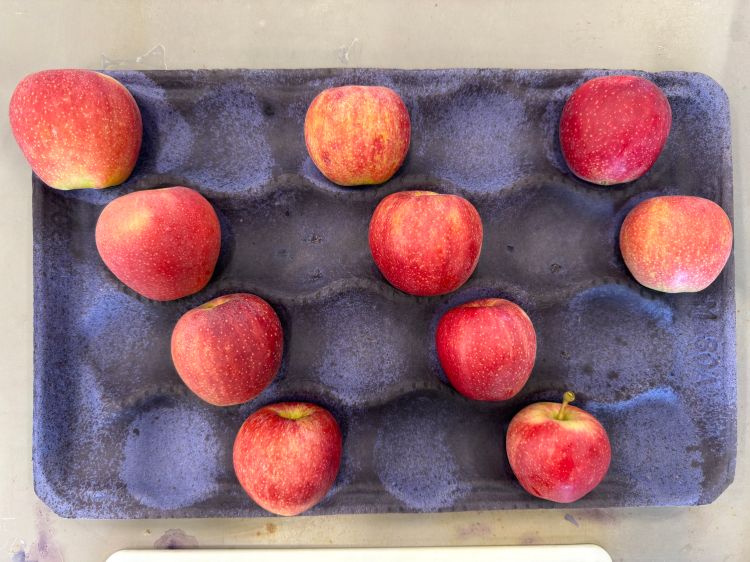
Apple maturity testing will occur weekly for the southwest region beginning now through the end of harvest. Reports will be sent out every week following the Michigan State University Extension fruit team apple maturity calls on Wednesday mornings.
In the southwest region, early apple varieties of Gala and Premier Honeycrisp are being harvested this week. Paula Red, Pristine, Lodi, Gingergold and Transparent have been harvested. Honeycrisp, McIntosh and Gala are close to maturity, but immature when sampled on Monday.
Weather over the past few days has been moderate with low temperatures dipping down into the low 50s across the region. Day and nighttime temperatures will rise over the next few days and through the weekend with highs in the mid-80s. Low temperatures will be in the 60s. Chances of rain are in the forecast for the rest of the week. Cool nighttime temperatures drive color and maturity development.
How to read maturity tables
Each week, an apple maturity report will be provided and will include average values for several apple samples for varieties nearing maturity. Maximum and minimum values are included in tables below for the highest and lowest individual fruits evaluated for each, to give a full spectrum of maturity. Samples included in the reports have been untreated with ReTain or Harvista, unless otherwise noted. Samples were collected from 1-2 locations in Berrien County. Further maturity reports will include data from 3-5 locations.
For more information about apple maturity testing, review these resources compiled by the MSU Extension tree fruit team.
- Predicted apple harvest dates for 2026 from MSU.
- More information on harvest management tools and timings can be found in this article.
- Guidelines from MSU to check for apple maturity in your own orchard, including specific pressure and starch recommendations by variety.
- New starch charts for evaluating apple maturity in Michigan from Michigan State University
- Predicting apple maturity and starch chart from Cornell University.
- Starch chart for Honeycrisp Apples developed by Washington State University.
Maturity information for the Southwest Region
Gala
Gala fruit were sampled from two locations in Berrien County on Monday. Samples in the table below are for Brookfield and Simmons Gala. Fruit size is small in the region. Red color is highly variable across sites. Red color is at 68%. Background color is yellow at 2.3. Fruit firmness is at 23.3 lbs of pressure. Starch is an average of 2.1. Sugars are an average of 12.0 °Brix.
|
Collection Date |
Fruit Weight (g) |
Red Color (%) |
Background color (5-1) |
Firmness (lbs) |
Starch (1-6) |
Soluble Solids (Brix) |
|
Aug 24 |
160(230-110) |
68 (90-25) |
2.3 (4-1) |
23.3 (29.0-16.0) |
2.1 (4-1) |
12.0 |
Honeycrisp
Fruit were sampled from one location in Berrien County. Red color is at 56%. Background color is green, at 3.7. Pressure is 18.1 lbs, and starch rating averaged at 2.7. Sugars are at 11.9 Brix. Honeycrisp should be harvested at a starch index of 3.5 for short- or long-term storage, which will be reached soon.
Bitter pit has been observed in some fruit across the region. Risk is generally greater in young or highly vigorous trees, blocks on susceptible rootstocks, trees carrying light crop loads, and fruit that have sized especially large. Fruit from high-risk blocks should be cooled promptly to the recommended storage temperature of 38°F, since pre-conditioning can increase bitter pit expression. These fruit should also be marketed relatively quickly rather than held for extended storage. Fruit with lower bitter pit risk that are intended for longer-term storage can be pre-conditioned at about 50°F for 5–7 days before cooling.
|
Collection Date |
Fruit Weight (g) |
Red Color (%) |
Background color (5-1) |
Firmness (lbs) |
Starch (1-6) |
Soluble Solids (°Brix) |
|
Aug 24 |
159 (200-125) |
56 (70-25) |
3.7 (5-3) |
18.1 (22.0-15.0) |
2.7 (4-2) |
11.9 |
McIntosh
McIntosh fruit were sampled from two locations in Berrien County on Monday. Red blush is at 44%, and background color is green at 4.5. Fruit firmness is at 17.8 lbs of pressure. Starch is an average of 3.1. Sugars are high at an average of 12.9 °Brix. McIntosh are still immature this week.
|
Collection Date |
Fruit Weight (g) |
Red Color (%) |
Background color (5-1) |
Firmness (lbs) |
Starch (1-8) |
Soluble Solids (°Brix) |
|
Aug 24 |
171 (230-110) |
44 (90-0) |
4.5 (5-3) |
17.8 (25.0-10.0) |
3.1 (6-2) |
12.9 |
Empire
Empire fruit were sampled from two locations in Berrien County on Monday. Red color is at 39%, and background color is green at 4.3. Fruit firmness is at 19.9 lbs of pressure. Starch is an average of 1.9. Sugars are high at an average of 11.2 °Brix for the maturity. Empire are still immature this week.
|
Collection Date |
Fruit Weight (g) |
Red Color (%) |
Background color (5-1) |
Firmness (lbs) |
Starch (1-8) |
Soluble Solids (°Brix) |
|
Aug 24 |
156 (220-85) |
39 (80-10) |
4.3 (5-3) |
19.9 (26.0-12.0) |
1.9 (3-1) |
11.2 |
Apple maturity sampling parameters
- Color % = the visual percentage of red color from 0 to 100; range is of all fruits tested. Indicates surface area covered in red and intensity of red color.
- Background color: 5 = Green, 1 = Yellow; range is of all fruits tested.
- Firmness in pounds pressure = measured with a Güss Fruit Texture Analyzer; range is of all fruits tested.
- Starch For Honeycrisp: will typically be rated using the standard Michigan State University starch scale (1-8). However, a separate starch chart for Honeycrisp Apples developed by Washington State University (scale 1-6) also exists.
- Brix = % sugar measured with Atago PAL-1 Pocket Refractometer
Looking for more? View Michigan State University Extension’s Apple page for regional reports throughout the state and additional resources.
|
Suggested firmness and starch index levels for long-term and shorter-term controlled atmosphere (CA) storage by variety. |
|||||
|---|---|---|---|---|---|
|
Variety |
Firmness (pounds)* |
Starch Index* |
|||
|
Short CA |
Mid-CA |
Long CA |
Mature |
Over mature |
|
|
McIntosh |
14 |
15 |
16 |
5 |
7 |
|
Gala |
16 |
17 |
18 |
3 |
6 |
|
Honeycrisp |
15 |
16 |
17 |
3.5 |
6 |
|
Empire |
14 |
15 |
16 |
3.5 |
6 |
|
Early Fuji |
16 |
17 |
18 |
3 |
7 |
|
Jonagold |
15 |
16 |
17 |
3.5 |
5.5 |
|
Jonathan |
14 |
15 |
16 |
3.5 |
5.5 |
|
Golden Delicious |
15 |
16 |
17 |
3 |
6.5 |
|
Red Delicious |
16 |
17 |
18 |
2.5 |
6 |
|
Idared |
14 |
15 |
16 |
3.5 |
6 |
|
Fuji |
16 |
17 |
18 |
3 |
7 |
|
Rome |
15 |
16 |
18 |
3 |
5.5 |
|
Brix Guide |
Low |
Fair |
Good |
Excellent |
|
All varieties |
Less than 11 |
11 |
12 |
13 |
|
Honeycrisp |
Less than 12 |
12 |
12 |
Greater than 14 |
This work is supported by the Crop Protection and Pest Management Program (grant no 2024-70006-43569) from the USDA National Institute of Food and Agriculture. Any opinions, findings, conclusions, or recommendations expressed in this publication are those of the author(s) and do not necessarily reflect the view of the U.S. Department of Agriculture.