Statewide monitoring network for cucurbit downy mildew verifies the 2026 arrival of spores in four Michigan counties
 Print
Print Email
EmailEarly alert issued for the state’s cucumber growers.
Michigan’s spore-trapping network
Our early alert system for detecting downy mildew spores in the air has been established in several Michigan counties. In addition to the counties including Berrien, Bay, Allegan and Muskegon, where spore traps have been launched, we will be launching spore traps in Monroe and Saginaw. Results from the spore traps can be found on our website and are a couple of days behind the actual sampling period due to processing of the spore tape reels. Keeping an eye on the spore trap results across the state will be helpful in knowing when and how often the downy mildew spores have been detected in air samples from a particular production region. Click here for spore trap results and current downy mildew news and recommendations.
Downy mildew spores have arrived in Michigan
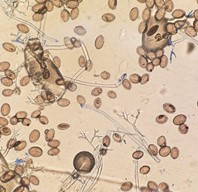
Cucurbit downy mildew spores have been verified in air samples from Berrien, Bay, Allegan and Muskegon counties from samples collected from May 19 to May 26. During this period, Berrien and Muskegon had 6 days with a positive detection; Allegan had 3 days that were positive for downy mildew, and Bay had 2 days that were positive. Our lab uses a Burkard volumetric spore trap coupled with qPCR molecular analysis of the spore trap tape, and any early positive samples are verified with microscopy to ensure there are no false positives. Berrien, Allegan and Muskegon counties are on the state’s west side that hosts significant cucumber, pumpkin, zucchini and squash acreage. Bay County is located on the east side of the state in the Thumb region and hosts cucurbit production for the fresh and processing markets. These positive air samples confirm that airborne downy mildew spores have arrived in the state this growing season. The cucurbit downy mildew spores detected in the air may have originated from local/regional cucumber production greenhouses or from early field plantings of cucumbers and melons being grown in low/high tunnels. Elsewhere in the U.S., cucurbit downy mildew outbreaks in the field have been reported in Florida. A cucurbit downy mildew disease outbreak in the field on cucumbers or other cucurbits has not been reported in Michigan.
Airborne downy mildew spores are early this year
This first occurrence of cucurbit downy mildew spores in air samples from the field is earlier than last year. It is notable that we have detected multiple positive samples in one week from Berrien and Muskegon counties. While in past years, we have detected the first disease outbreak in a Michigan field around the first week of July, the first field occurrence may be earlier this year, depending on the weather conditions. The detection of downy mildew spores in the air usually occurs a few days or a few weeks prior to a field outbreak.
While it is concerning that an influx of spores has been detected earlier than last year, these spores must land on a suitable plant, such as a cucumber or melon (for Clade 2 downy mildew) and then the weather conditions must allow the spores to germinate and infect the plant. The cucurbit downy mildew pathogen (Pseudoperonospora cubensis) prefers cooler temperatures and humid/wet weather. The weather earlier this growing season had been favorable for downy mildew disease (cooler temperatures and rain). Hot temperatures and dry conditions normally stall disease development. Storm systems bringing wind and rain favor downy mildew development and spore spread via air currents.
New technology enhances the early warning system
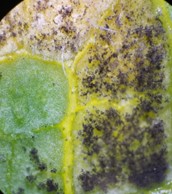
The use of recently developed molecular diagnostics coupled with microscopy ensures the accurate confirmation of this pathogen from our spore trap air samples. Our use of molecular tools in our statewide network allows us to distinguish the downy mildew pathogen that infects cucurbits from similar downy mildew pathogens that infect other crops, such as hops. Without the use of our new tools, we could mistake the spores of hop downy mildew (which overwinters in Michigan) for those of the downy mildew that affects cucumbers, resulting in a false positive and unnecessary fungicide sprays.
Another important feature of our alert system is the ability to tell growers which cucurbits will be targeted by the arriving downy mildew spores. For instance, in past years, only Clade 2 of the cucurbit downy mildew pathogen has been detected in the air. Clade 2 most commonly infects cucumbers and melon. Clade 1 has not been detected in the state in recent years, meaning that growers of pumpkins, squash, and zucchini do not need to be concerned about downy mildew on their crops. However, each week’s positive air samples are tested to determine whether Clade 1 and/or Clade 2 have been detected so that growers can know if and which cucurbit crops are at risk from this highly destructive pathogen.
Scout cucurbits growing in low and high tunnels
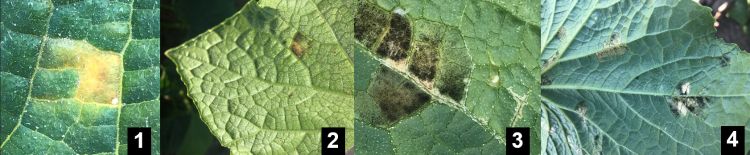
Currently, it is recommended that growers and scouts keep a close eye on cucumber and melon plantings, especially those in low or high tunnels and scout frequently. Monitor greenhouse cucumber production and early cucumber and melon field plantings. Suspect samples should be submitted for a diagnosis. Click here for instructions on how to submit samples.
Use proven downy mildew fungicides
A protective fungicide application to cucumber and melon crops may be considered now, especially for those growers on the west side of the state. It is very important that growers use proven downy mildew fungicides (shown below in alphabetical order). These fungicides were effective in our yearly 2021 - 2025 research field plots and include:
- Elumin + chlorothalonil or mancozeb
- Omega (Orbus) + chlorothalonil or mancozeb
- Orondis Opti (chlorothalonil is part of the premix)
- Previcur Flex + chlorothalonil or mancozeb
- Ranman + chlorothalonil or mancozeb
- Zampro + chlorothalonil or mancozeb
Fungicides should be alternated so that resistance of the pathogen to the fungicide’s active ingredient does not develop. It is important that the fungicides be applied prior to the plants becoming infected. Waiting until the disease develops in the field before applying fungicides can lead to control failure and pathogen resistance. Currently, many of the state’s pickling cucumber crops are in early development. Downy mildew infection at this stage would likely hurt yields significantly if left uncontrolled. Downy mildew can infect the cotyledons of newly emerged cucumbers and has been observed in previous years, especially for the later season’s plantings.
Reference to commercial products or trade names does not imply endorsement by Michigan State University Extension or bias against those not mentioned.