Steelhead season outlook from Great Lakes Angler Diary
 Print
Print Email
EmailAll signs point to good fishing ahead in most Lake Michigan tributaries, with a couple of caveats.
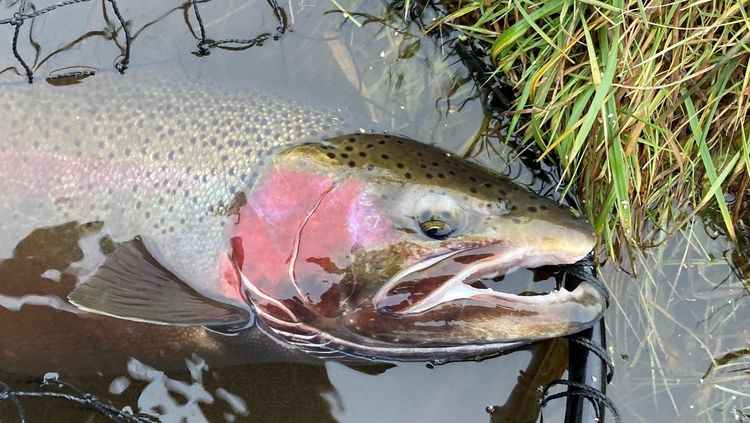
The onset of autumn signals the beginning of a new steelhead fishing season in many West Michigan rivers. As the leaves start to fall, chrome fish can be found nosing into the lower end of rivers and making their way upstream. Of course, weather conditions and other factors can either make or break a season for anglers.
Last fall, expectations for the river steelhead season were high. Great Lakes Angler Diary data had shown the negative impact of weak year-classes during the 2023-2024 fishing season. The lack of stocking in 2021 due to pandemic restrictions was largely to blame, but both stocked and wild fish showed shifts in age structure around 2023. Skippers roughly doubled in relative abundance, and the median age declined across all rivers with consistent data. Although the lack of larger, older fish caused some concern, high catch rates for smaller fish suggested that plenty of young fish were already in the system and would contribute to quality fishing over the next few years.
Of course, steelhead fishing is not known for predictability. Last year brought with it a host of weather conditions with the potential to impact catches. Fall weather came later than usual. Low, warm, clear water persisted in many rivers into mid-November. Then, after a brief window of optimal conditions, winter came in with a vengeance.
Boat launches were iced in for much of the winter at lower river access sites, while shelf ice made wading and fishing a challenge at upper river sites. When winter finally relented, another brief period of good fishing was followed by high water and record flooding in popular steelhead rivers like the Manistee and Muskegon. Even as the floods receded, access was compromised in some areas where shifting sediment, new logjams, and even damaged roads posed challenges.
How did weather and water conditions affect steelhead fishing last year?
Despite all the environmental challenges last year, steelhead are resilient – and so are steelhead anglers!
The 2026 Great Lakes Angler Diary Survey found that satisfaction with catch rates remained steady. Although there was a decline in the number of steelhead reported in the Great Lakes Angler Diary app, this was more related to the drop in fishing effort than any decline in catch rates.
A series of questions asked steelhead anglers how different conditions affected fishing patterns, and each question was answered by 77 to 80 angler diary participants. Median responses indicated that low, warm water in fall, icy conditions in winter, and high water in spring did not affect catch rates any more than they would in a normal year. However, participants did report taking fewer fishing trips and decided not to go fishing more often than normal due to icy winter conditions and spring flooding. High water during spring also caused more trip cancellations than normal.
Comments recorded in the survey indicated that flexibility was a key to success last year. People with rigid work schedules, vacations plans arranged with other people, or guide trips scheduled in advance were not always able to take advantage of the narrow windows of good fishing conditions. Some anglers reported fantastic fishing when conditions allowed.
What is the outlook for the upcoming river steelhead season?
With NOAA predicting a strong El Nino effect this year, we can expect a dry, warm winter in contrast to last year. In five of the past six winters, mild to moderate conditions led to consistent steelhead fishing opportunities throughout the season. A strong El Nino and mild winter should mean consistently good steelhead fishing through the dead of winter this year, along with the possibility of excellent fishing during warm-ups that bump water temperatures into the 40s.
A dry fall could result in another lackluster fall run, but the exact timing of rain events is difficult to predict. If heavy rains coincide with river temperatures falling into the low 50s and high 40s, we can expect good fishing this fall and more holdover fish available through winter. Since fall-run steelhead spend several months in the river before spawning, there is no biological need to swim upriver until spring. Bright fall fish are a blast to catch, but they are never a sure thing.
Unlike the fall run, the spring run occurs regardless of conditions since steelhead are mature and ready to spawn. Great Lakes Angler Diary results suggest that this year should have good numbers of fish returning. Steelhead have a complex and variable life history, with fish returning to spawn for the first time after spending one to four summers in Great Lakes waters.
We generally expect three-summer fish to contribute most to the catch. That means the 2024 smolt cohort should be the most important contributor to fishing success in the coming year. We saw high catch rates of one-summer “skippers” from the 2024 smolt cohort during the 2024-2025 fishing season, which should translate to strong returns of three-summer fish for the upcoming 2026-2027 fishing season. The 2023 smolt cohort also showed strong returns after one and two summers spent in the lake, so we can expect good numbers of four-summer fish from this cohort, as well.
In short, the outlook for the upcoming season is good. El Nino years produce more consistent quality fishing through the winter months, and strong numbers of three- and four-summer fish should translate to good fishing for larger fish in Lake Michigan tributaries.
One caveat is that predator-prey balance in Lake Michigan has been tilting too far in favor of predators in recent years. Chinook salmon were noticeably smaller than normal over the past summer. Salmon over 20 pounds were rare, and only a handful of 30-pounders were recorded. Both salmon and steelhead obtain the vast majority of their caloric intake from alewife, so it is likely that declining salmon growth rate will be coupled with lower steelhead growth rate. In other words, those abundant three- and four-summer steelhead may be a bit smaller than expected this year.
Great Lakes Angler Diary had strong participation and good catch rates on the Betsie, Manistee, Pere Marquette, White, Kalamazoo, and St. Joseph rivers over the past couple of years. We’ve had spotty participation in the Muskegon River and lower Grand River, but we have had some good catch rates reported from those areas, as well. Reports from the upper Grand River (above Grand Rapids) and Prairie Creek were less encouraging last year, with a couple of experienced anglers noting that Prairie Creek did not have much spawning activity in areas that usually contain redds. Although Prairie Creek and the Grand are stocked, around 90% of the steelhead caught in Prairie Creek and the upper Grand have been wild in recent years.
Will Great Lakes Angler Diary continue since steelhead mass-marking was discontinued?
Yes. We will continue to ask participants to measure each fish, check for fin clips, and record every trip that targets steelhead over the next year.
The USFWS’s Great Lakes Mass Marking Program shifted emphasis from steelhead to coho salmon in 2025. Yearling steelhead stocked in 2025 were mass-marked with an adipose fin clip and coded wire tag (CWT), but the 2026 stocking cohort was not subject to mass marking.
This means that skippers returning to rivers in the upcoming fishing season will not necessarily be fin clipped. Even so, older fish from earlier smolt cohorts are still abundant and it is easy to separate one-summer skippers from older fish based on length.
For Great Lakes Angler Diary participants, this is a critical year for data collection. We now have six years of data that show some intriguing trends, but it is important to continue data collection this year to develop a clear picture of how the most recent smolt cohorts are faring. We are still accepting new registrants at GLanglerdiary.org, and you can find past reports and video of related presentations on our resource page.
Michigan Sea Grant helps to foster economic growth and protect Michigan’s coastal, Great Lakes resources through education, research, and outreach. A collaborative effort of the University of Michigan and Michigan State University and its MSU Extension, Michigan Sea Grant is part of the NOAA-National Sea Grant network of 34 university-based programs.
This report was prepared by Michigan Sea Grant under award NA24OARX417C0157-T1-01 from the National Oceanic and Atmospheric Administration, U.S. Department of Commerce through the Regents of the University of Michigan. The statements, findings, conclusions, and recommendations are those of the author(s) and do not necessarily reflect the views of the National Oceanic and Atmospheric Administration, the Department of Commerce, or the Regents of the University of Michigan.