The hidden hubs driving the global illegal wildlife trade
 Print
Print Email
EmailNew research reveals how transit countries quietly enable wildlife trafficking — and why targeting these hubs could disrupt global trafficking networks.
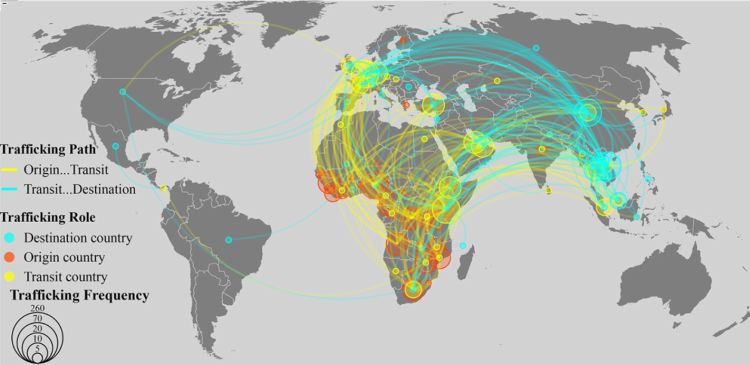
Efforts to combat illegal wildlife trade have traditionally focused on where wildlife is poached and where it is ultimately sold. But new research shows that a critical part of the global trafficking network lies in between. A study published in Conservation Biology reveals that “hidden hubs” — transit countries that connect origin and destination markets — play a pivotal and often overlooked role in enabling the global illegal wildlife trade.
The paper, “Role of transit countries in global illegal wildlife trade,” analyzes 15 years of international wildlife seizure data and reconstructs more than 2,600 complete trafficking routes worldwide. The researchers found that nearly 40% of illegal wildlife trade routes pass through one or more transit countries, substantially increasing the scale, complexity, and profitability of trafficking networks.
Researchers from the Chinese Academy of Sciences and Michigan State University (MSU), including Jianguo “Jack” Liu, Rachel Carson Chair in Sustainability at MSU’s Center for Systems Integration and Sustainability (CSIS), and former Ph. D student Xiaodong Chen and former visiting scholar Weihua Xu of CSIS, compiled and analyzed seizure records covering illegal trade from 2009 to 2023. The dataset spans mammals, birds, reptiles, marine species, amphibians, and arthropods across six continents.
“Transit countries are not simply passive stopovers,” said Liu. “They function as hidden hubs that connect distant regions, allowing illegal wildlife products to move farther, faster, and in larger volumes.”
Using the metacoupling framework, which examines human–nature interactions across origin, transit, and destination countries, the researchers traced complete supply chains rather than isolated seizure points. This systems-based approach reveals how illegal wildlife trade depends on global connectivity — including transport infrastructure, legal trade networks, and geographic positioning.
The analysis shows that transit hubs tend to have advanced airport infrastructure, extensive legal trade connections, and governance gaps that traffickers exploit to conceal routes, repackage products, and launder transactions.
The study highlights transit hubs are especially important for trafficking high-value wildlife products, including ivory, pangolin scales, and rhinoceros horn. More than half of all trafficking cases involving these products relied on transit countries, and routes that passed through transit hubs were associated with significantly larger volumes of illegal trade.
“High-value species move through longer and more complex routes, often involving multiple transit hubs,” Liu said. “These hubs act as bridges between economically underdeveloped origin regions and distant consumer markets.”
Many of these routes originate in Africa, pass through countries in Africa, Europe, or West Asia, and ultimately reach markets in East and Southeast Asia. Without transit hubs, much of this long-distance trade would be riskier, more costly, or infeasible.
Despite their importance, transit hubs have received comparatively little attention in international enforcement frameworks, which typically prioritize source and destination countries. The authors argue that this leaves major blind spots in global efforts to curb wildlife trafficking.
“Our findings suggest that targeting transit hubs could dramatically increase the effectiveness of enforcement,” Liu said. “Monitoring should focus not only on species and markets, but also on infrastructure, trade connectivity, and geographic locations.”
The study recommends governments and international organizations:
- Prioritize enforcement and monitoring in high-frequency transit hubs
- Identify trafficking risk based on transport infrastructure and legal trade volumes
- Strengthen inspections at major airports and ports
- Integrate transit countries more explicitly into global wildlife-trade governance frameworks such as CITES
By disrupting the hidden middle of the supply chain, the authors argue, policymakers can more effectively weaken trafficking networks and reduce pressure on endangered species.
In addition to Liu, Chen and Xu, Jiamei Niu from the Chinese Academy of Sciences is the lead author of the paper.