The Vineyard is the story: Michigan wine and the discipline of maturity
 Print
Print Email
EmailA science-based framework for building Michigan wine identity through site suitability, cultivar discipline, vineyard data and regional technical culture.
Michigan wine is entering a new phase
A mature grape-growing region is not simply a place where grapes are grown successfully. It is a region where growers, wineries, researchers, institutions, and markets have learned to connect wine quality to place. Scientifically, this means demonstrating repeatable relationships among climate, soil, topography, plant material, vineyard management, vine physiology, fruit composition, wine characteristics, and economic performance.
This perspective is consistent with the definition of terroir adopted by the International Organization of Vine and Wine. The OIV definition includes not only the physical and biological environment, but also the “collective knowledge” associated with “applied vitivinicultural practices.” Terroir is therefore not a fixed property of soil, climate, or geology. It is the result of interactions between a place, the vines planted there, and the technical decisions developed through repeated observation. Several scientific studies in the last 20 years described terroir as an interactive system involving climate, soil, cultivar and human practices. They emphasized that successful terroir expression depends on matching the phenological cycle of the cultivar with local environmental conditions so that ripening occurs within the appropriate part of the growing season. This principle is directly relevant for Michigan. A cultivar is not appropriate simply because it is internationally recognized, commercially attractive, cold hardy or successful elsewhere. It is appropriate when it can consistently produce quality fruit, achieve the maturity required for a defined wine style and provide an economically sustainable return.
Learning from the world, defining Michigan
The world’s mature wine regions followed different pathways. Burgundy developed a parcel-based culture centered on climates. The Langhe built its identity through Nebbiolo, vineyard consciousness, denomination rules, and accumulated grower knowledge. California accelerated its development through research, Extension, innovation, private investment and land protection. Michigan does not need to copy any of these systems. The important lesson is that regional reputation becomes durable only when place, quality, technical discipline and collective memory are connected.
Michigan has moved beyond the early experimental phase. The next step is not simply to plant more grapes, promote more wineries, or compare Michigan with famous regions elsewhere. The next step is to become more precise. This transition is particularly urgent because the global wine sector is experiencing declining consumption in many markets, changing consumer behavior, production surpluses in some categories, increasing costs and growing climatic instability. The global wine market is facing a striking contradiction: there is more high-quality wine available than ever before, but too few consumers to absorb it. The scale of the imbalance is substantial. Europe’s unsold wine inventory has exceeded the equivalent of an entire year of production, enough wine to fill approximately 8,000 Olympic-sized swimming pools. Australia alone is holding more than 2 billion liters in storage, equivalent to about 859 Olympic-sized swimming pools. These figures show why future success cannot be measured simply by producing more wine or planting more acres. In an oversupplied market, regions must focus on distinctiveness, consistent quality, production discipline and wines that give consumers a clear reason to choose them.
Future success will favor regions that can define their strengths, recognize their limitations and produce wines with clear technical and regional identities. For Michigan, precision means understanding which sites can reliably support Riesling, Chardonnay, Pinot Noir, Cabernet Franc, Pinot Gris, Blaufränkisch or disease-resistant cultivars. It also means identifying which vineyard blocks need redevelopment and which management practices improve fruit quality, vine resilience and profitability rather than simply increasing vine size or short-term yield.
From cultivar adoption to cultivar discipline
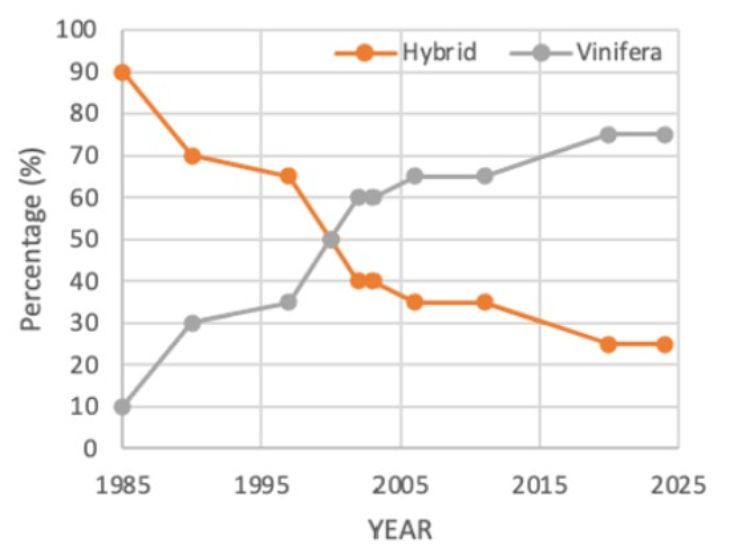
Over the last several decades, Michigan has shifted strongly toward Vitis vinifera and toward a smaller group of core cultivars. Riesling, Chardonnay, Pinot Noir, Pinot Gris and Cabernet Franc now account for most of the state’s wine-grape acreage. This represents a significant transition from broad experimentation toward greater specialization (Figure 1).
This convergence is an important sign of maturation, but acreage concentration alone does not demonstrate cultivar adaptation. Michigan must now move from cultivar adoption to cultivar discipline. The industry needs to determine where each cultivar performs best, which wine styles it should support and which vineyard practices are necessary to produce those wines consistently. For Riesling, this means treating the cultivar not simply as a reliable white grape, but as a potential flagship for Michigan’s cool-climate identity. Its regional value depends on the consistent expression of acidity, aromatic precision, freshness and site transparency. These outcomes are influenced by crop load, canopy exposure, disease pressure, harvest timing, fruit health and the relationship between sugar accumulation and acid degradation. For Pinot Noir, the strategy must be selective. The cultivar is internationally recognized and compatible with Michigan’s cool-climate image, but it is also highly sensitive to site, disease pressure, crop level, canopy microclimate and vintage conditions. Pinot Noir should not be planted simply because consumers recognize its name. It should be grown where multiple years of evidence indicate that it can achieve fruit health, phenolic maturity, aromatic development and wine quality before fall weather becomes limiting.
Vineyard management is part of terroir expression
Michigan terroir cannot be separated from vineyard management. The state has a humid climate, relatively short and variable growing seasons, significant disease pressure, and recurrent winter injury. Under these conditions, the same cultivar can produce very different outcomes depending on vine balance, canopy architecture, crop level, rootstock, soil management, disease control, and harvest timing. Scientific literature supports the inclusion of vineyard management within terroir. Soil and climate influence wine through their effects on root development, vine water status, nitrogen availability, vegetative growth, phenology, berry development, and fruit composition. These effects are then modified by cultivar, rootstock, and management.
Direct correlations between soil classification and wine quality are therefore insufficient unless the physiological response of the vine is also measured. Vine balance is particularly important, but the term should not be used only as a visual or subjective description. It represents the relationship among canopy source capacity, reproductive demand, canopy exposure, and the accumulation of perennial reserves. Pruning weight, yield-to-pruning-weight ratio, shoot density, canopy dimensions, and exposed leaf area per unit of fruit can all provide useful indicators. Cluster thinning should also be treated as a conditional practice rather than a universal solution. Its effects depend on the initial crop level, canopy capacity, timing of thinning, cultivar, season and vineyard condition. Thinning may improve maturity when a vine is genuinely overcropped, but it may have little benefit when the canopy already has sufficient assimilatory capacity. The objective should be to correct an imbalance, not simply to reduce yield.
Better acreage, not more acreage
For many years, wine regions measured progress through expansion. More acres, more wineries, more visitors and more bottles were interpreted as signs of success. In the present market, that logic is no longer sufficient. Additional acreage contributes to regional development only when it strengthens quality, profitability and reputation. Several years ago, Joe Herman, an important Michigan grower, made a comment that captured both the ambition and the challenge of the industry. He said that the former Michigan Grape and Wine Industry Council had once hoped Michigan would reach 10,000 acres of wine grapes by 2024. “In a way, we already did,” he told me. “We planted the current 3,700 acres three times over through cycles of establishment, failure, replanting and redevelopment.” The comment highlights an important technical and economic reality. Acreage alone is not a reliable measure of progress. A region can establish, remove, replant, graft over and redevelop the same acreage repeatedly when site suitability, cultivar choice, rootstock, vine balance and market destination are not correctly aligned. Michigan should therefore move from an expansion strategy to a redevelopment strategy. The central questions should be which acres deserve further investment, which blocks require correction and which vineyards should be replanted, grafted over, redirected toward a different product or removed from premium wine production. A mature region does not plant first and understand later. It understands first, then plants.
Vineyard suitability must become a decision-support system
Michigan needs a grower-facing vineyard suitability and redevelopment strategy. This system should not be limited to identifying where new vineyards could be planted. It should also help evaluate existing blocks and determine whether they are aligned with the correct cultivar, clone, rootstock, training system, floor management, wine style and market category. In 2020, Bunting et al. at MSU developed a scientific foundation for this approach by integrating Michigan climate, soils, topography, land use, wetlands and high-resolution spatial data into a land-suitability model for Vitis vinifera. The study demonstrated that vineyard potential is spatially heterogeneous and that geospatial modeling can identify areas with different levels of climatic and environmental suitability.
The next step is field validation. A suitability model becomes practically valuable only when its predicted classes are compared with actual vineyard outcomes. Michigan should test modeled suitability against bud survival, frost injury, phenology, yield stability, disease pressure, fruit composition, wine sensory performance, production cost and economic return. The goal should not be to classify land only as suitable or unsuitable. It should be to estimate the probability that a particular cultivar and wine style can achieve acceptable yield, fruit health, compositional maturity, winter survival and economic value across multiple seasons.
Not every site needs to produce the same wine. Some vineyards may be most appropriate for aromatic white wines, others for sparkling base wine, others for selected red cultivars, and others for disease-resistant or alternative varieties. A mature region is not uniform, it is organized.
Michigan needs a vineyard intelligence system
One of the clearest indicators of regional maturity is the ability to learn collectively. Michigan has skilled growers and winemakers, but much of its vineyard knowledge remains fragmented. Growers understand their individual sites, wineries understand their wines, researchers collect focused datasets, and Extension educators respond to seasonal problems. The next step is to connect these observations into a shared scientific system.
A statewide vineyard intelligence network should use standardized measurements, common protocols, repeated sampling, and appropriate data-quality procedures. Permanent commercial and research blocks could provide information on location, elevation, slope, aspect, soils, cultivar, clone, rootstock, vine age, spacing, training system, phenology, climate, vine growth, yield, disease, winter injury, fruit composition, wine destination, labor, inputs and economic return. The objective should not be to collect data without a defined purpose. The network should estimate relationships and probabilities that can support decisions. It should help determine the probability of winter injury for a cultivar and site, the likelihood of reaching a defined wine specification, the stability of yield, the response of fruit composition to crop load or canopy management, and the economic return of different production strategies.
The data should be analyzed with methods capable of separating site, cultivar, management and vintage effects. Mixed-effects models would be particularly appropriate because vineyards are measured repeatedly across years. Spatial analysis could identify stable zones within vineyards, while multivariate approaches could connect climate and vine physiology with fruit chemistry and sensory expression.
Michigan does not need to reinvent this type of system. Italy, New Zealand, Australia and several French regions already collect and interpret regional viticultural data. Michigan can adapt these approaches to its scale and conditions. The purpose would not be to expose private business information. The data could be anonymized and summarized by region, cultivar, training system or wine style. The practical value for growers would be better planting decisions, fewer repeated mistakes, clearer production targets, stronger fruit contracts and better estimates of which investments are likely to return value. Mature regions do not rely only on memory. They build memory with data.
Technical tastings can connect vineyard decisions with wine identity
Technical tastings should be designed to generate knowledge rather than simply identify favorite wines. Michigan already has consumer tastings and promotional events, but regional maturity requires structured tastings that examine relationships among vineyard source, vintage, management, fruit composition, wine chemistry and sensory expression. Whenever possible, vineyard comparisons should use standardized winemaking protocols. Samples should be coded, presentation order randomized and panelists trained or calibrated for the attributes being evaluated. Appropriate sensory methods may include descriptive analysis, difference testing, projective mapping or structured quality assessment.
A Pinot Noir tasting could compare sites in relation to phenolic maturity, green character, crop level, fruit health and vintage consistency. A Cabernet Franc tasting could relate herbaceous character to methoxypyrazines, fruit-zone exposure, berry temperature, crop load and harvest date. A sparkling-wine tasting could connect base-wine acidity, pH, harvest timing, clone, yield and vineyard source with the characteristics of the finished wine. A site should not be declared superior based on one tasting or one season. The critical criterion is whether sensory differences are reproducible across vintages and whether they can be explained through measurable vineyard processes.
Underperforming blocks need technical support, not blame
A mature region must be honest about underperforming vineyard blocks. This is not an easy conversation, but it is necessary in a tighter wine market. Fruit that lacks quality, consistency or a clear economic role creates difficulty for both growers and wineries. Michigan should not wait for crisis-driven vineyard abandonment. Some blocks may need to be replanted with better cultivar–site combinations. Some may be grafted over, redirected toward sparkling base wine or alternative products or transitioned to disease-resistant cultivars. Some may eventually need to leave wine-grape production.
This does not mean that every vineyard must produce a luxury wine. A mature industry needs different price points and styles. However, every vineyard should have a defined production and market purpose. The industry should approach underperformance through diagnosis rather than blame. A block may be limited by cultivar choice, rootstock, soil drainage, winter injury, excessive vigor, insufficient canopy capacity, disease pressure, poor vine balance or market mismatch. Once the primary limitation is understood, the response can be more precise. The goal is to protect growers and protect regional reputation at the same time.
Michigan must protect land and protect meaning
If Michigan wants to become a mature wine region, it must protect its best agricultural sites. Premium vineyard land should not be treated as ordinary real estate. Once high-quality agricultural land is converted to development, it is extremely difficult to recover. Napa Valley provides a useful example. The creation of the Napa Agricultural Preserve in 1968 helped protect the agricultural land base that later supported the region’s global wine reputation. Michigan does not need to copy the Napa system, but it should recognize that land protection and wine quality are connected.
Michigan should also protect the meaning of its AVAs and regional names. These names should represent more than tourism or promotional identity. They should communicate genuine differences in climate, soils, grape-growing conditions, production practices and wine characteristics.
The same principle applies to quality terminology. When every wine is labeled “Reserve,” the word no longer communicates meaningful selection or distinction; it becomes decoration. Overuse of such terms can also confuse consumers and undermine their trust, because it suggests a level of quality or exclusivity that may not be supported by clear standards. In the long term, this does not respect the consumer; it weakens the credibility of both the producer and the region. Regional names can lose value in the same way when they are used primarily as marketing language without consistent agricultural and wine-quality support. A wine region cannot be built only around tasting-room traffic. It must be grounded in the land, vines, growers and wines that justify the regional name.
The new Michigan story: Quality, climate and place
Michigan’s future message should not be limited to “Come visit our wineries.” Tourism remains important, but it is not sufficient to build a durable wine reputation. A stronger story is that Michigan is a cool-climate region shaped by the Great Lakes, latitude, winter risk, natural acidity, site variability, humid-season disease pressure and continuous technical adaptation. Riesling matters because it can express acidity, aromatic intensity and place. Sparkling wine matters because the climate can preserve natural freshness. Cabernet Franc matters where sites can support distinctive cool-climate red wines. Winter injury matters because it imposes discipline in cultivar selection, pruning, crop management and vineyard investment. This identity is not defensive. Michigan does not need to apologize for being different from California, Oregon, New York, Burgundy or Piemonte. It needs to become the most technically precise and confident version of itself.
The role of Dirt to Glass and regional technical culture
This is where the Dirt to Glass Conference becomes important. A mature region needs a forum where growers, winemakers, researchers, Extension educators, wine experts and industry leaders can examine evidence together.
Dirt to Glass should not be evaluated only by attendance or by the number of presentations. Its larger value is whether it helps Michigan organize a shared technical agenda. Day 1 can review climate, phenology, winter injury, disease pressure, cultivar performance, vineyard data, fruit composition, sensory results, economic conditions, and research priorities. Day 2 can evaluate those findings in vineyards and wineries, where management decisions are implemented and wine quality is created.
The conference can function as the annual review of a repeated scientific cycle: observations are collected, measurements are compared, wines are tasted, results are interpreted, management is adjusted, and the response is measured again. Dirt to Glass can therefore become the moment when Michigan converts individual vineyard experience into collective regional knowledge. It can connect data collected by growers with research interpretation, Extension recommendations, technical tastings, and practical decisions for the following season. This is how Michigan can move from fragmented observations to a disciplined and cumulative technical culture.
Conclusion: From narrative to evidence
France demonstrates the importance of place, classification and protection of origin. Italy, particularly the Langhe, demonstrates the value of connecting local tradition with vineyard identity, grower knowledge and denomination rules. California demonstrates how research, Extension, innovation, private investment, and land protection can accelerate regional development. Michigan can learn from these examples, but it should not copy them. It must develop a model based on its own climate, sites, cultivars, production risks, growers and wines.
The scientific foundation already exists. Michigan research has documented climatic change, spatial land suitability, canopy-management effects, fruit-zone responses, crop-level interactions, rootstock–scion relationships and cold-climate red-wine challenges. The next step is to connect these areas through long-term, multi-site studies and a statewide vineyard information system.
Michigan’s future identity should be built by linking environment, vine physiology, fruit composition, wine sensory expression, and economic outcome. This approach does not reduce the importance of grower experience. It makes that experience cumulative, comparable, testable and transferable.
A mature wine region is not one that claims every vineyard is distinctive. It is one that has collected enough evidence to understand which vineyards are distinctive, why they are distinctive, how consistently they perform, and how they should be managed. For Michigan, the path forward is not generalized promotion. It is sharper site selection, stronger data, clearer cultivar strategy, disciplined red-wine production, serious sparkling-wine development, scientifically tested disease-resistant cultivars, and stronger coordination among growers, wineries, research and Extension. The vineyard is no longer the background to the Michigan wine story. The vineyard is the experiment, the evidence, and ultimately the story.