Thinking about making a postemergence herbicide application in soybeans approaching flowering?
 Print
Print Email
EmailFarmers need to consider several restrictions to avoid crop injury and stay on label when making postemergence herbicide applications in soybeans.
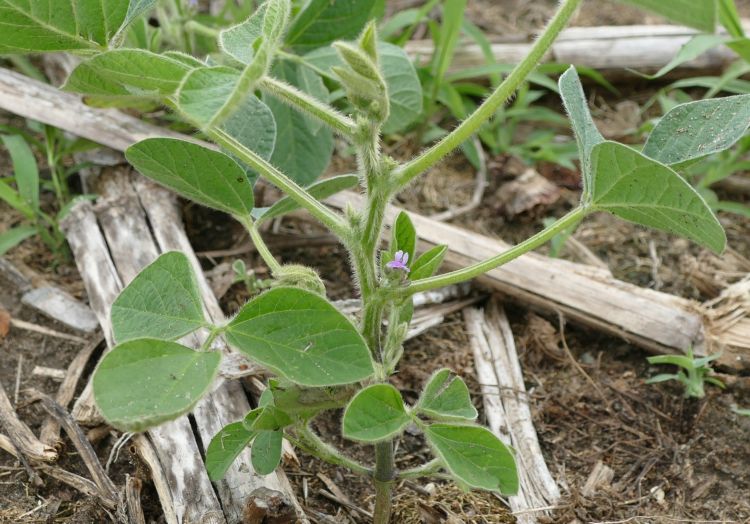
Late June through early July is a common window for making a postemergence (POST) herbicide application in soybeans. Early-season weeds like common lambsquarters, common and giant ragweed, pigweeds and grasses continue to emerge in May and June, and a herbicide with residual activity applied preemergence (PRE) will typically only provide control for up to 4–6 weeks but oftentimes less. There are certain precautions farmers need to take when applying POST herbicides as soybean flowering approaches.
Many herbicides have restrictions on when POST applications can be made according to soybean growth stages. Just a few examples include:
- Outlook (dimethenamid-P) can be applied up to V5 (only provides residual control)
- Liberty Ultra (glufosinate) can be applied until flowering (i.e., before R1)
- Enlist One (2,4-D choline) can be applied through R1 (beginning flower)
- Roundup PowerMax 3 and other glyphosate can be applied through R2 (full flower)
- Cobra (lactofen) can be applied through R6 (full seed)
Other products list preharvest intervals as cutoff dates. For example, Flexstar (fomesafen) has a 45-day preharvest interval, but it is important to be mindful of rotation restrictions for the following crop.
To confirm soybean growth stage, refer to the MSU Extension article, “Identifying soybean reproductive growth stages.” Briefly, vegetative (V) stages are named by the number of fully-formed trifoliates on the main stem, beginning flower (R1) is when 50% of plants in a field have at least one flower on any node, and full flower (R2) is when there is an open flower at one of the two uppermost nodes on the main stem in 50% of the plants in a field.
The first and best defense to avoid off-label applications and reduce risk of soybean injury is to read the label of the herbicides being applied for precautions about soybean growth stage at the time of application. Labels for some products are considered “living labels” and may change after a purchase is made, so be sure to access the most current version.
Another helpful resource is the MSU Weed Control Guide for Field Crops (Bulletin E0434). This bulletin is updated annually, and the current edition is available for purchase from the Spartan Spirit Shop website or for free as a pdf downloadable by chapter from the MSU Plant, Soil and Microbial Sciences – Weeds website. There is a separate chapter for weed control in soybeans which includes useful features such as Table 2F: Soybean Herbicides—Remarks and Limitations that lists growth stage restrictions and other precautions. There are also additional features including Table 12: Herbicide Crop Rotation Restrictions—an important resource when planting wheat following soybeans or for crops planted the following spring.
Reference to commercial products or trade names does not imply endorsement by Michigan State University Extension or bias against those not mentioned.