Updated onion thrips management guidelines for Michigan onion growers
 Print
Print Email
EmailA new tool for your pest management toolbox: Vertento is now available for the 2026 season. Check out our latest guide on how to strategically integrate this new chemistry into your existing rotation to maximize efficacy and protect against resistance.
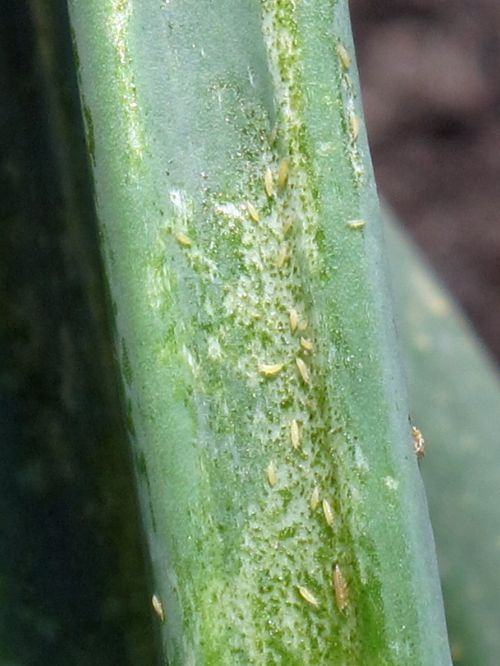
Onion thrips remain one of the most challenging insect pests in onion production. Feeding damage can reduce photosynthetic capacity, weaken plants and contribute to yield losses, particularly during hot, dry conditions that favor population growth. Thrips can also contribute to spreading both fungal and bacterial diseases of onions.
Because thrips populations can increase rapidly, management decisions are most effective when based on regular scouting and pest thresholds rather than reacting only after severe injury becomes visible. In Michigan’s direct seeded onions, the first insecticide applications become necessary around the end of June in a typical year.
One challenge for growers is determining not only when to spray, but which products to use and when to rotate them. The most effective programs adjust insecticide choices based on pest pressure and rotate modes of action to maintain efficacy and slow resistance development.
Radiant SC has been one of the most effective tools available for onion thrips management, but repeated use may increase the risk of reduced susceptibility over time. Radiant should be viewed as a valuable tool that must be protected rather than a product to rely on every year. A new insecticide, Vertento by Syngenta, in a novel mode of action class (Group 30) has just become available to growers in 2026. This creates an opportunity for growers to rotate away from using Radiant annually, reducing resistance risks.
The first step in an effective thrips management program is weekly field scouting. Examine plants from multiple areas of the field and determine the average number of thrips per leaf. This average provides a practical way to estimate population pressure and guide treatment decisions.
Insecticide applications typically consist of two applications of the same active ingredient seven days apart. For example, all the programs described below start with two applications of Movento a week apart. Movento is an insecticide that moves to new onion growth and controls immature stages of thrips. After this insecticide is applied twice, thrips populations usually stay below the treatment threshold for a couple of weeks. So, this is one instance when scouting is worth the investment!
Use the following categories to classify onion thrips pressure levels based on scouting. Once pressure levels have been identified, follow a treatment sequence appropriate for that level.
|
Thrips pressure |
Average thrips per leaf |
Management approach |
|---|---|---|
|
Low |
0.6–1.0 |
Begin a preventative rotation |
|
Moderate |
1.1–2.0 |
Shift to more effective products and maintain active ingredient rotation |
|
High |
≥2.1 |
Use a more aggressive management program |
The treatment sequences below highlight recommended insecticide programs selected from available options based on efficacy and resistance management considerations. If you want to learn more about onion thrips management, watch this webinar by Brian Nault, PhD, Cornell University.
Low-pressure program: stay ahead of the population
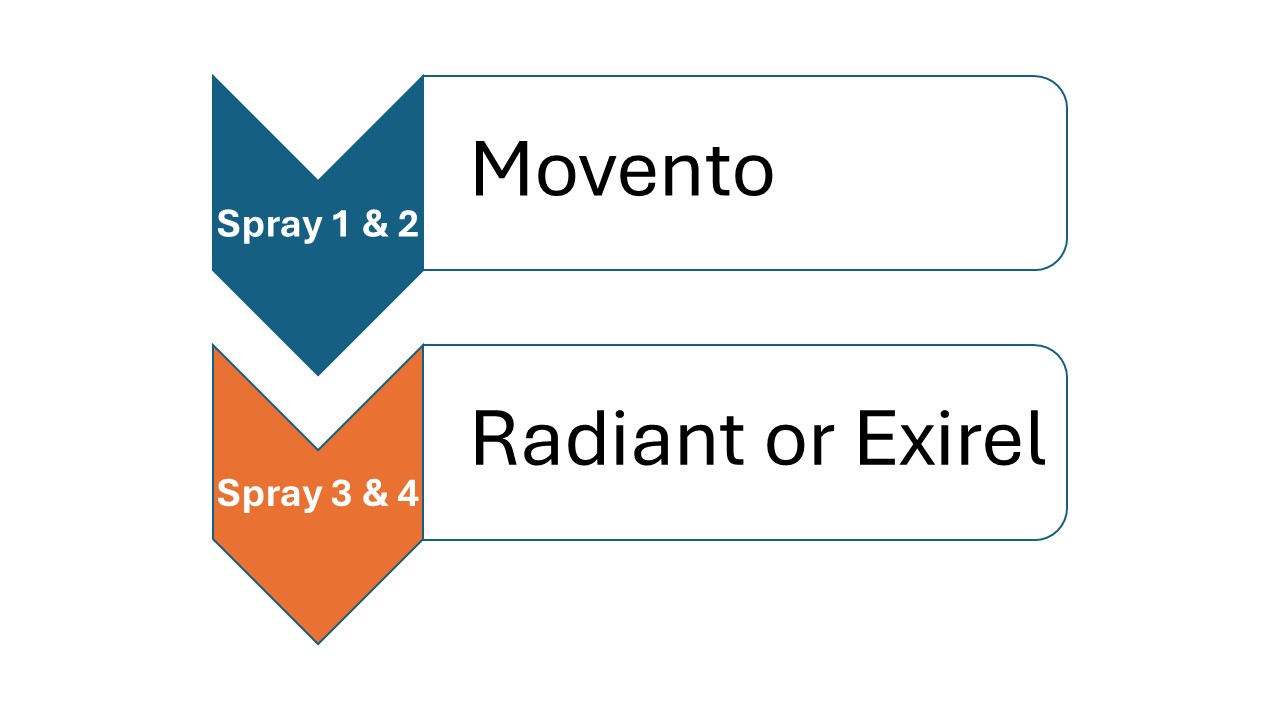 When thrips numbers remain relatively low and resistance to Radiant is not a concern, the goal is to prevent populations from building while preserving effective chemistries for later in the season. Early intervention can reduce the need for more intensive programs later in the season. After the first two Movento sprays, the population could stay low. If so, an Agri-Mek SC or Lannate + Warrior application might be adequate to keep the population from increasing—this option does not use Radiant. For a longer maturing onion cultivar, adding Agri-Mek SC for sprays three and four and using Radiant or Exirel as sprays five and six might provide a good option for managing low thrips pressure.
Moderate-pressure program: stay ahead of the population
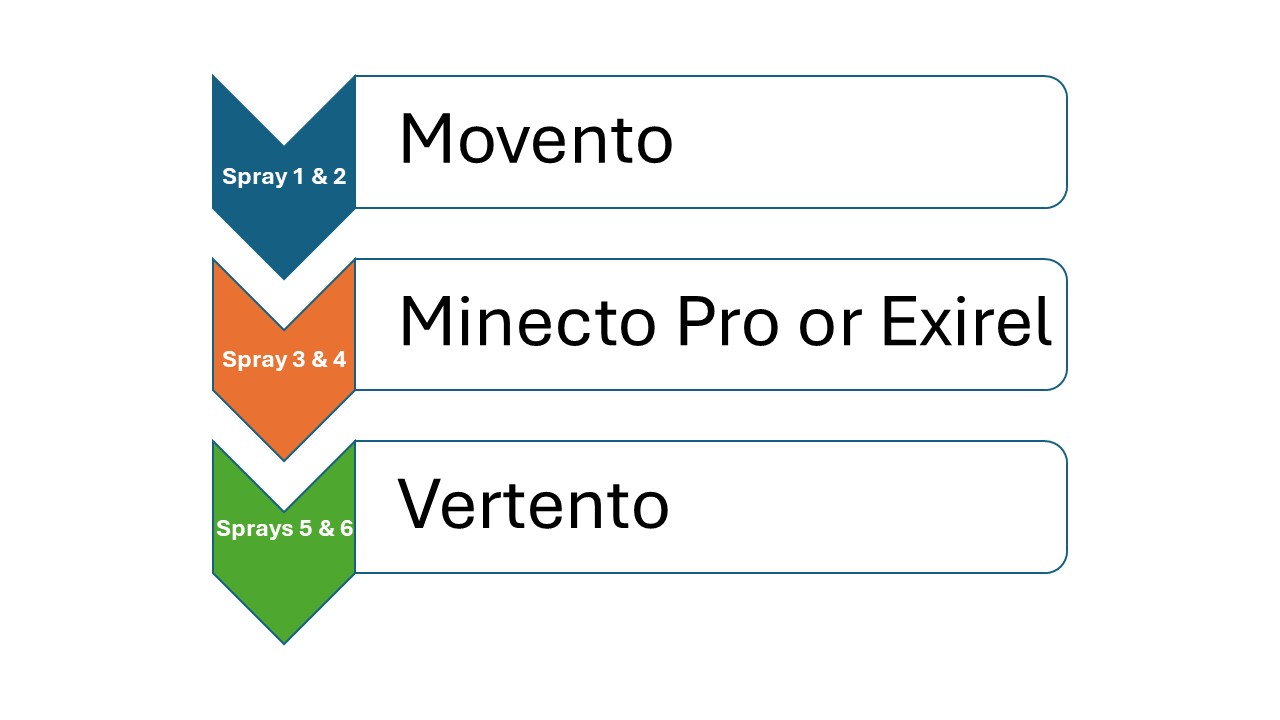 When average densities reach 1.1–2.0 thrips per leaf, populations may increase quickly under favorable conditions and stronger products become necessary. Maintaining rotation is particularly important at moderate pest densities because populations can escalate rapidly if control begins to slip. This example program does not use Radiant.
High-pressure program: aggressive suppression is required
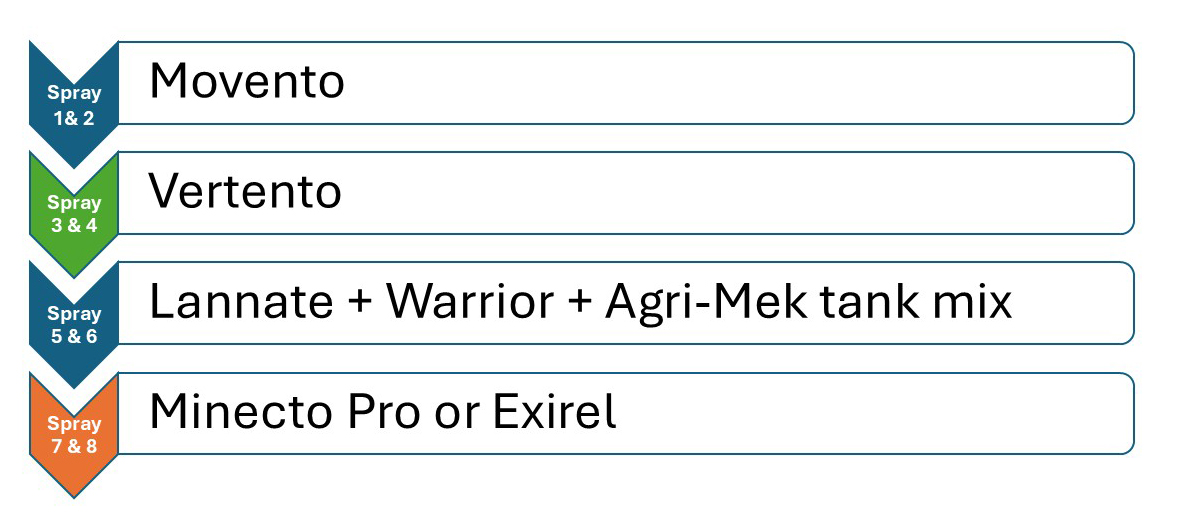 Fields averaging more than or equal to 2.1 thrips per leaf require rapid suppression to avoid economic losses and prevent populations from becoming difficult to control. High pest pressure often requires the most aggressive options and close scouting after treatment to ensure suppression is maintained. If thrips populations stay high after the two initial Movento applications, Vertento can be used as an effective option to suppress populations quickly. This program does not use Radiant.
Onion thrips insecticide reference table
Insecticide names in the following table are examples; other generic products exist for some of them. Warrior, Lannate and sometimes Agri-Mek are ineffective at managing thrips when applied individually. While tank-mixing Lannate and Warrior boosts performance beyond solo applications, a three-way combination of all three insecticides provides good control.
|
Insecticide name |
Active ingredient(s) |
IRAC class |
Company |
Rate for onion thrips |
|---|---|---|---|---|
|
Movento |
Spirotetramat |
23 |
Bayer |
5 fl oz/A |
|
Minecto Pro |
Cyantraniliprole + Abamectin |
28 + 6 |
Syngenta |
7–10 fl oz/A |
|
Exirel |
Cyantraniliprole |
28 |
FMC |
13.5–20.5 fl oz/A |
|
Vertento |
Isocycloseram |
30 |
Syngenta |
3.1–4.1 fl oz/A |
|
Radiant |
spinetoram |
5 |
Coretva |
6-10 fl oz/A |
|
Lannate |
Methomyl |
1A |
Corteva |
1 lb/A |
|
Warrior |
Lambda-cyhalothrin |
3A |
Syngenta |
1.28 – 1.92 fl oz/A |
|
Agri-Mek |
Abamectin |
6 |
Syngenta |
1.75 - 3.5 fl oz/A |
Reference to commercial products or trade names does not imply endorsement by Michigan State University Extension or bias against those not mentioned.
This work is supported by the Crop Protection and Pest Management Program (grant no 2024-70006-43569) from the USDA National Institute of Food and Agriculture. Any opinions, findings, conclusions or recommendations expressed in this publication are those of the author(s) and do not necessarily reflect the view of the U.S. Department of Agriculture.