Vegetable Extension Across Michigan
 Print
Print Email
EmailMichigan State University Extension's vegetable program delivered high-impact, collaborative education in 2025, reaching thousands of growers across Michigan and beyond.
Michigan State University Extension's vegetable program delivered high-impact, collaborative education at scale in 2025, reaching thousands of growers across Michigan and beyond. From global exchanges with Ukrainian producers to bilingual, on-farm and community-based learning, programs were designed to meet participants where they are and respond in real time to their needs. Hands-on training, campus immersion, and digital outreach connected diverse audiences while strengthening practical skills and professional networks. These efforts advanced more resilient, efficient, and profitable vegetable production systems while building the next generation of growers and agricultural decision-makers.
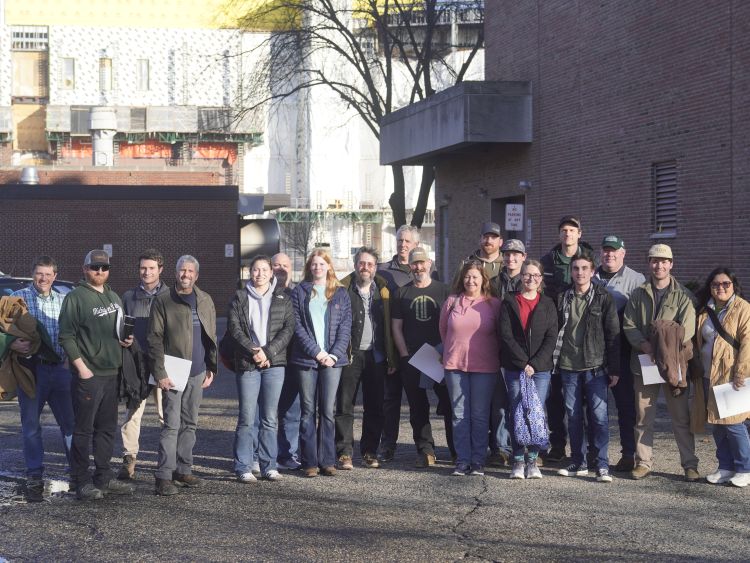
In 2025, a multi-part team effort demonstrated how high-intensity collaboration can bridge cultures, experience levels, and languages. Twenty Ukrainian agribusiness leaders visited Michigan growers, researchers and industry partners to learn about sorting systems, packing efficiency and storage design through live interpretation and observation in their war to maintain domestic vegetable production.
That same adaptive, participant-driven approach carried into Spanish-language workshops, where 30 Latina/o farmers shaped real-time lessons on irrigation, fertility, pest management and crop cycles—moving fluidly between whiteboard planning and in-field demonstrations at the Southwest Michigan Research and Extension Center.
Complementing these efforts, seed-starting programs with community groups, tribal partners and large public audiences created hands-on learning environments where 133 participants worked side-by-side mixing soil, seeding and managing transplants, regardless of prior experience.
On the farm, an Amish no-till pumpkin field day brought together 44 producers to evaluate cover crop systems for weed control and soil health through replicated demonstrations and peer learning. A beginning farmer field day convened 53 new and aspiring producers with Extension, conservation and industry partners to build foundational skills in production, business planning, environmental stewardship and regulatory compliance.
A capstone “Veg on the Go” campus program further connected 19 growers with university researchers through a fast-paced series of lab visits, fostering relationships that increased participants’ willingness to collaborate with specialists and strengthening pathways for the next generation of farm decision-makers.
Extending reach further, the Ag Ideas to Grow With webinar series engaged over 1,300 participants in a single week, drawing a more gender-balanced and racially diverse audience than typical in-person events.
Across all formats—on the road, in the field, in the classroom, on campus and online—participants ranged from war-impacted producers to Plain community growers, small-scale market farmers, multi-generational farm families, beginning farmers and first-time gardeners. Through real-time interpretation, tightly coordinated logistics, hands-on learning and shared problem-solving, these efforts aligned diverse groups around practical skills and common goals, demonstrating that collaborative learning at scale can accelerate knowledge transfer, strengthen agricultural networks and support resilient, economically viable food systems.