West central Michigan tree fruit update – June 17, 2026
 Print
Print Email
EmailSweet and tart cherries are starting to turn red across the region.
Weather update
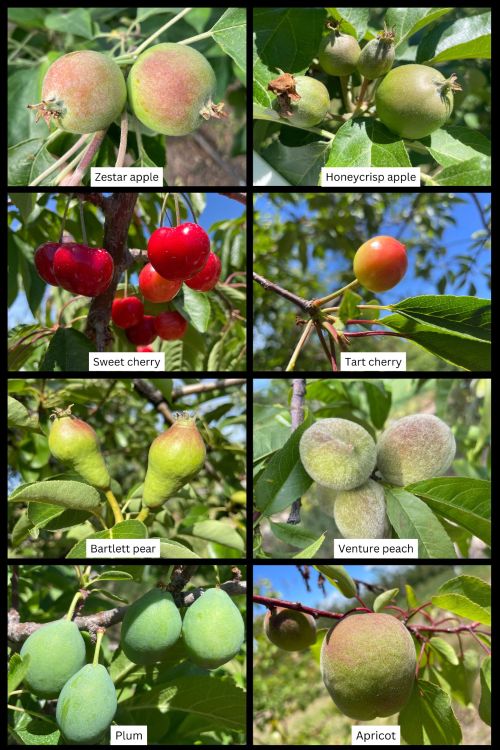
Conditions this week have been cooler than last week with scattered showers in the west central and Grand Rapids, Michigan regions. Warm weather has rapidly advanced phenology and fruitlet size for tree fruit crops such as cherry, peach, and apple (Figure 1). Based on the Hart weather station for June 17, current degree-day (DD) accumulation is 1172 DD42 and 674 DD50. At the Sparta weather station, current DD accumulation is 1335 DD42 and 796 DD50.
Storms over the last few days brought needed rain across the region. More rain is expected on June 17-18 with chances of precipitation over the weekend as well. Temperatures will remain moderate into next week. Highs in the 70s and lows in the 50s are forecasted into next week.
Listen to the weather update from Jeff Andresen, MSU climatologist, at the Fruit & Nuts Weather page from MSU Extension.
Weather data was gathered from MSU Enviroweather.
More information and reports on normal weather conditions and departures from normal can be found on the NOAA Climate Prediction Center website, NOAA U.S. Climate Normals website, NOAA Climate Normals Quick Access Page.
Crop update
Apple varieties in Oceana County range from 29-45mm fruitlet growth stages depending on the location in the county. In Hart, average fruitlet size for Zestar on June 15 was 37.5mm, and Idared was 33.7mm. Average fruitlet size for later varieties such as Gala was 27.4mm, Honeycrisp was 29.6mm, Jonagold was 27.6mm, and Minneiska was 29.6mm. Scout block by block to assess fruit set to determine potential crop load and hand thinning needs.
Fruit set is variable across the region, and early evaluation of thinner efficacy has also been variable. Some blocks will need additional hand thinning as the window for chemical thinning is coming to a close. Some apple for varieties like Honeycrisp and Jonagold are measuring larger 18-23mm, but based on fruit growth measurements, these fruit have stopped or significantly slowed growth and will fall.
Summer sprays of NAA can be applied to enhance return bloom, especially for varieties that tend to be biennial. Summer NAA applications are recommended at 5, 7, and 9 weeks after bloom for varieties with a heavy crop load or that tend to have poor return bloom. At this timing, fruitlets are about 1 inch in diameter and are no longer sensitive to NAA as a chemical thinner like smaller fruitlets are. Flower bud initiation has already begun for most varieties such as Honeycrisp and Minneiska, but summer NAA treatments (3 applications) of 5ppm during the next 30 days have been shown to enhance return bloom of varieties like Golden Delicious, Jonagold, Fuji, and Empire. Find more information about return bloom sprays here.
More information about general apple thinning recommendations and decision-making tools for apple can be found at Honeycrisp crop management - Apples (msu.edu).
Apple scab pressure for primary scab is coming to a close. For Sparta, primary scab is over, and Amy Irish-Brown with Valent, did not catch any spores during the last two rains on June 13-14.
For Hart, 1.5 spores per rod were counted for the rain event on June 11-12, but the rain in the forecast over the weekend on June 13-14 never came. Enviroweather is predicting that 98% of the spores will be released by June 15, and 99% of spores will be released by June 22. I will continue to trap spores until there are 2 rain events with counts of 0.
With the storm from June 16, there were reports of hail, and hail was observed at the West Central Michigan Research and Extension Center in Hart. Apple blocks should be evaluated for trauma from hail or wind, and if there is concern for trauma blight, streptomycin can be used to management the fire blight bacteria. This is the most effective material against fire blight, but in areas where there is streptomycin resistance, copper products can also be used. Copper can kill bacteria that are still on the tissue surface.
Tart and sweet cherry fruitlets are growing rapidly in Hart and are turning red. For early sweet cherry varieties such as Ebony pearl, average fruitlet size was 24.8 mm this week. There was some bird damage reported this week.
For tart cherry, average fruitlet size was 16.6 mm. For tart cherry in Hart, there have been a couple cherry leaf spot infection periods on June 8-11 and 11-12. Some cherry leaf spot symptoms are present in the west central region. As a reminder, continue rotating fungicide chemistries to manage resistance. Captan and copper containing products are effective against cherry leaf spot. Chlorothalonil is also an effective material, but the 10-day re-application restriction may be limiting. Another fungicide application may be needed prior to the end of the 10-day re-application timing, so use a different fungicide such as Captan or copper products during that timing if needed.
Peaches are growing quickly, and Venture peaches at the West Central Michigan Research and Extension Center are almost at the pit hardening stage. Average fruit size for Venture peach at the West Central Michigan Research and Extension Center was 28.3mm. Rusty spot (powdery mildew) and bacterial spot management is needed in peaches, particularly if disease pressure was high in 2025. For the MSU trapline, oriental fruit moth (OFM) count was 0 this week at the West Central Michigan Research and Extension Center. A biofix date for the 1st generation OFM was set for May 11 in Hart. OFM populations around the county are declining for this first generation, and trap counts at other farms in the county were 0 this week for OFM. For West Central Michigan Research and Extension Center, peak egg laying was predicted on June 4th. The second generation biofix is predicted to be sometime this week. Continue monitoring for sustained catch to set the biofix for the 2nd generation. Scout for flagging in terminal shoots from the 1st generation of OFM.
Plum fruitlets are growing rapidly in West central. Average fruitlet size for Castleton plums was 27.5mm. June drop is occurring in plum. Some varieties have heavy fruit set and will need to be hand thinned. If needed, management for black knot is recommended. Bacterial spot symptoms were also observed this week resulting in a shothole appearance in the leaves which is caused by Xanthomonas arboricola pv. pruni (XAP). Varieties differ in their response to infection, and symptoms can include necrotic leaf spots, yellow halos and yellow leaf tips, necrotic spots on fruitlets, or only slight skin-flecking.
Apricot average fruit size was 42.4mm. Fruit set was very light this year, likely due to cold damage and poor pollination weather during bloom. Protect trees against bacterial spot and canker during this time of the season.
Pear fruitlets are also growing, and average fruitlet size of Bartlett pear at the West Central Michigan Research and Extension Center was 23.5mm. Similar to last week, applications to manage pear scab are needed to cover new green tissue similar to apple scab. Pear scab symptoms have been observed in the region. Pear psylla adults have been observed in the Bartlett pear block at the West Central Michigan Research and Extension Center.
Additional pest and disease information
No green fruit worm adults were trapped this week in Oceana County. Pest activity has been high with the warm weather observed again this week on shoot terminals. Codling moth counts were also 0 this week at the West Central Michigan Research and Extension Center. Obliquebanded leafroller pupae were observed in orchards this week, and there are some reports of adults in traps in Oceana County.
American plum borer and lesser peach tree borer were trapped at the West Central Michigan Research and Extension Center. Other pests to scout for this week include rose chafer, green peach aphid, European red mites, and white apple leafhopper.
At the Trevor Nichols Research Center, Dogwood borer were trapped at 28 borers/trap. Spotted wing drosophila was also trapped at 4.8/trap, and cherry fruit fly were trapped at 0.7/trap.
For more information about regional reports, please visit the Michigan State University Extension website.
This work is supported by the Crop Protection and Pest Management Program (grant no 2024-70006-43569) from the USDA National Institute of Food and Agriculture. Any opinions, findings, conclusions, or recommendations expressed in this publication are those of the author(s) and do not necessarily reflect the view of the U.S. Department of Agriculture.