West central Michigan tree fruit update – May 19, 2026
 Print
Print Email
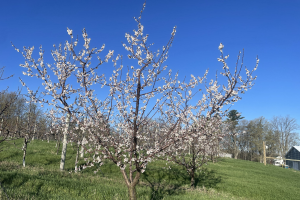
EmailApple trees are in full bloom this week in the west central region.
Weather update
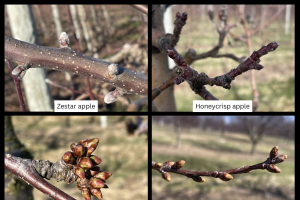
Warmer weather over the past few days has rapidly advanced phenology across west central Michigan and the Grand Rapids regions (Figure 1). Wind and rain have accompanied the warmer weather. Precipitation totals over the past week were 0.26 inches in Hart and 0.60 inches in Grand Rapids. Based on the Hart MSU Enviroweather station for May 19, current degree-day (DD) accumulation is 561 DD42 and 280 DD50. At the Sparta MSU Enviroweather station, current DD accumulation is 691 DD42 and 374 DD50.
As storm systems move across the region May 19-23, day and nighttime temperatures will cool down slightly. Nighttime temperatures will dip down into the upper 30s on May 21. Scattered showers are in the forecast for Friday, May 22, into Saturday. Windy conditions will continue this week. Temperatures for the end of May are expected to be warmer than normal with average or below average precipitation.
Listen to the weather update from Jeff Andresen, MSU climatologist, at the Fruit & Nuts Weather page from MSU Extension.
Weather data was gathered from MSU Enviroweather.
More information and reports on normal weather conditions and departures from normal can be found on the NOAA Climate Prediction Center website, NOAA U.S. Climate Normals website, NOAA Climate Normals Quick Access Page.
Crop update
With warmer weather over the past few days, tree phenology advanced quickly and we can see initial fruit set in some crops.
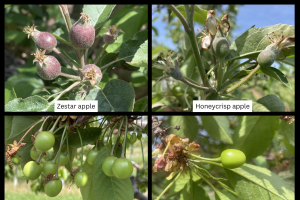
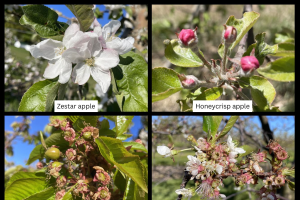
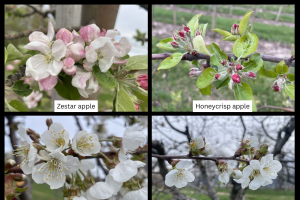
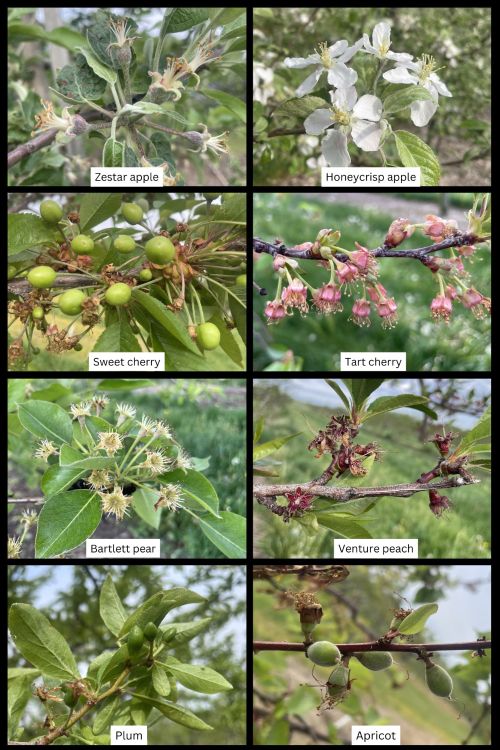
Apple varieties in Oceana County range from petal fall to fruit set. Early varieties such as Zestar and Idared average 4–6 millimeters (mm) in size, and later varieties such as Gala and Honeycrisp are in bloom. In Sparta, early varieties are 8–10 mm and later varieties like Gala and Honeycrisp are at fruit set. Scout block by block to assess bloom and early fruit set to determine potential crop load and thinning needs. Last week, spur leaves were showing signs of cold injury with leaf reddening, some deformation or cupping at the leaf margins, and necrotic spots on the leaves. Leaves have expanded quite a bit and are greener now after warmer weather and rain.
ReTain can still be applied on some varieties in full bloom if needed, such as EverCrisp. Read more about using ReTain and application rates.
Over the next few weeks, apple thinning sprays will need to be implemented as fruit set can be evaluated. Early thinning strategies can begin for this season with bloom and petal fall thinning applications. You can use the pollen tube growth model to help make decisions about bloom thinning. For more information about the pollen tube growth model, watch this video from the Lake Ontario Fruit Program.
For later thinning times, information on the fruit growth rate model and the Malusim carbohydrate model, see this article from MSU Extension. Particularly this season, with prolonged bloom, variable fruit set and freeze damage, understanding crop load will be critical to understanding thinning efficacy.
See this article on general apple thinning recommendations and decision-making tools. Risk for overthinning at these earlier application timings is low.
Apple scab pressure is typically high this time of year. According to the RimPro model for Hart, leaf wetting periods have been short, which has limited infection periods. Spores will be counted after the rain event on May 19. The RimPro model is predicting spores will be ejected today (May 19) with the rain event today and tomorrow. The wetting periods will be short so the fungus may not have enough time to infect during the wetting periods due to slow fungal growth. Leaf wetness will differ by orchard site.
Similarly for Sparta, the Rimpro model also shows release of apple scab spores this week with rain events on May 19 and 20.
With wind and rain in the forecast for the rest of the week, it may be challenging to find adequate spray windows. Continue checking the weather to find the best time to put on an application and minimize drift.
The MSU Enviroweather fire blight model for Hart and Sparta is predicting high fire blight infection over the next few days due to warm temperatures and wet conditions. EIP values are predicted to be above 71 from May 19–22 in Hart and Sparta, with warm temperatures and wet conditions. If open blooms are present, antibiotic applications are recommended before a rain event to protect blossoms from bacterial infection. Fire blight is becoming less of a concern in the Grand Rapids region and further south as bloom comes to an end.
Tart and sweet cherry buds are at petal fall with some lingering bloom in Hart. For sweet cherry, fruitlet size ranged from 6–10 mm. For tart cherry, there is risk for cherry leaf spot due to warmer temperatures, but the fast-drying conditions have helped limit infection and the MSU Enviroweather model shows progress toward infection did not reach 100%.
Cherry leaf spot is caused by the fungus Blumeriella jaapii. This fungus overwinters on the ground in diseased leaves. Fungal ascospores are released in spring during prolonged wetting events. According to George Sundin, MSU tree fruit pathologist, spores can infect as soon as bract leaves emerge. Spores infect through open stomata, and stomates on bract leaves were shown to be open when they emerged from buds.
Peaches are in the shuck for some varieties. Rusty spot (powdery mildew) management may be needed in peaches, particularly if disease pressure was high in 2025. For the MSU trapline, oriental fruit moth were trapped this week at the West Central Michigan Research and Extension Center and other farms in Oceana County. A biofix date was set for May 11 in Hart.
Plum varieties are in the shuck. If needed, manage for black knot. Plum size ranges from 3-5 mm.
Pear varieties are at petal fall. Like last week, applications to manage pear scab are needed to cover new green tissue similar to apple scab. Pears will also need to be protected against fire blight before the next rain this weekend. Pear psylla adults are in the Bartlett pear block at the West Central Michigan Research and Extension Center.
Additional pest and disease information
No green fruitworm adults were trapped this week in Oceana County. Pest activity was higher this week, and with the warm weather, activity is expected to increase. Ambrosia beetle adults were observed on sticky traps. Trap counts for oriental fruit moth averaged 28 adults per trap in Oceana County.
Other pests to scout for include obliquebanded leafroller, aphids, American plum borer, rose chafer, green peach aphid, European red mites and white apple leafhopper.
For more information about regional reports, please visit the Michigan State University Extension website.
This work is supported by the Crop Protection and Pest Management Program [grant no 2024-70006-43569] from the USDA National Institute of Food and Agriculture. Any opinions, findings, conclusions, or recommendations expressed in this publication are those of the author(s) and do not necessarily reflect the view of the U.S. Department of Agriculture.