What's that weird stuff floating in your lake?
 Print
Print Email
EmailIt may -- or may not -- be a harmful algal bloom. Learn how to identify a HAB!
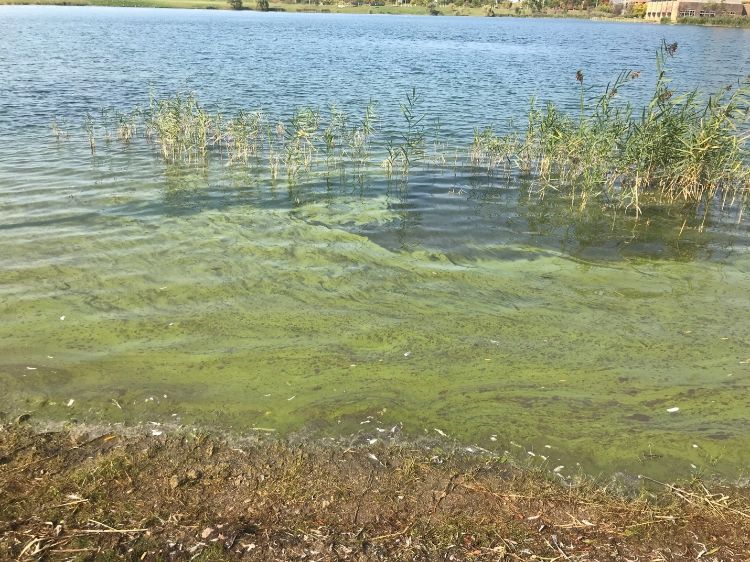
Ever looked at a lake and noticed something strange or unexpected floating on the water’s surface? What should you do next? It’s good to rule out if what you see is a natural phenomenon like pollen or bacteria or aquatic plants. Sometimes small plants, such as watermeal or duckweed, floating on the surface can make it look like the whole lake is green. If you have ruled out a natural phenomenon and aquatic plants, you may be looking at an algal bloom.
What are algal blooms?
Algal blooms happen when tiny, naturally occurring organisms grow rapidly in water and are visible without a microscope. Most algae is not toxic, but an algae-like organism called cyanobacteria can produce toxins that are harmful to people, pets and livestock. Algal blooms that can produce toxins dangerous to humans or animals are considered harmful algal blooms (HABs). During a HAB, the lake water may look green (or other colors, like purple) or have scum floating on top.
There have been increased reports of HABs in inland lakes and the Great Lakes since 2013. Most counties across Michigan have had reports of HABs on inland lakes. Western Lake Erie and Saginaw Bay, as well as Lake Superior, have also had confirmed HABs. An online map shows confirmed blooms through the current season.
Reporting a potential HAB is important
There are some steps you can take to report a harmful algal bloom:
- Take clear pictures that show the bloom close up, with a leaf or familiar object to show scale.
- Get photos of the surroundings, too, and try using your map or camera app to pinpoint the location.
- Report information online to Michigan.gov/HABs or call EGLE’s Environmental Assistance Center at 800-662-9278.
Your report will reach trained staff at state agencies. If they agree that the photos show a HAB, the location will be added to Michigan’s map of confirmed HABs. They can provide guidance on how to keep your family and animals safe.
Staff from a state agency or local health department may visit the site to take a water sample, especially if a HAB hasn’t been reported at the location before. A test strip and/or laboratory test will confirm whether the water contains algal toxins. If the location has a history of confirmed HAB reports, staff may not visit the site, but your report will still show up on the online map. Staff will follow up if they need more information or if the photos don’t appear to show an identifiable HAB.
If a HAB is confirmed, the local health department may notify nearby residents. Your report also becomes valuable data for studying where and when HABs occur.
Take precautions!
If you suspect a HAB is present, don't touch the water. HABs can cause human health impacts like skin rashes, runny noses, stomach pain, and headaches. Also keep livestock and pets away from the water. If you think a domestic or wild animal is ill or dead because of a HAB, submit one of the forms on the EGLE HABs webpage.
Find out more about HABs by viewing this Michigan Sea Grant video. You can also view resources about HABs on the HABs 101 resources website.
Michigan Sea Grant helps to foster economic growth and protect Michigan’s coastal, Great Lakes resources through education, research and outreach. A collaborative effort of the University of Michigan and Michigan State University and its MSU Extension, Michigan Sea Grant is part of the NOAA-National Sea Grant network of 34 university-based programs.
This article was prepared by Michigan Sea Grant under award NA24OARX417C0157-T1-01 from the National Oceanic and Atmospheric Administration, U.S. Department of Commerce through the Regents of the University of Michigan. The statement, findings, conclusions, and recommendations are those of the author(s) and do not necessarily reflect the views of the National Oceanic and Atmospheric Administration, the Department of Commerce, or the Regents of the University of Michigan.