When boats tell stories: Preserving Michigan’s Great Lakes fishing heritage
 Print
Print Email
EmailResearchers’ painstaking documentation saves the tales of commercial fishing vessels.
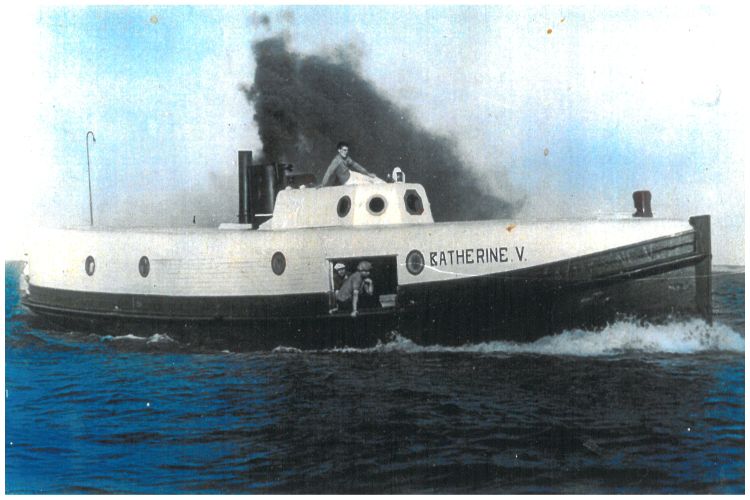
The wooden gill net fishing tug Katherine V fished through the height, and the eventual decline, of commercial fishing on the Great Lakes carrying people, nets, and catches across the waters of northern Lake Huron. Today, the vessel carries an equally valuable story of Michigan’s commercial fishing history and heritage. Now preserved at the Besser Museum for Northeast Michigan in Alpena, Mich., the Katherine V serves as both a historic artifact and a gateway to a broader effort to document and preserve the vessels that shaped Great Lakes fishing communities. 
The archeological documentation of this vessel, and several other historic fishing vessels, is part of a multi-year partnership involving the National Park Service’s Historic American Engineering Record (HAER) and the Great Lakes Fisheries Heritage Trail (GLFHT) network, Michigan Sea Grant, museums, and coastal communities across the state. Together, these partners worked to document historic commercial fishing vessels that represent the people, technologies, and traditions that sustained Great Lakes fisheries for more than a century.
Beginning in 2021, maritime archaeologist Cassandra Sadler researched and documented ten historically significant vessels, creating detailed historical reports and recording stories often absent from traditional maritime histories, including those of Indigenous and family-operated fisheries. In 2024, HAER returned to expand the work using advanced laser scanning, photogrammetry, and archival photography to create permanent records that are now preserved in the Library of Congress and featured as part of the Great Lakes Fisheries Heritage Trail. Sadler has since joined NOAA’s Thunder Bay National Marine Sanctuary as a resource protection specialist and now provides leadership in connecting NOAA’s Maritime Heritage mission and work among the Great Lakes Fisheries Heritage Trail network.
Read more about Cassandra Sadler's research and access the historical reports.
The vessels documented through the project range from classic gill-net tugs such as Katherine V, Bob S, and Helen S to the research vessel Chinook, illustrating the evolution of Great Lakes fisheries from commercial harvest to modern science and management. By combining historical research, cutting-edge documentation, and community partnerships, the HAER and GLFHT collaboration is ensuring that Michigan’s fisheries heritage remains accessible for future generations to explore, study, and celebrate.
More stories
Michigan Sea Grant and Michigan State University Extension, in partnership with America250MI and the Great Lakes Fisheries Heritage Trail (GLFHT) network, offer this Great Lakes fisheries history and heritage storytelling series celebrating Michigan’s commemoration of America’s 250th anniversary. Follow these stories exploring Michigan’s Great Lakes fisheries heritage online at the Great Lakes Fisheries Heritage Trail website.
Additional resources
Explore to learn more about Great Lakes fisheries:
- Great Lakes Fishing Vessels over time - a short history of commercial fishing vessels.
- Life of the Lakes: A Guide to the Great Lakes Fishery — produced by Michigan Sea Grant with University of Michigan Press.
- Small Fry, Big Catches: The Great Lakes Fishery — a Michigan History Magazine article published by the Historical Society of Michigan in partnership with Michigan Sea Grant.
- The Fish Thief: A Great Lakes Mystery — Full-length award-winning historical documentary about Great Lakes fisheries; funding production by the Great Lakes Fishery Commission (free viewing here).
- Learn more about America250MI: america250mi.org.
The following worked together to bring you this learning series as part of Michigan’s America250 commemoration: Great Lakes Fisheries Heritage Trail network, Michigan Sea Grant and Michigan State University Extension, Great Lakes Fishery Commission, Michigan Department of Natural Resources, Besser Museum for Northeast Michigan, Fishtown Preservation Society, and others. This series has been made possible in part by America250MI.