Why is downy mildew so late to arrive in Michigan? It will be here soon.
 Print
Print Email
EmailDowny mildew disease was confirmed in cucumbers in Indiana.
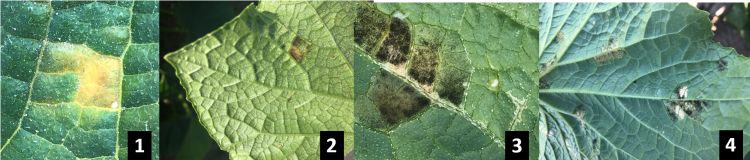
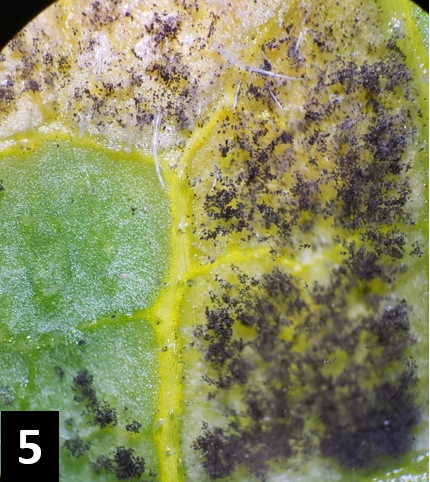
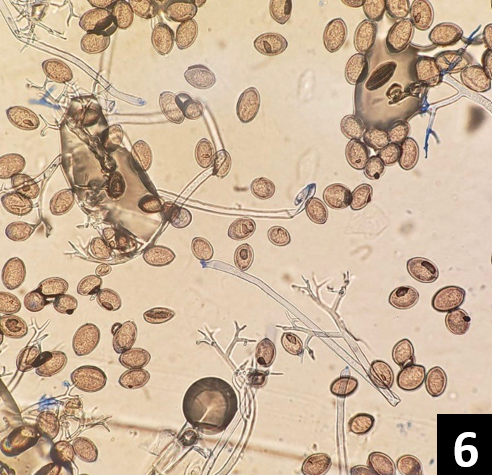
The first symptoms of cucurbit downy mildew disease on cucumber plants in a commercial field planting have been verified in LaGrange County, Indiana, on July 29, 2026. This is much later than the last several years. LaGrange shares the border with St. Joseph and Branch counties in Michigan. Michigan growers should expect to see the first field downy mildew symptoms in the next few days given the nearby outbreak in Indiana and the recent milder temperatures and rainfall.
The statewide spore trapping network to detect downy mildew spores in the air has shown very few positives from across the state during July 4 to 21. The most recent air sample results will be posted on July 29 on the Downy Mildew News website from Michigan State University (MSU). Visit MSU Downy Mildew News for spore trap results and current downy mildew news.
Our air sample results are confirmed by qPCR. The qPCR results indicate that this is Clade 2 which prefers cucumber and cantaloupe. Clade 1 is rarely found in Michigan and favors watermelon, pumpkin, and squash. Only growers of cucumber and cantaloupe need to protect their crops from downy mildew currently.
This year, downy mildew outbreaks in the southeast U.S. have also been later than usual, perhaps because of the dry conditions that these states experienced earlier in the growing season. Northern Florida recorded downy mildew on June 1 on watermelon. On June 25, an outbreak was reported on cucumber and melon in southern Georgia. The disease was more recently recorded on cucumbers in eastern North Carolina on July 20. The pattern of downy mildew outbreaks this year seems to indicate that the delay of disease developing in Michigan has been influenced by the late development of downy mildew on crops in the southeast U.S.
The Downy Mildew News website is updated with the latest results of confirmed positives for field disease and spore trap air samples. The results from the spore traps are a few days behind due to the processing of the spore tapes. We can distinguish between cucumber and hop downy mildew spores using molecular tools. Air samples are processed on Tuesday and Wednesday, with our online report updated each Thursday. Suspect plant samples should be submitted for diagnosis. The positive plant samples can be tracked on our map. See instructions on how to submit samples.
Downy mildew development is influenced, in part, by temperature and moisture (relative humidity and the duration of leaf wetness). The cucurbit downy mildew pathogen (Pseudoperonospora cubensis) prefers cooler temperatures, overcast conditions, high humidity, and long dew periods and can rapidly escalate in the state if fungicide sprays are delayed. The recent dry conditions in Michigan along with high temperatures earlier this month may have helped delay the initial onset of downy mildew. The state’s first pickling cucumber crops have been harvested but the subsequent crops should be protected with fungicides to preserve fruit quality and yield.
It is very important that cucumber growers use proven downy mildew fungicides (shown below in alphabetical order). These fungicides were effective in our 2025 research field plots and include:
- Elumin + chlorothalonil or mancozeb
- Omega (Orbus) + chlorothalonil or mancozeb
- *Orondis Opti (chlorothalonil is part of the premix, additional chlorothalonil is suggested [see label for maximum chlorothalonil rates])
- Previcur Flex + chlorothalonil or mancozeb
- *Ranman + chlorothalonil or mancozeb
- Zampro + chlorothalonil or mancozeb
*Across many years of field tests, Orondis Opti and Ranman have been the leading fungicides in cucurbit downy mildew control in Michigan and would be especially recommended given the positive downy mildew air samples detected across the state.
Fungicides should be alternated so that resistance of the pathogen to the fungicide’s active ingredient does not develop. It is important that the fungicides be applied prior to plant infection. Waiting until downy mildew has developed in the field prior to applying fungicides can lead to control failure and pathogen resistance. Downy mildew can infect the cotyledons of cucumbers and has been observed in previous years under high disease pressure.
This material is based on work is supported by MSU Project GREEEN and the Agricultural Research Fund and Pickle and Pepper Research Committee of Pickle Packers International.
Reference to commercial products or trade names does not imply endorsement by MSU Extension or bias against those not mentioned.