Winter canola greens up in Michigan
 Print
Print Email
EmailSpring has sprung, so how can you make sure your winter canola is on the right track?
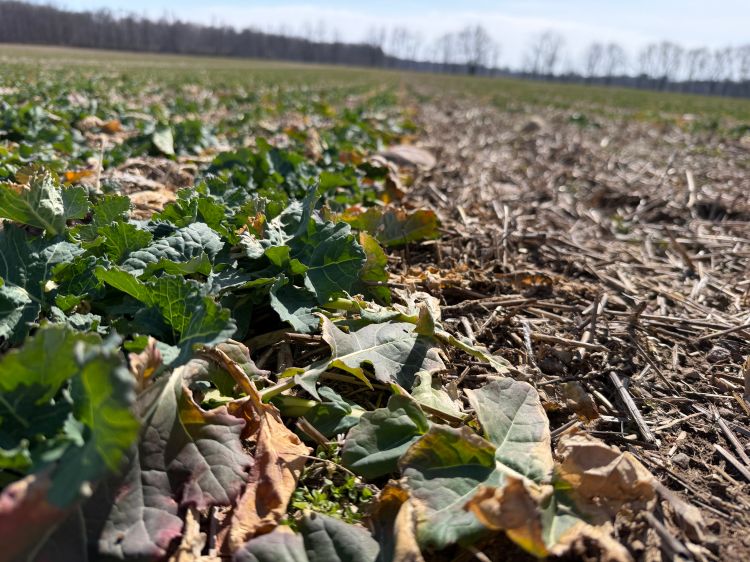
Fall 2025 was dry and much of Michigan was experiencing some level of drought. The later-planted canola especially struggled. Through much of winter, most of the state’s canola growing area enjoyed consistent snow cover, which is helpful for protecting canola. Evaluating stands in early spring can help guide management decisions for the remainder of the growing season.
Early spring scouting: stand counts
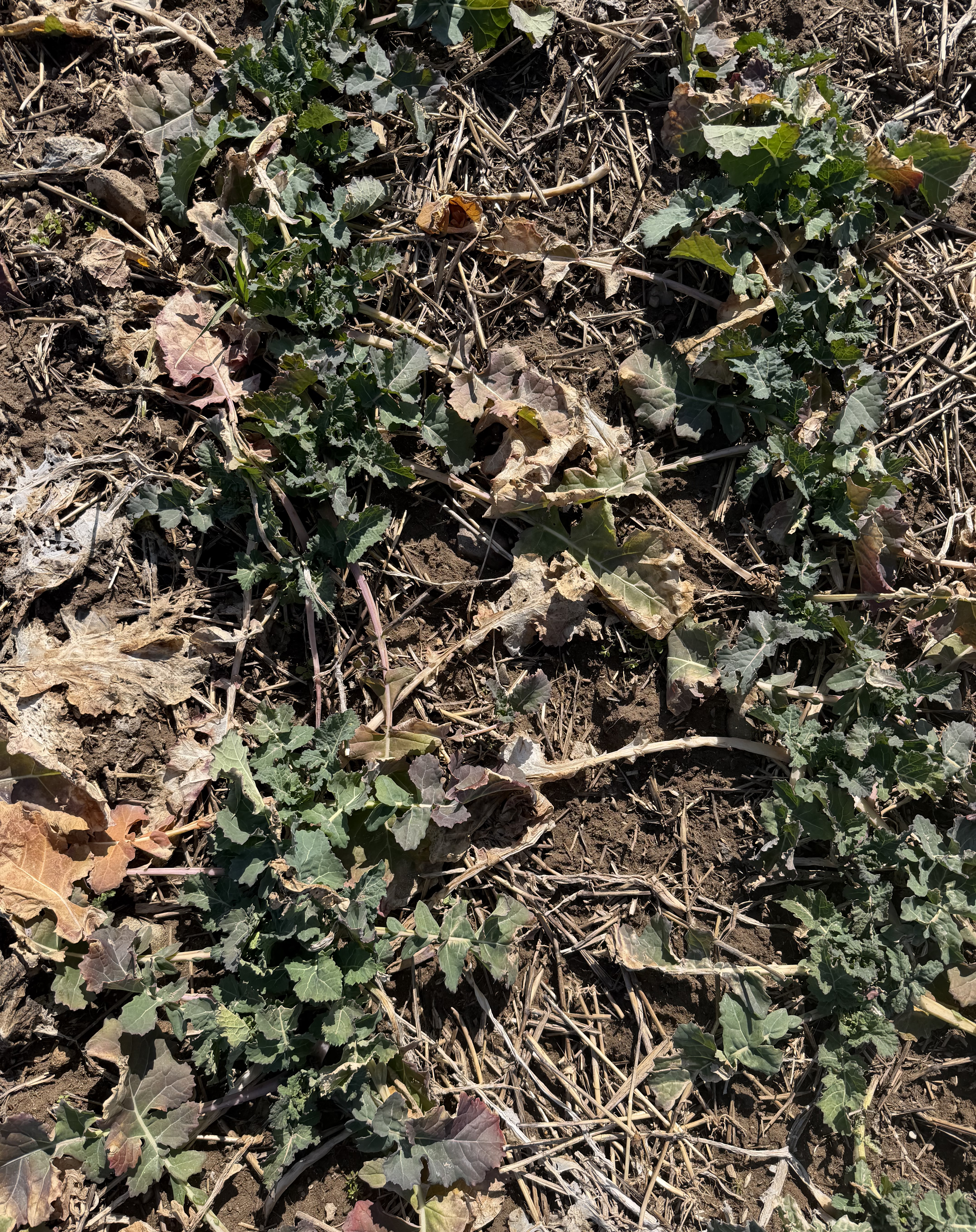
March–April is a great time to check stands for winter survival. Generally, the stand count target is 3-5 plants per square feet. To take stand counts, two methods are recommended:
- Plants/square feet: Take a hula hoop or quadrat of known dimension. Convert to plants/square feet by dividing your count by the area of your quadrat (in square feet).
- Plants/foot of row: Place a yard stick or measuring tape next to a row and count the number of pants in a row. Convert to plants/feet by dividing your count by the length of your measuring device (in feet).
Table 1. Plant populations in plants/sq ft based on number of plants per foot.
|
|
Plants/sq ft |
|||
|---|---|---|---|---|
|
Plants/ft |
10” Row Width |
15” Row Width |
20” Row Width |
30” Row Width |
|
2 |
2.4 |
1.6 |
1.2 |
0.8 |
|
3 |
3.6 |
2.4 |
1.8 |
1.2 |
|
4 |
4.8 |
3.2 |
2.4 |
1.6 |
|
5 |
6.0 |
4.0 |
3.0 |
2.0 |
|
6 |
7.2 |
4.8 |
3.6 |
2.4 |
|
7 |
8.0 |
5.6 |
4.2 |
2.8 |
|
8 |
8.8 |
6.4 |
4.8 |
3.2 |
Early spring scouting: stand health
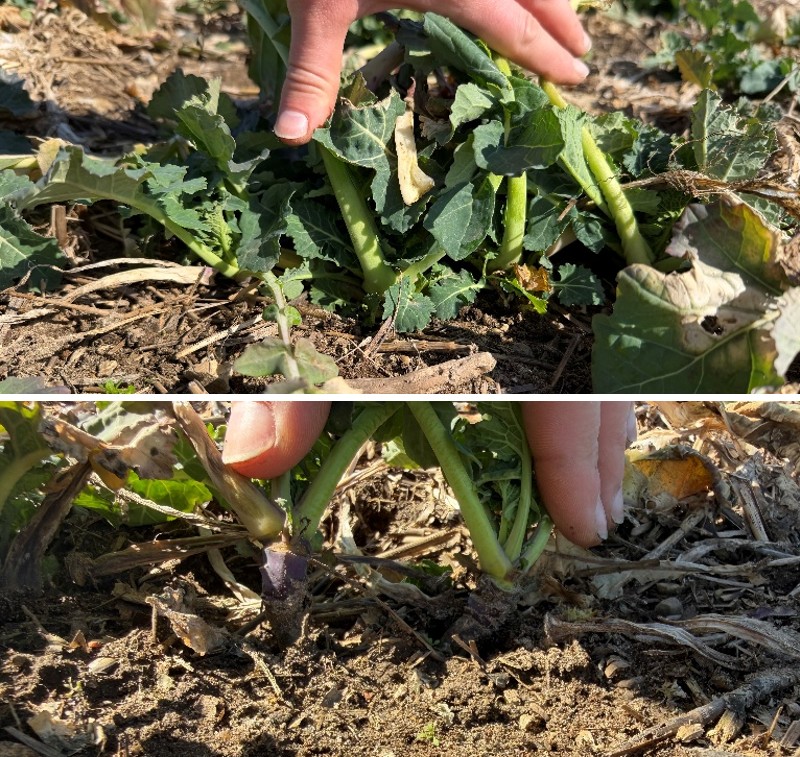
In addition to evaluating plant stands, evaluating plant health can also be helpful to make early season management choices. Though plants may look green, some signs beneath the canola canopy indicate unhealthy plants and loss of yield potential. One example of this would be crowns heaved out of the ground, exposing roots (Photo 3).
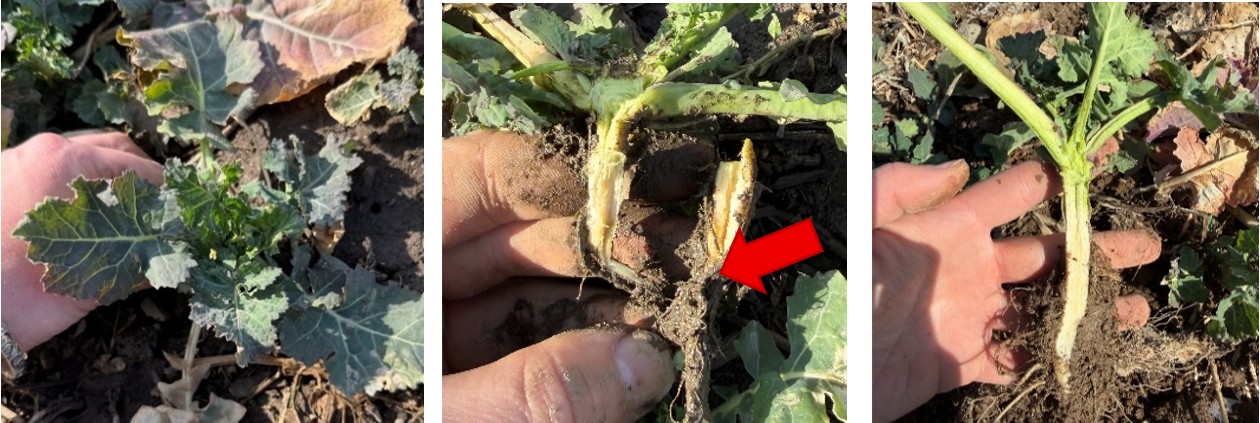
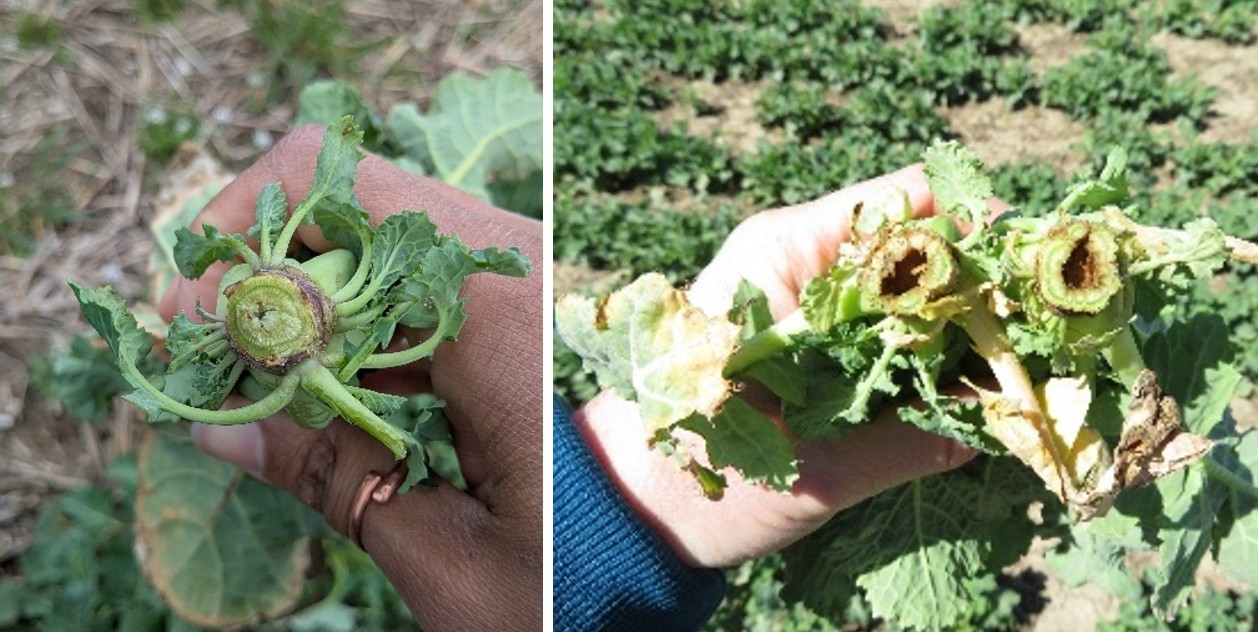
Canola, especially when it is young, is sensitive to waterlogged soil. Sometimes waterlogging can cause plants to decompose completely, causing bare spots in the fields in the spring. Sometimes the crown may stay green through spring while the root rots away (Photo 4). While rotted roots can be caused entirely by extreme waterlogging, wet cold soil also exacerbates seedling disease caused by soil borne fungi, especially Pythium. Check out this resource from the Canola Council of Canada for a description of canola seedling disease complex.
Waterlogged or diseases roots and stems early can grow out of the disease but will struggle to produce because of the damaged stem tissue. Photo 5 shows stems of plants, which survived early season water and/or disease stress.
Finally, winter canola is attractive to deer, like many of our crops. Canola plants often survive browsing because the growth point is low to the ground, however the damage can slow early season growth. Extreme deer feeding can cause yield reductions.
Early spring management
Fertilizer
Once you evaluate your stand survival, you can make informed management decisions. A healthy stand should be fed and protected accordingly. As canola transitions from vegetative stages to reproductive stages by bolting, nitrogen demand increases dramatically. Nitrogen and sulfur should be applied before bolting to maximize fertilizer use efficiency. Canola sulfur requirements are higher than winter wheat. Spring applied sulphate (supplying 20-40 lbs S/A) has been sufficient to support winter canola grown on coarse textured soils at the Kellogg Biological Station.
Weeds
A fall burndown before planting is the most important step for canola weed management as young canola plants do not compete well with weeds. Spring offers another window for addressing weeds. Postemergence grass herbicides like clethodim and quizaflop can be helpful to deal with annual grasses. Clopyralid can be used to control marestail in canola between two-leaf and six-leaf stages, however the 18-month rotation restriction to legume crops can be limiting for many growers.
Consult herbicide labels and check with your canola seed dealer to determine which products will help you avoid rotation restrictions and crop damage. RoundUp Ready and Clearfield canola varieties have herbicide tolerant traits allowing for additional postemergence herbicide options, though it is important to consider these traits can limit your options for managing volunteer canola. Once canola enters its reproductive stages, the canopy effectively competes with most weeds.
Tips for managing a thin stand
So, what happens when stands look thin? Brian Caldbeck from Caldbeck Consulting suggested regional variety trials are seeing good yields with as few as 1.5-2 plants per square feet, though he notes “at lower densities, uniformity becomes more important as does verification remaining plants are healthy and water and nutrient supply is optimal.” In thin stands, canola plants compensate by branching out more. With thin stands, you may anticipate a later harvest or more variability in maturity between plants. A study in Ontario showed thin stands had more branching with delayed maturity by 21 days.
If you are interested in growing canola, check out Michigan State University Extension’s canola crop updates from 2025 highlighting management and scouting tips for flowering through harvest. Also, come to one of the Michigan Forever Green canola events this summer:
- June 16 – Canola Experience Field Day, 11:30 a.m. to 3 p.m. at the North Central Research Station, 5606 Findlay Rd, St Johns, MI 48879. Register by June 5.
- June 17 – Canola Crop Walk from 1-3 p.m. following the Food Grade Grains Field Day. Sign up for any part of the day. For questions, contact Christine Charles.
- August 11-12 – AgroExpo Canola Plots. ADM will have a canola demonstration at AgroExpo, Booth #P318.
This work is supported by the Crop Protection and Pest Management Program [grant no 2024-70006-43569] from the USDA National Institute of Food and Agriculture. Any opinions, findings, conclusions, or recommendations expressed in this publication are those of the author(s) and do not necessarily reflect the view of the U.S. Department of Agriculture.