Year two of Michigan’s Aquatic Invasive Species Detection Blitz casts a wider net for community science
 Print
Print Email
EmailThe 2026 Blitz brought more participants, more observations and more verified aquatic invasive species records.
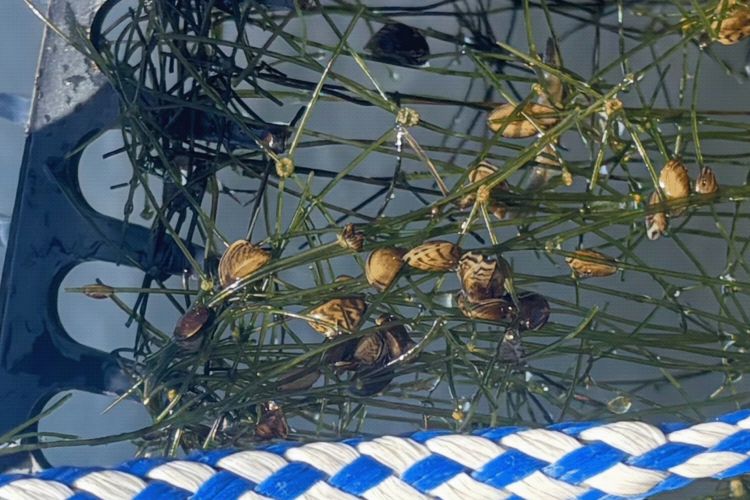
The second annual 2026 Michigan Clean Water Corps (MiCorps) Aquatic Invasive Species (AIS) Detection Blitz brought increased participation and substantially more verified observations in 2026. From June 29 through July 12, participants statewide used the iNaturalist platform to document known or suspected aquatic invasive species in lakes, streams, wetlands, and shorelines.
Aquatic invasive species can dramatically impair Michigan’s waterways, affecting native species, habitat, recreation, and other uses. Understanding where these species are present helps resource managers evaluate impacts and target monitoring and management efforts. Community science can play an important role in that work by helping document where AIS are being observed across the state.
A total of 174 people joined the 2026 project, a 74% increase from 2025. Additionally, 97 participants submitted observations, leading to a 137% increase from the first year. After submissions were expertly reviewed and identified, the final 2026 dataset included 284 verified observations of 18 aquatic invasive species from 47 observers.
Compared with 109 verified observations in 2025, that represents a 161% increase in verified AIS observations in the Blitz’s second year. The higher total reflects the substantial increase in participation and reporting effort in 2026, rather than a comparable increase in AIS spread from one year to the next. With more people participating and submitting observations, the 2026 Blitz was able to document more AIS during the project period.
Common reed, or phragmites, was the most frequently documented species in 2026, followed by Eurasian watermilfoil. Other observations included purple loosestrife, curly-leaf pondweed, zebra mussels, narrow-leaved cattail, European frog-bit, Chinese mystery snails, water forget-me-not, starry stonewort, flowering rush, yellow iris, New Zealand mudsnails, mute swans, common carp, Asian clams, brittle naiad and rusty crayfish.
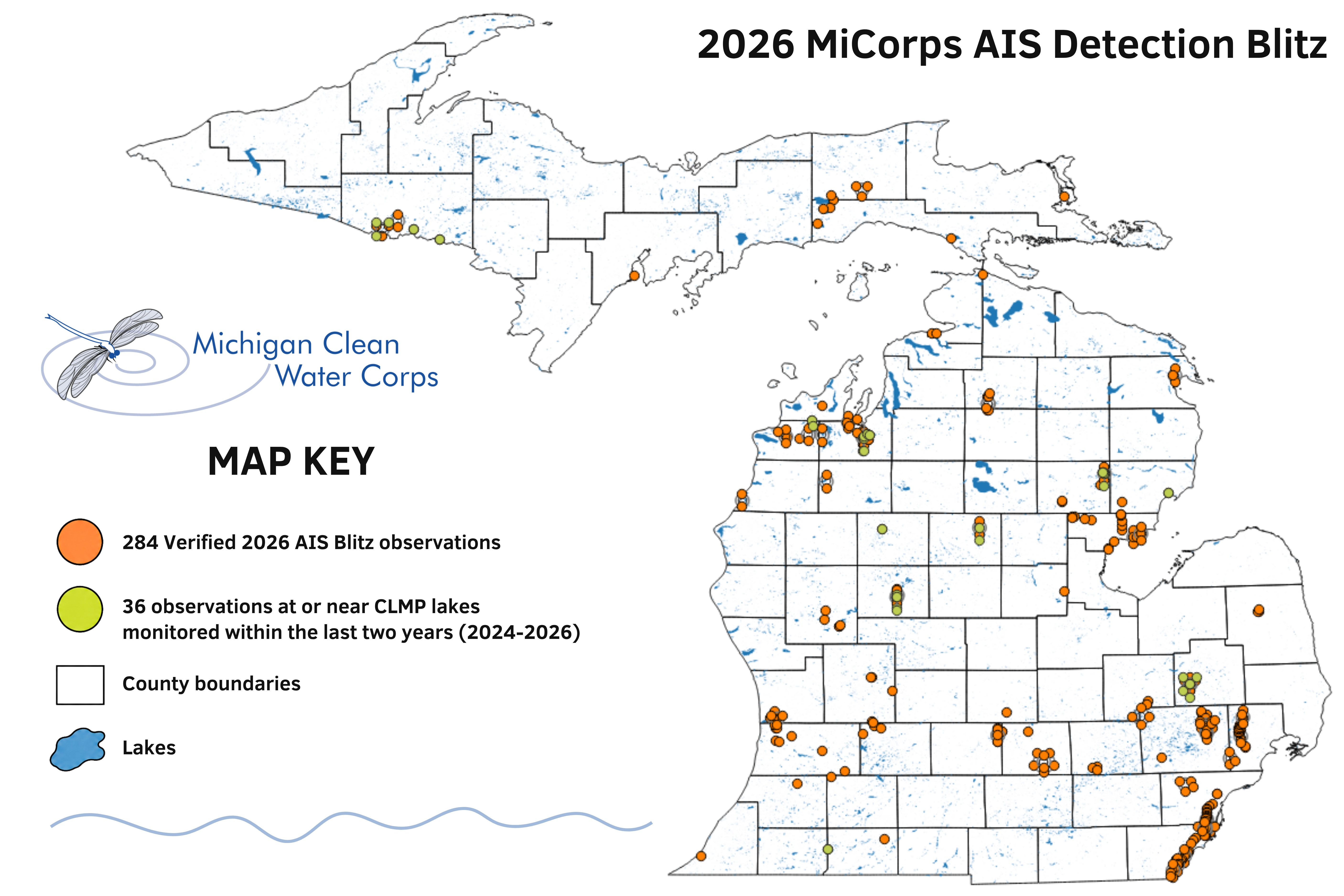
The geographic distribution of the observations also provided insight into how the Detection Blitz is extending aquatic invasive species reporting beyond locations already involved in long-term MiCorps volunteer lake monitoring through the Cooperative Lakes Monitoring Program (CLMP).
To compare the Blitz with that existing monitoring footprint, verified 2026 observations were mapped against lakes with recent CLMP monitoring data. Of the 284 verified Blitz observations, 36 observations, or 12.7%, occurred at or near 13 lakes with recent CLMP monitoring activity. Out of the 13 lakes, 6 of them had participated in the Exotic Aquatic Plant Watch within the last two years through CLMP. The remaining 87.3% occurred outside that recent CLMP lake footprint.
This comparison does not indicate whether individual Blitz participants were or were not enrolled in the CLMP. It does show that the locations represented in the Blitz extended well beyond lakes with recent CLMP monitoring data.
That broader geographic reach is one of the purposes of an open community science event. Participation in the AIS Detection Blitz does not require enrollment in a MiCorps monitoring program or previous aquatic invasive species experience. Anyone in Michigan could participate using iNaturalist, creating an opportunity to gather observations from places that may not otherwise have regular volunteer monitoring.
For aquatic invasive species, increasing the number of people paying attention can strengthen early detection efforts. Many invasive species are first noticed by people who already spend time near the water. Community science provides a way to document those observations and make them available for identification, mapping, and potential follow-up.
The Detection Blitz can also introduce participants to more structured monitoring opportunities. MiCorps’ early detection survey, the Exotic Aquatic Plant Watch (EAPW) is a parameter of the Cooperative Lakes Monitoring Program that provides enrolled volunteers with training and support to monitor aquatic invasive plants on a lake of their choice. Volunteers learn about the existing plant community, conduct regular surveys, and look for invasive aquatic plants that may be newly appearing.
The two efforts serve different roles. The AIS Detection Blitz provides a short-term, low-barrier opportunity for anyone to contribute observations from across Michigan. EAPW provides trained volunteers with a consistent approach to monitoring the same lake over time. Participation in an event like the Blitz can be an entry point for people interested in learning more about aquatic plants and becoming involved in longer-term early detection monitoring.
The growth of the Detection Blitz in its second year shows the potential for community science to expand the geographic reach of aquatic invasive species observation while connecting more people with Michigan’s volunteer monitoring programs.
Learn more about MiCorps
MiCorps is Michigan’s volunteer lake and stream monitoring program, administered by Michigan State University Extension under the direction of the Michigan Department of Environment, Great Lakes, and Energy and in partnership with the Huron River Watershed Council and Michigan Lakes and Streams Association.
Learn more about the MiCorps Cooperative Lakes Monitoring Program and the Exotic Aquatic Plant Watch at micorps.net.