Your planning commission prepares an annual report, but what about a work program?
 Print
Print Email
EmailSince 2008, an annual report has been required of all planning commissions in Michigan, but it is the work program that sets the agenda for next year’s planning commission initiatives in tandem with the annual budget request.
Planning commissions in Michigan should now be well versed in preparing an annual report for the legislative body; this was a new requirement for cities, villages, and counties with the passage of the Michigan Planning Enabling Act (MCL 125.3801 etseq.) in 2008. Briefly, planning commission annual reports are required under Sec. 19(2) (MCL 125.3819(2)) and should include a summary of:
- Operations of the commission
- Status of ongoing planning activities
- Recommendations to the legislative body related to planning and development
- Fiscal needs for next year
(See Michigan State University Extension news articles “What’s in a planning commission annual report?” Part 1 and Part 2).
Logically, the annual report provides the foundation and rationale for the following year’s budget and planning commission initiatives. In fact, the MPEA states, “After preparing the annual report … a planning commission may prepare a detailed budget and submit the budget to the legislative body for approval.”
Like any other local government department budget, the planning commission budget is a framework for maintaining the operations of the department and advancing the commission’s goals and objectives. However, the budget is an accounting instrument for a single year and only details how the planning commission/department plans to spend its allocation for the year (e.g.a master plan update, new zoning ordinance, training, etc.). The budget request fails to fully communicate the ongoing and evolving priorities of the planning commission or the aspects of the planning commission’s work that have unspecified costs and are therefore not included in the budget.
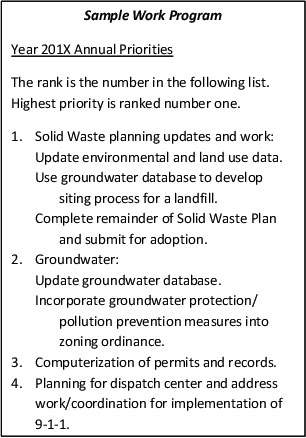 Ideally, along with the annual report, the planning commission should submit an annual work program to the legislative body in time to fit into the annual budget process. At its most basic level, a work program (also known as a work plan or plan of work) provides the planning commission, the legislative body, and the planning staff (if applicable) with a list of projects/initiatives to be accomplished in the coming year. At right, you can see a sample work program. Being similar to project management tools in the business sector, a work program describes the projects to be accomplished and outline show they will be done. It should go into enough detail to breakdown how individual project-related tasks will be accomplished and might include a timeline for completion and possibly cost projections.
Best practice suggests that a planning commission annually adopt its work program as the formal agenda for planning commission initiatives. Some communities have made the annual planning commission work program a requirement by including it in the planning commission ordinance. Best practice also suggests that the planning commission maintain along-term work program that spans two to six years and serves as a long-range or strategic plan for the planning commission.
This approach is similar to the Capital Improvement Program that many local governments are required to have under the MPEA, but focuses on activities and initiatives of the planning commission instead of infrastructure and capital expenditures of the local government (see MSU Extension news article Update your community’s Capital Improvement Program). A multi-year work program does not need to be adopted by the planning commission and can serve as a running, prioritized list of initiatives to be undertaken. When it is time to prepare next year’s annual work program, the running list of initiatives is referenced and the highest-priority items that can be accomplished in the coming year are included in the annual work program.
In conclusion, the planning commission work program is a recommended best practice that fits squarely between the required annual report and the planning commission budget. In other words, the annual report provides the necessary accountability back to the legislative body on how their funds were used in the past year and the work program proposes next year’s initiatives and provides a foundation for all or part of the budget request for the coming year. For example work programs from various Michigan planning commissions or planning and zoning departments, explore those detailed in the sidebar.
Work Program Examples
- Detroit City Planning Commission
- Gaines Charter Township Planning and Zoning Department
- Shelby Township Planning and Zoning Department
- Village of Clarksville Planning Commission