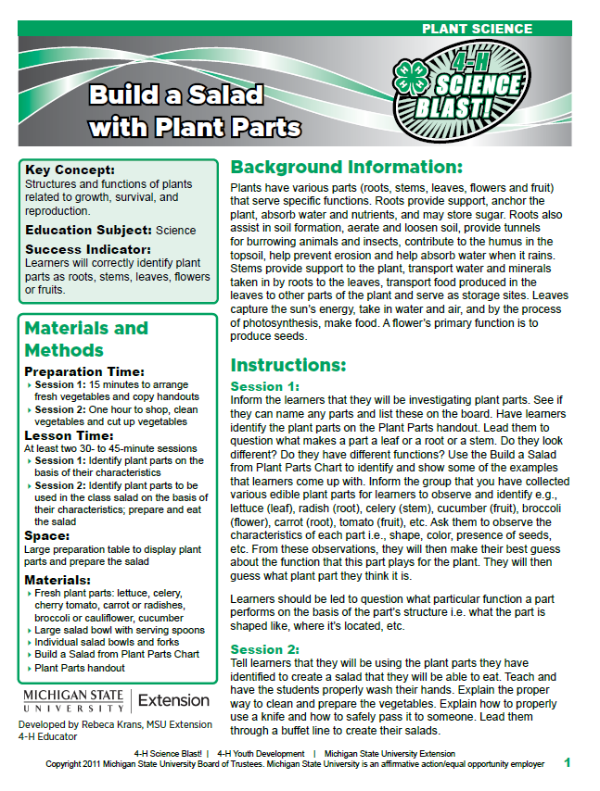
4-H Science Blast Activities: Build a Salad with Plant Parts
DOWNLOADNovember 2, 2026 - Michigan State University Extension
 Print
 Email
Educational Elements:
Key Concept:
Structures and functions of plants related to growth, survival, and reproduction.
Education Subject:
Science
Success Indicator:
Learners will correctly identify plant parts as roots, stems, leaves, flowers or fruits
Materials and Methods
Preparation Time:
- Session 1: 15 minutes to arrange fresh vegetables and copy handouts
- Session 2: One hour to shop, clean vegetables and cut up vegetables
Lesson Time:
At least two 30- to 45-minute sessions
- Session 1: Identify plant parts on the basis of their characteristics
- Session 2: Identify plant parts to be used in the class salad on the basis of their characteristics; prepare and eat the salad
Space: Large preparation table to display plant parts and prepare the salad
Materials:
- Fresh plant parts: lettuce, celery, cherry tomato, carrot or radishes, broccoli or cauliflower, cucumber
- Large salad bowl with serving spoons
- Individual salad bowls and forks
- Build a Salad from Plant Parts Chart
- Plant Parts handout
Background Information:
Plants have various parts (roots, stems, leaves, flowers and fruit) that serve specific functions. Roots provide support, anchor the plant, absorb water and nutrients, and may store sugar. Roots also assist in soil formation, aerate and loosen soil, provide tunnels
for burrowing animals and insects, contribute to the humus in the topsoil, help prevent erosion and help absorb water when it rains. Stems provide support to the plant, transport water and minerals taken in by roots to the leaves, transport food produced in the leaves to other parts of the plant and serve as storage sites. Leaves capture the sun’s energy, take in water and air, and by the process of photosynthesis, make food. A flower’s primary function is to produce seeds.
Instructions:
Session 1:
Inform the learners that they will be investigating plant parts. See if they can name any parts and list these on the board. Have learners identify the plant parts on the Plant Parts handout. Lead them to question what makes a part a leaf or a root or a stem. Do they look different? Do they have different functions? Use the Build a Salad from Plant Parts Chart to identify and show some of the examples that learners come up with. Inform the group that you have collected various edible plant parts for learners to observe and identify e.g., lettuce (leaf), radish (root), celery (stem), cucumber (fruit), broccoli (flower), carrot (root), tomato (fruit), etc. Ask them to observe the characteristics of each part i.e., shape, color, presence of seeds, etc. From these observations, they will then make their best guess about the function that this part plays for the plant. They will then guess what plant part they think it is.
Learners should be led to question what particular function a part performs on the basis of the part’s structure i.e. what the part is shaped like, where it’s located, etc.
Session 2:
Tell learners that they will be using the plant parts they have identified to create a salad that they will be able to eat. Teach and have the students properly wash their hands. Explain the proper way to clean and prepare the vegetables. Explain how to properly use a knife and how to safely pass it to someone. Lead them through a buffet line to create their salads.
Ways to Extend:
- Have learners act out a plant part and have other learners guess the part.
- Have students create plant parts out of materials you provide for them. Have them work in groups to present their plant parts to the rest of the groups, describing why they designed the plant parts the way they did e.g., show a very large leaf (adaptation) that will grow in a shaded area or at the ground level in the rain forest to capture as much light as possible. Introduce the term “adaptation” via problem solving by learners e.g., if a plant is continually mowed down, how does it ‘adapt’ to continue reproducing?
Learn more (optional):
Salad Bowl Experiment, MSU Children’s Garden at http://4hgarden.msu.edu/volunteer/sostraining.htm. Students test and rate various salad greens on characteristics such as taste, texture, etc.
Further Understanding:
- Do plant parts look different?
- Do plant parts have different functions?
- What are the functions of plant parts?
Vocabulary:
According to botany.com
Leaf – The part of the plant that ordinarily performs photosynthesis, the process that converts sunlight and carbon dioxide into energy.
Stem – The main axis of a tree, shrub or plant; trunk, stalk; the plant part that supports the leaves, flowers or fruits of a plant.
Flower – The part of the plant that ordinarily contains the reproductive organs, which are usually surrounded by colorful petals and sepals.
Root – The part of a plant, normally underground, that absorbs nutrients and anchors the plant into the ground.
Fruit – The reproductive product of a plant; the seed of plants, or the part that contains the seeds.
Humus – The organic residue of decayed vegetable matter in soil.