Aquatic Invasive Plant Identification Cards: Curly-leaf Pondweed vs. Clasping-leaf Pondweed
DOWNLOADSeptember 2, 2026 - Jo Latimore, Paige Filice, Erick Elgin, and Chelsea Cooper
 Print
Print Email
EmailWith its abundance of lakes, rivers, and wetlands, Michigan is vulnerable to the impacts of aquatic invasive plants. Invasive plants can negatively impact habitat, water quality, and biodiversity. Fortunately, new invasions can often be stopped if caught early. To help Michiganders identify invasive aquatic plants, Michigan State University Extension created a series of illustrated identification cards.
Learning to identify aquatic invasive plants is critical to slowing their spread in Michigan lakes, rivers, and wetlands. If your organization is interested in large quantities of any of these identification cards for distribution, they are currently available in packs of 100 of each design at no cost by filling out our request form at bit.ly/aiscards. You may also be interested in our more detailed 2025 publication, “Aquatic Invasive Plants: A Field Guide for Michigan Lakes, Streams, and Ponds.”
Curly-leaf Pondweed vs. Clasping-leaf Pondweed
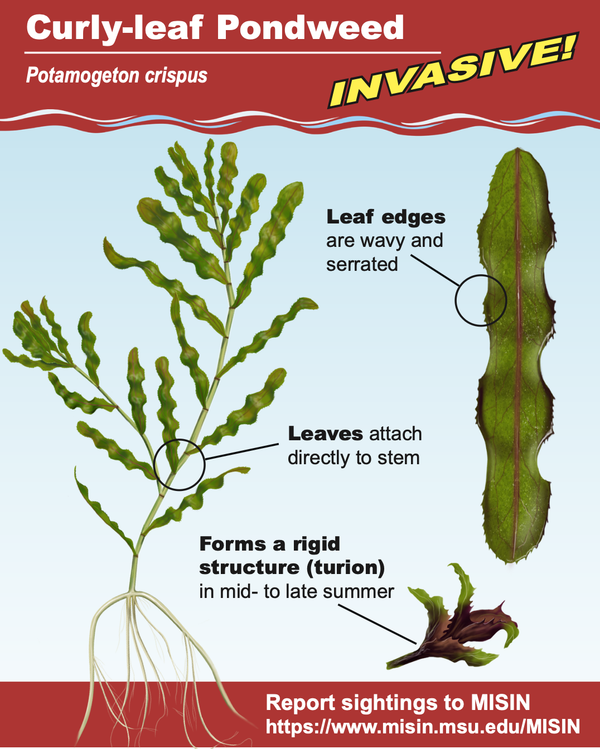
Curly-leaf pondweed is another well-established invasive plant in Michigan. It is sometimes confused with some of the over two dozen native Michigan pondweeds, but a few key characteristics set it apart. Curly-leaf pondweed is the only pondweed found in Michigan whose leaves have serrated edges. It gets its name from its wavy-edged leaves that resemble lasagna noodles. Curly-leaf pondweed forms a rigid, spiky structure called a turion in mid- to late summer for overwintering.