Biosecurity for County Fairs and Exhibitions
DOWNLOADMarch 25, 2026
 Print
Print Email
EmailKeeping fair families, the public and animals safe are top priorities at county fairs and animal exhibitions. When animals from different locations comingle, there is the chance that a disease or illness could be spread among animals and humans. Implementing biosecurity practices help minimize the risk of the introduction or spread of disease, help prevent potential outbreaks from happening.
1. Actions to consider prior to fair
-
- Prior to the fair, make sure that the animal facilities, pens and cages are cleaned and disinfected. Wild birds can transfer disease, while there is no way to eliminate contact with wild birds, cleaning and disinfecting prior to the start of your fair will reduce the instance of disease outbreaks.
- Emphasize bringing healthy animals to your fair and exhibition.
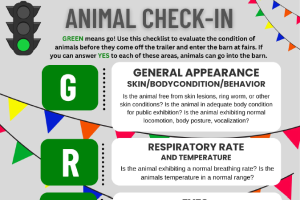
- Plan for a way to evaluate the health of the animals prior to unloading off the trailer and into the barns. This can be completed by a person knowledgeable in animal care.
- Common signs and symptoms to look for: coughing, sneezing, watery/matted eyes, nasal discharge, skin lesions.
- It is not recommended to take the temperature of every animal that enters the barn/fair, as this is time consuming and may unintentionally spread more disease, however if an animal is exhibiting any of the symptoms above, barn staff may want to consider taking the animal’s temperature.
2. Understand how viruses travel
Viruses travel through nose-to-nose contact, on things (fomites such as scales, feed pans, waterers) and on footwear, clothing and hands.
DISINFECT YOUR SCALE BETWEEN GROUPS OF ANIMALS! The scale plate is a high-risk area for virus particles; every animal going into the scale will touch this
-
- Use a disinfectant with a short contact time (accelerated hydrogen peroxide) and a hand sprayer to clean
- the scale plate between groups of pigs.
- Other items to disinfect sorting boards, wash areas, common wheelbarrows, shovels, etc.
- Have hand sanitizer readily available for those who are manning the scales to sanitize their hands between groups of animals.
3. Virus travel well when attached to something!
Virus travel well when attached to something!
-
- Consider the flake size of shavings that you use, the smaller the flake the dustier it is, the larger the flake the less absorbent, there is “happy” medium.
- If possible, keep bedding out of the alley/traffic paths. This will reduce dust that is created when animals/people walk through the barns.
- Especially on hot, dry days, consider wetting down the aisle ways and potentially the pens that animals are housed in, the fine mist created with the handheld sprayer works well.
4. Manage ventilation
When using fans in barns, make a plan to direct all air flow the same way. This allows for particle movement to move in one direction verses creating a “tornado” of dust/virus particles.
Routinely assess the need for fan use. If the temperature drops at night or a day is cooler, you may want to discontinue the use of fans during that time.
5. Potential methods that will help limit exposure to viruses
Limit the time animals are kept on the fairgrounds (72 hours or less is ideal). This will help prevent or interrupt the spread of influenza or other diseases between animals.
Developing traffic patterns for fair visitors that purposefully limits close contact between animals and people and areas where soiled bedding is housed.
Create a decision tree and plan to prepare for ways to close barns to the public if needed (i.e. if there is a animal potentially sick with influenza, neighboring livestock facility breaks with a disease).
6. Protecting our fair families and the public from zoonotic diseases
Zoonotic diseases are those that can be shared between animals and people, one of the most common being influenza. Promoting good hygiene to fair families and guests is important and one of the best protective measures that we can take.
- Have clean, fresh signage posted that promotes good hygiene.
- Washing hands after being around animals.
- Do not eat or drink in the barn.
- Those with compromised immune systems should take care when visiting animal exhibitions.
Station and maintain hand washing and hand sanitizer stations close to animal exhibits.
Use proper precautions when milking exhibitions are held. Exhibitors and staff responsible for milking should wear appropriate PPE when handling the product. Precautions to limit public exposure to raw products should be taken (incorporate viewing windows or Plexiglas in areas where milking is done).
Identify potential areas where animals that may be showing symptoms of illness can be housed away from other animals and the general public.
7. Where can I find help?
- https://www.canr.msu.edu/fair-and-exhibition-animal-health/
- https://www.canr.msu.edu/swine_influenza/
- https://www.michigan.gov/mdard/animals/exhibitions/resources-for-exhibitions
- https://www.canr.msu.edu/protecting-animal-health/
Resource People
- Janelle Stewart; MSU Extension Children Youth and Families Educator, stewa191@msu.edu
- Beth Ferry; MSU Extension Agriculture and Agriculture Business Educator, franzeli@msu.edu
- Katie Ockert; MSU Extension Community, Food & Environment Institute, ockertka@msu.edu