Bulletin E3549
Blueberry Irrigation Management
DOWNLOAD
September 22, 2026 - Younsuk Dong, Joshua Vander Weide, Brenden Kelley, Angie Gradiz, Cheyenne Sloan, Carlos Garcia-Salazar, Lyndon Kelley, Michigan State University Extension
 Print
Print Email
Email1. Introduction
Michigan is one of the leading producers of highbush blueberries in the United States. Production is concentrated along the Lake Michigan shoreline, where sandy soils and the lake’s moderating influence historically created ideal growing conditions. While irrigation was once primarily limited to frost protection in the region, increasing climate variability combined with the highly permeable nature of local soils now makes consistent irrigation an essential management practice.
Blueberries possess shallow, fibrous root systems, concentrated within the upper 12 inches of soil, rendering them highly sensitive to both drought stress and excessive moisture. Therefore, effective irrigation management is critical. It not only ensures optimal soil moisture and nutrient uptake but also significantly reduces plant stress, enhances fruit size, quality, and sugar content, all while promoting the responsible use of water resources.
What are the consequences of water stress? Water stress, whether caused by insufficient irrigation (drought stress) or excessive irrigation (waterlogging and overwatering), can profoundly affect blueberry plant physiology, fruit quality, crop productivity, and environmental sustainability.
Impact on plant health and development: Insufficient water during critical stages can have severe repercussions. During flowering and fruit set, it can impair pollination and initial plant growth. As the fruits develop, stress leads to smaller berries, increased fruit drop, and reduced sugar accumulation. Chronic water stress further hinders shoot growth, limits bud formation for the subsequent season, and heightens susceptibility to pests and diseases.
Moreover, the combination of heat stress and water deficit can exacerbate conditions, causing leaf scorching and defoliation. Critically, young plants experiencing water stress may suffer irreversible damage, affecting their long-term recovery and productivity. Excessive soil moisture can be equally damaging. Saturated soils reduce oxygen availability in the root zone, impairing root function and nutrient uptake. Prolonged waterlogging may promote root diseases such as Phytophthora root rot, reduce plant vigor, and limit long-term productivity. Young plants are particularly vulnerable to both drought and excessive moisture, which can cause lasting damage and hinder establishment.
Direct yield and quality reductions: The economic impact of water stress is substantial. Research demonstrates that highbush blueberries under drought stress can experience yield reductions ranging from 20% to 60%, with variability depending on the stress’s timing, duration, and severity.
Beyond yield losses, inadequate or inconsistent irrigation can result in uneven fruit ripening, smaller berry size, reduced sugar accumulation, and diminished pack-out quality across the field. Conversely, excessive irrigation can leach nutrients below the root zone, reducing fertilizer-use efficiency and increasing production costs. Over-irrigation may also contribute to runoff, soil erosion, and degradation of nearby water resources. Therefore, effective irrigation scheduling is essential not only for maximizing yield and fruit quality but also for promoting efficient water and nutrient use while minimizing environmental impacts.
2. Irrigation Systems
2.1. Sprinkler Irrigation
Sprinkler irrigation is a widely adopted method in blueberry production, especially for mature plantings and critical spring frost protection. These systems typically operate within a pressure range of 20–60 psi, with flow rates varying based on nozzle size, sprinkler head spacing, and desired coverage. Achieving uniform pressure and correct spacing is paramount for even water distribution across the field.
A key advantage of sprinklers is their full-surface coverage, which is beneficial for cooling plants during periods of high temperatures. Additionally, light sprinkler applications during dry spells can effectively activate herbicides or fungicides.
However, efficiency can be compromised by water loss due to evaporation and wind drift. The uniformity of water application is influenced by several factors, including sprinkler type, layout design, prevailing wind conditions, and consistent maintenance. Regular inspection for clogged nozzles and broken components is therefore essential to ensure optimal performance. The specific advantages and disadvantages of typical sprinkler systems are detailed in Table 1.
2.2 Drip Irrigation
Drip irrigation is increasingly adopted for its exceptional water use efficiency and precise delivery directly to the plant’s root zone, which minimizes water waste and suppresses weed growth. Other micro-irrigation systems, such as micro-sprinklers and spray stakes, are also used in some blueberry plantings, particularly during establishment or when a larger wetted soil volume is desired. Achieving adequate wetting of the active root zone requires proper emitter spacing. Drip systems typically operate at 10-20 psi, with emitters available in a range of discharge rates, typically 0.5-2.0 gallons per hour (gph). The appropriate emitter flow rate is selected based on plant size, spacing, soil characteristics, and irrigation requirements. When properly designed and maintained, drip irrigation offers high uniformity. However, continuous filtration is essential for reliable system performance, with simple screen or disc filters often being sufficient for blueberry production systems.
Periodic flushing is also crucial to remove accumulated sediments, debris, and mineral deposits that can obstruct flow and reduce performance.
Drip irrigation can be implemented as either surface drip (on or above ground) or subsurface drip (buried below the soil surface). Surface drip is easier to install, inspect, maintain, and monitor for water application but carries a higher risk of damage from equipment or animals. Subsurface drip offers advantages such as reduced evaporation and minimal interference with field operations. However, clogging and leaks are more difficult to detect and correct in subsurface systems, and installation is generally more complex than surface drip.
Both surface and subsurface drip systems apply water directly to the soil, eliminating the evaporative losses and surface wetting associated with overhead sprinklers. This direct application also minimizes interference with other field operations such as harvesting and pesticide application, allowing workers to safely and comfortably tend to the crop while the system is running.
A key challenge in drip irrigation is designing and managing the system so that the wetted soil volume matches the crop’s active root zone. On sandy soils with low water- holding capacity, applying sufficient water without excessive drainage can be problematic. Because water is delivered via emitters, the application is relatively confined in surface area compared to overhead methods. However, the minimal evaporative loss with drip allows for smaller, more frequent water applications. Drip irrigation can also be ‘pulsed’ to provide the crop more time for water uptake before it moves beyond the root zone.
Table 1. Comparison of sprinkler irrigation systems
| Sprinkler type | Advantages | Disadvantages |
|---|---|---|
| Overhead sprinklers |
|
|
| Micro-sprinklers |
|
|
Depending on application rate, crop size and variety, and soil type, a single drip line might suffice to meet the crop’s evapotranspiration (ET) needs. If water is consistently moving below the active root zone to achieve adequate volume, solutions include adding a second drip line on the opposite side of the row or using a line with closer emitter spacing.
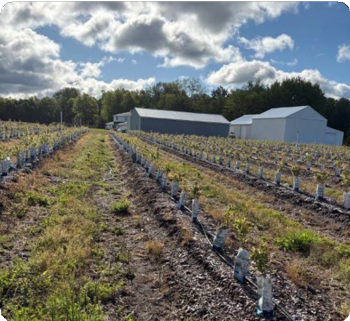
These adjustments provide greater control over application depth, optimizing efficiency since most root activity occurs in the upper soil layers. Furthermore, by placing more emitters within the rooting area, plants gain better access to water and, consequently, nutrients, as roots require water for nutrient uptake. A typical drip installation is illustrated in Figure 1.
3. Water Requirement by Growth Stage
Blueberry water needs vary across their phenological stages (Table 2) (Bryla et a., 2011). For instance, daily irrigation may be necessary during periods of peak growth, especially in sandy soils with limited water retention. Furthermore, maintaining consistent moisture is critical during the fruit swelling stage to maximize both size and quality.
Table 2. Blueberry irrigation requirements by developmental stage. (Source: https://www.canr.msu.edu/blueberries/growing_blueberries/growth-stages)
| Stage | Irrigation Requirement |
|---|---|
| Bud Break to Flowering | 0.1–0.2 inches/day |
| Flowering to Fruit Set | 0.2–0.3 inches/day |
| Fruit Development | 0.25–0.35 inches/day (peak demand) |
| Post-Harvest | 0.1–0.2 inches/day |
4. Irrigation Scheduling
4.1 Berrigation
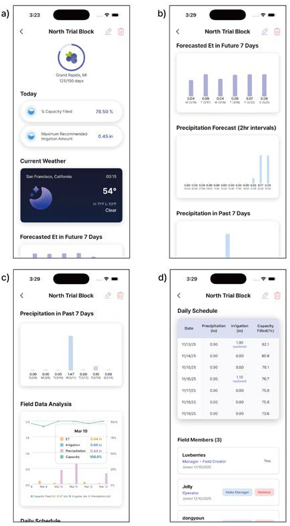
Berrigation is a mobile application designed to optimize irrigation scheduling by estimating crop water use through reference evapotranspiration (ET) and crop coefficients (Kc). The app sources ET data directly from the National Oceanic and Atmospheric Administration (NOAA).
To set up a field, users input the field’s location and name, soil type (derived from the USDA Soil Survey), irrigation system type (sprinkler or drip), and the bud break date. Berrigation also facilitates collaborative field management with “manager” and “operator” roles, allowing managers to invite additional users via email to access and manage specific fields.
Within the Daily Schedule table, users can adjust the water balance by entering irrigation amounts or overriding precipitation values as needed. For drip irrigation systems, the app requires additional inputs, including plant canopy diameter, the number of emitters per plant, and the emitter flow rate, to accurately calculate the wetting zone.
Ultimately, Berrigation provides daily irrigation recommendations to ensure optimal soil moisture levels are maintained throughout the growing season. Examples of app’s interface are presented in Figure 2. Berrigation is available for download on both the Apple App Store and Google Play Store through the link.
4.2 Soil Moisture-Based Irrigation Management
Soil moisture sensors, such as tensiometers and capacitance probes, provide real-time monitoring capabilities that are crucial for preventing both over-irrigation and waterlogging. For sandy soils, optimal tension thresholds typically range from -10 to -25 kPa. This approach to irrigation scheduling ensures water is applied only when truly needed, thereby significantly improving water use efficiency.
When implementing soil moisture-based management, it is essential to consider the specific mode of operation for each sensor type, as data interpretation can vary. Table 3 provides an overview of commonly used sensors, detailing their operating principles and associated costs.
Table 3. Soil moisture sensor comparison.
| Sensor type | Operating principle | Cost (approximate) |
|---|---|---|
| Time Domain Reflectometer (TDR) | Measures the travel time of an electromagnetic pulse along two parallel rods inserted into the soil. Soil moisture influences the soil’s dielectric properties, affecting pulse travel time. | Moderate to high ($300–$2,200) |
| Frequency Domain Reflector (FDR)/Capacitance | Uses the soil as a dielectric, measuring its capacitance by running an electrical current through electrodes. As soil moisture increases, the soil’s ability to transmit current changes, altering the frequency of the wave passing through the soil. | Low to high ($50–$2,000) |
| Tensiometer | Directly measures soil matric potential. A water-filled tube with a porous ceramic cup is inserted into the soil. As soil moisture decreases, the soil tension draws water out, creating a vacuum measured by a gauge. | Low ($80–$200) |
| Granular matrix | Indirectly measures soil matric potential. Detects electrical resistance between electrodes embedded in a granular matrix (often gypsum). As soil moisture decreases, the resistance with the matrix increases. | Low (Starting at $40 per sensor) |
4.3. Pulsed Irrigation Management
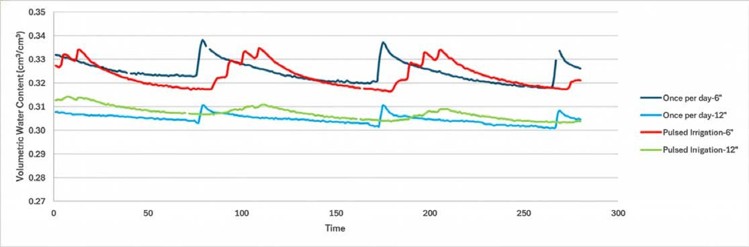
Pulsed irrigation, which involves delivering water in short, repeated bursts, can be effectively implemented using timer-controlled, solenoid-triggered irrigation valves. Rather than applying the entire irrigation amount in a single event, the daily irrigation requirement can be divided into multiple applications throughout the day. In our trial study, irrigation was applied in four pulses per day. This method offers significant benefits by reducing runoff and enhancing water use efficiency, particularly in sandy soils or on sloped fields.
For pump-driven systems, a Variable Frequency Drive (VFD) is often essential to support pulsed irrigation. VFDs regulate the pump’s motor speed based on flow demands, thereby maintaining consistent pressure during frequent on/ off cycles. This prevents pump wear and mitigates pressure surges commonly associated with pulsed applications.
Soil moisture monitoring is highly recommended when employing pulse irrigation. It provides real-time data on how efficiently the soil retains water between pulses, helping operators to fine-tune irrigation timing and duration. This precision ensures crop water needs are met without over- or under-watering. While both once-per-day and pulsed irrigation treatments may deliver the same total daily water volume, pulsed irrigation helps maintain soil moisture within a narrower range and closer to the desired target level throughout the day. This can reduce periods of excessive wetting followed by drying, particularly in coarse-textured soils where water can rapidly move below the root zone.
5. Irrigation Water Use by Cultivar
While blueberry cultivars exhibit varying irrigation water requirements, specific recommendations remain limited. Differences in root system architecture, rooting depth, and root-to-shoot ratio can influence how cultivars access and utilize soil water. The root-to-shoot ratio describes the balance between water-absorbing roots and transpiring canopy, affecting a plant’s ability to meet water demand during periods of high evaporative stress. For example, ‘Bluecrop’ often displays a smaller root system and root- to-shoot ratio, whereas ‘Elliott’ and ‘Draper’ are known for larger root systems and ratios. Cultivar differences in canopy development may also influence water use by altering transpiration demand. Cultivars such as ‘Legacy’, ‘Calypso’, and ‘Envoy’ may exhibit relatively low root-to-shoot ratios because canopy growth can outpace root development. As a result, cultivars with relatively large canopies in relation to their root systems may be more susceptible to short- term water deficits, particularly during hot, dry conditions.
Consequently, irrigation management should be tailored to each cultivar’s growth characteristics. Cultivars with smaller or shallower root systems may not necessarily require greater irrigation volumes, but they may benefit from more frequent, smaller irrigation applications to maintain adequate soil moisture within the active root zone and sustain stem and leaf turgor. Conversely, cultivars with larger or deeper root systems may be able to access a larger volume of soil water and tolerate longer intervals between irrigation events. Understanding these cultivar-specific differences can help growers optimize irrigation scheduling and improve water- use efficiency.
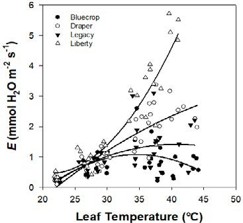
Differences in cultivar water use are less pronounced under moderate or cool weather conditions but become more significant during abnormally hot periods (>90°F/ 32°C). High air temperatures amplify variations in leaf transpiration, as each cultivar exhibits a unique strategic response to heat stress (Figure 4). While precise assessment of plant water status in hot conditions often requires complex instrumentation like a Scholander pressure chamber, growers can utilize a simpler indicator—leaf temperature. Under adequate irrigation, plants transpire, allowing leaves and the canopy to remain cooler than the surrounding air. Conversely, insufficient soil water causes stomata to close, reducing transpiration and leading to an increase in leaf temperature. Therefore, a simple touch test can help growers gauge irrigation adequacy: if the leaf feels cooler the ambient air, the plant is likely well-hydrated.
6. Irrigation Water Quality
Blueberries require acidic soil to thrive, with an ideal pH range between 4.0 and 5.5. While rainfall is an ideal water source because of its low dissolved mineral content, increasingly erratic rainfall patterns in Michigan often necessitate supplemental irrigation. Irrigation water may be obtained from groundwater wells or surface water sources such as ponds, lakes, streams, and rivers. Because water quality varies among sources, routine testing is recommended to evaluate parameters such as alkalinity, dissolved minerals, and potential contaminants.
For blueberries, water alkalinity is more important than water pH. Alkalinity measures the concentration of bicarbonates and carbonates and reflects the water’s ability to neutralize acidity and resist changes in pH. Water with a high pH but low alkalinity may have little effect on soil pH, whereas water with high alkalinity can gradually increase soil pH over time (Fernandez, 2018). Many groundwater sources in Michigan contain elevated alkalinity due to naturally occurring carbonate and bicarbonate minerals associated with regional limestone-derived geologic materials. Repeated irrigation with high-alkalinity water can raise soil pH above the optimal range for blueberries, reducing the availability of essential nutrients such as iron and manganese and leading to nutrient deficiency symptoms. In contrast, rainwater typically has very low alkalinity and therefore contributes little to long- term changes in soil pH. Consequently, regular monitoring of irrigation water alkalinity and soil pH, along with periodic applications of elemental sulfur when needed, are essential for maintaining favorable growing conditions for blueberry production.
Salinity also presents a critical concern. High salinity levels in irrigation water stress blueberry plants and can lead to reduced yields. Recommended upper thresholds for safe use include an electrical conductivity (EC) of 1.0 dS/m and total dissolved solids (TDS) of no more than 640 ppm. Exceeding these thresholds can lead to detrimental salt buildup in the root zone, particularly in poorly drained soils or under frequent irrigation.
Furthermore, certain elements in irrigation water can be harmful in high concentrations. Boron levels exceeding 1 ppm, chloride above 70 ppm, and sodium above 46 ppm can all damage blueberry plants. Regular water testing is therefore advised to monitor these elements, along with alkalinity, pH, salinity, sodium adsorption ratio (SAR), residual sodium carbonate (RSC), and lime deposition potential (LDP).
References
Bryla, D., et al. (2011). Evaluation of irrigation methods for highbush blueberry—I. Growth and water requirements of young plants. HortScience. 46(1):95-101.
Carroll, J.L., et al. (2024). Weather-based scheduling and pulse drip irrigation increase growth and production of northern highbush blueberry. HortScience. 59(5):571–577.
Fernandez, T. (2018). Water alkalinity and pH: What they mean in regards to water quality. Michigan State University Extension Article. https://www.canr.msu.edu/news/water_alkalinity_and_ph_what_ they_mean_in_regards_to_water_quality
Rett-Cadman, S., and Vander Weide, J. (2026). Leaf photosynthetic and morphological traits underlie heat stress resilience in northern highbush blueberry (Vaccinium corymbosum L.). Environmental and Experimental Botany. 243, 106327.