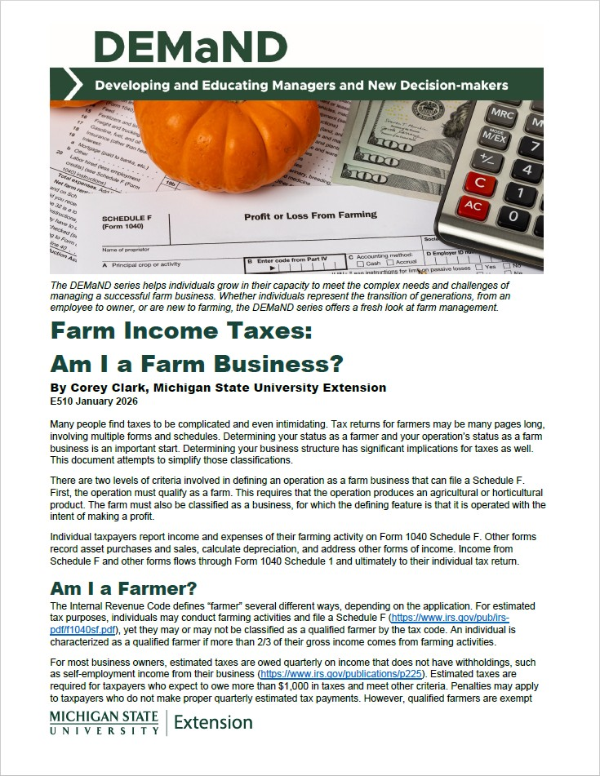
Bulletin E-3510
Bulletin E-3510 Farm Income Taxes: Am I a Farm Business?
DOWNLOAD
January 26, 2026 - Corey Clark
 Print
Print Email
EmailMany people find taxes to be complicated and even intimidating. Tax returns for farmers may be many pages long, involving multiple forms and schedules. Determining your status as a farmer and your operation’s status as a farm business is an important start. Determining your business structure has significant implications for taxes as well. This document attempts to simplify those classifications.
There are two levels of criteria involved in defining an operation as a farm business that can file a Schedule F. First, the operation must qualify as a farm. This requires that the operation produces an agricultural or horticultural product. The farm must also be classified as a business, for which the defining feature is that it is operated with the intent of making a profit.
Individual taxpayers report income and expenses of their farming activity on Form 1040 Schedule F. Other forms record asset purchases and sales, calculate depreciation, and address other forms of income. Income from Schedule F and other forms flows through Form 1040 Schedule 1 and ultimately to their individual tax return.
Am I a Farmer?
The Internal Revenue Code defines “farmer” several different ways, depending on the application. For estimated tax purposes, individuals may conduct farming activities and file a Schedule F (https://www.irs.gov/pub/irs-pdf/f1040sf.pdf), yet they may or may not be classified as a qualified farmer by the tax code. An individual is characterized as a qualified farmer if more than 2/3 of their gross income comes from farming activities.
For most business owners, estimated taxes are owed quarterly on income that does not have withholdings, such as self-employment income from their business (https://www.irs.gov/publications/p225). Estimated taxes are required for taxpayers who expect to owe more than $1,000 in taxes and meet other criteria. Penalties may apply to taxpayers who do not make proper quarterly estimated tax payments. However, qualified farmers are exempt from these penalties if they file one estimated payment by January 15 or file their return and pay any tax due by March 1 (https://www.irs.gov/publications/p225).
Example: Sam Spinnelli has a layer farm which generates gross farm income of $20,000 on his Schedule F. He also has a part-time job at which he earns $30,000 per year. As a result, Sam has $20,000 of gross income from farming and $30,000 of gross farm income from nonfarm sources. Since only 40% of his gross income comes from farming, he is not classified as a qualified farmer. If he expects to owe more than $1000 in taxes and meet other criteria, then he must file quarterly estimated taxes.
|
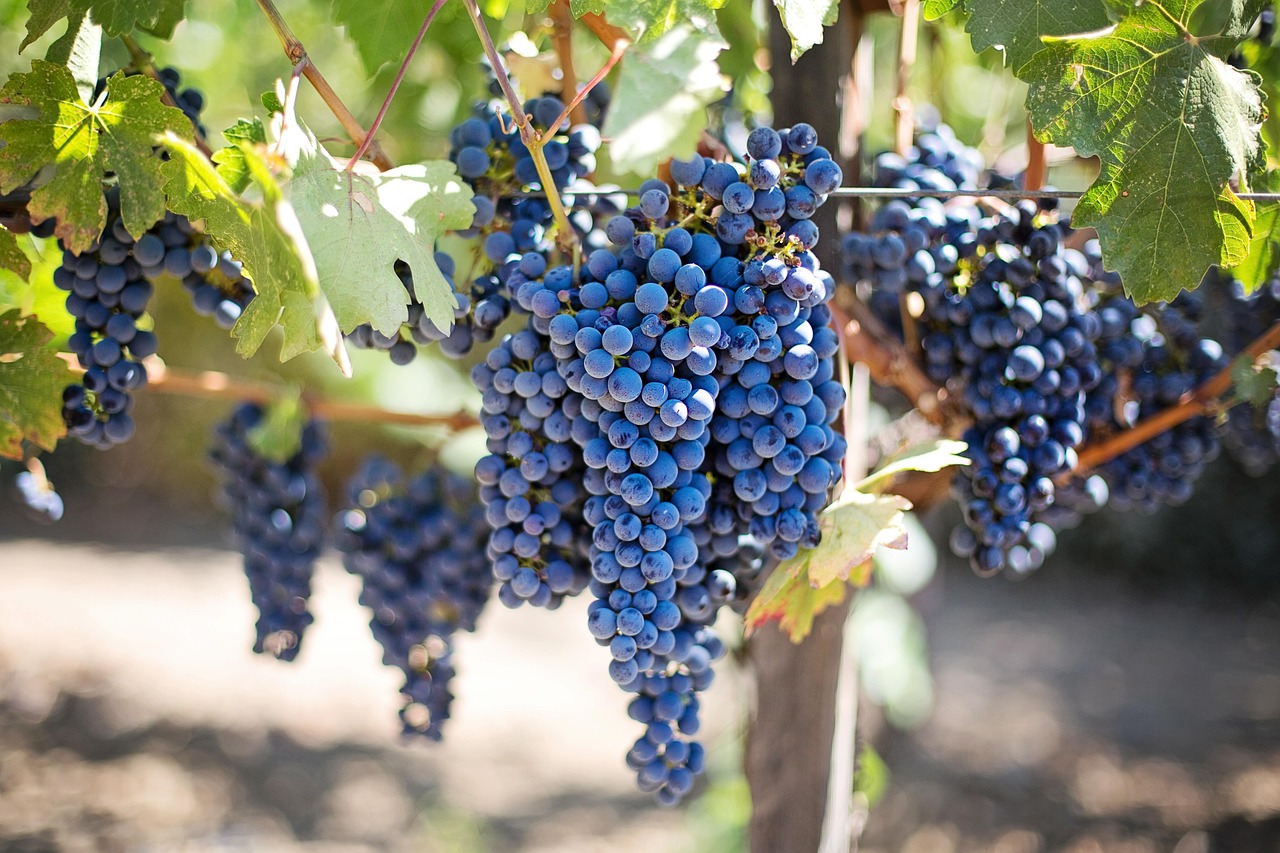
Figure 1. Grapes in a vineyard. Photo credit: pixabay.com/photos/grapes-vines-grapevine-vineyard-553464/ |
Am I a Farm?
The Internal Revenue Service characterizes an operation as a farm based on two criteria – whether the income was earned from production activities and whether the taxpayer materially participated in these activities.
The Internal Revenue Service defines a farm as an operation that produces an agricultural or horticultural product. IRS Publication 225 notes that “A farm includes livestock, dairy, poultry, fish, fruit, and truck farms. It also includes plantations, ranches, ranges, and orchards” (https://www.irs.gov/publications/p225). Thus, operations producing milk, livestock, fruit, and other agricultural or horticultural products would be classified as farms. Farms report their income and expenses on Form 1040 Schedule F (unless they are a subchapter C corporation). Operations processing those same products (jelly, cider, and wine are examples) would not be considered farms. Instead, these businesses report their income and expenses on Form 1040 Schedule C. Farms often conduct multiple activities, some of which may be farming activities and some non-farm activities. These farms need to work with their tax preparer to properly classify their income and report on the appropriate farm and nonfarm business tax forms.
Example: Angus Acres raises purebred cattle to sell bulls and embryos. Their revenues are derived from products they have produced. Angus Acres is considered a farm and will file a Schedule F with the farm’s income and expenses.
Example: Claymore Orchards produces apples both for wholesale and for processing into apple cider to sell with homemade doughnuts at its farmstand. Claymore will need to work with their tax preparer to divide their income and expenses between farm (Schedule F) and nonfarm (Schedule C) tax forms.
Am I a Farm Business?
All farm businesses and hobby farms must report the income earned from farming activities. Farming operations that are considered businesses are allowed to deduct their operating expenses on Form 1040 Schedule F (https://www.irs.gov/pub/irs-pdf/f1040sf.pdf). However, certain farms may be classified as a hobby farm that is not a business. The IRS distinguishes between farm businesses and hobby farms by several factors, including their intent to make a profit. Farm businesses must demonstrate that they have a profit motive, while hobby farms would be judged not to have a profit motive. For hobby farms, the operator must report their farm income but cannot deduct most farm expenses.
The IRS uses multiple criteria to determine whether the farm operates with a profit motive. If the farm is profitable in three of the last five years, the IRS will presume a profit motive. Some horse farms can achieve this presumption with a profit in two of the last seven years. However, a farm does not need to be profitable for the IRS to determine that the operator is farming with the intent of making a profit. The IRS uses nine criteria to evaluate the profit motive. These criteria are evaluated together, not by any individual factor alone.
Nine Criteria of Profit Motive
|
Criterion |
Description |
|
1. Does the operator manage the farm in a businesslike manner? |
Evaluate recordkeeping, business planning, and management practices aimed at improving profitability. |
|
2. Does the taxpayer and their advisors have the necessary expertise? |
Assess the operator's expertise and that of their advisors, along with whether recommended practices are followed. |
|
3. How much time and effort is the taxpayer putting into the farm business? |
Evaluate the individual's level of involvement and effort dedicated to the farm operation. |
|
4. Does the taxpayer own assets that are likely to appreciate in value? |
Consider whether land and other farm assets are expected to increase in value over time. |
|
5. Has the taxpayer had success with other activities in the past? |
Review the operator’s past business ventures for evidence of profit‑seeking success. |
|
6. What is the farm’s history of income or losses? |
Assess historical patterns of farm income and losses, acknowledging risks such as weather and markets. |
|
7. How do the profits from good years compare with the losses in bad years? |
Compare the size of profits in good years with losses in bad years to determine overall profitability. |
|
8. Is the farm a significant source of income for the taxpayer? |
Consider whether the farm provides a significant share of the taxpayer’s total income. |
|
9. How much personal pleasure or recreation is involved in the farm? |
Evaluate the extent to which the farm includes recreational or personal‑pleasure activities. |
Table 1: Nine questions and descriptions that illustrate the criteria of profit motive used by the Internal Revenue Service (IRS).
The nine criteria of profit motive are further defined below:
- Does the operator manage the farm in a businesslike manner? A key component of meeting this criterion is maintaining complete and accurate records, including a separate checkbook for the farm business, ideally in the farm business’s name. A business plan can also provide relevant documentation. In addition, the IRS evaluates whether management practices adapt as needed to improve profit.
Ex: Lonnie sells his produce at the local farmers market and efficiently manages his expenses. His management is consistent with his business plan. He has a separate bank account in the farm’s name in which only farm transactions take place, and he uses this information each year to assess his profit and update his management. Lonnie’s management of the farm business is consistent with a profit motive.
- Does the taxpayer and their advisors have the necessary expertise? The farm operator should have some expertise in the relevant areas of production and the business of farming. The professionals they consult should be experts in their area. Further, the farmer should generally follow recommended practices.
Ex: Sam is transitioning from working as an engineer to now engaging in vegetable farming. Sam attends Extension meetings about vegetable production and marketing planning. They also work with their input sales personnel to determine the best chemical, seed, and fertilizer to use. Sam’s farming activities are consistent with a profit motive.
- How much time and effort are the taxpayer putting into the farm business? The farmer must demonstrate that their balance of business, management, outside work, and personal activities are consistent with the intention of making a profit on the farm. It is also legitimate to hire management employees for time that they are not able to be present.
Ex: Theresa raises goats and sells their milk. She does most of the labor on the farm, feeding and tending to the animals as well as managing marketing and sales. She has hired a few employees but recently quit her job in order to make adequate time for working on her farm. Theresa’s farming activities are consistent with a profit motive.
- Does the taxpayer own assets that are likely to appreciate in value? Many farms use land, livestock, or other assets in farming that they can expect to grow in value. This appreciation in value can compensate for lower income in some farming years because the combination will ultimately generate a net profit. It is important, however, that the farm income covers its variable costs.
Ex: The Townsend Family Partnership owns 1200 acres of land on which they plant corn and soybeans each year. Although the farm has not made a significant profit in recent years, the land value has continued to grow. The farm business is consistent with a profit motive.
- Has the taxpayer had success with other activities in the past? If the farm operator previously had a different business venture, the IRS might use performance of the prior ventures as evidence of a profit motive.
Ex: Kara has entered into dairy farming, and the venture has been only marginally profitable with losses in a number of years. However, she previously had a dog kennel business that was successful until market changes due to the pandemic forced her to close. Kara’s previous business activities can be evidence of a profit motive.
- What is the farm’s history of income or losses? While losses are expected in the start-up phase of a business, profits should improve in later years. However, the IRS acknowledges that farming carries a number of risks. Additional losses may occur due to circumstances beyond the owner’s control like weather disasters, disease, or low prices.
Ex: Aaron has been row crop farming for six years and has only made a profit in one of those years. The first few years were expected losses in his start-up phase. He made a significant profit in his fourth year. However, the planting got rained out the next year, and then crop prices dropped, resulting in another year without a profit. These losses do not disqualify Aaron from being found to have a profit motive because he was in a start-up phase at the beginning and more recently was affected by circumstances beyond his control.
- How do the profits from good years compare with the losses in bad years? This criterion evaluates the size of profits in profitable years against the size of losses in unprofitable years. The presence of small profits in some years followed by large losses in other years may weigh against the determination of a profit motive. It is important to note, however, that all nine criteria are weighed together in the determination of a profit motive.
Ex: Evelyn became a partner in an apple orchard six years ago. Despite their best efforts, the orchard has been unprofitable for four years. However, the two years of profit were substantial compared to the losses in the other four years. This is consistent with a profit motive.
- Is the farm a significant source of income for the taxpayer? The balance of farm vs non-farm income is considered in evaluating a profit motive. Relying on the farm for most of one’s livelihood is evidence of a profit motive. If the farm is a minimal source of the taxpayer’s income, especially accompanied by significant losses, it may be evidence that the farm does not have a profit motive.
Ex: Jason worked in retail for 10 years but quit his job two years ago to farm full-time. He has more than doubled his cattle operation in the past few years and is now relying on the farm for most of his family’s income. Jason’s farming activities are consistent with a profit motive.
- How much personal pleasure or recreation is involved in the farm? The IRS acknowledges that farmers often prefer the lifestyle and activity of a farm. However, they also want to ensure that the farm is primarily intended to earn a profit and not an attempt to deduct recreational expenses.
Ex: Thomas has owned a horse for years whose main purpose is pleasure riding by him and his daughters. He boards three horses for neighbors with whom he rides trails. He does not supply food or tack for the neighbors’ horses. Rather, they primarily feed and ride their own horses. Thomas’s farming activities are not consistent with a profit motive.
When Do I Start Being a Farm Business?

|
Figure 2. Flowers in a greenhouse. Photo credit: https://www.pexels.com/photo/man-looking-at-flowers-6508537/ |
Farms in the start-up phase are often unprofitable despite their intent to make a profit. The IRS acknowledges that the start-up phase may not generate a profit and uses the nine criteria to assess the profit motive. In starting a farm business, it is essential that the operation be treated like a business. A farmer or farm business cannot file a Schedule F until they have started production. Generally, this means they have received income from their operations. However, production expenses may begin before income is received.
Ex: Jenson has planted and harvested his first crop of soybeans. He treats his farm as a business and can demonstrate a profit motive. He has sold some, but not all, of the crop he produced in the current tax year. Jenson has a farm business and can file a Schedule F with his farm income and expenses.
Ex: Elizabeth has purchased a tractor and supplies for fencing her pastures. She can demonstrate intent to make a profit but has not yet planted her pasture or purchased cows. Elizabeth will not file a Schedule F this year but may be able to depreciate her tractor and fencing in future years.
Special rules exist for perennial crops and orchards. Expenses required to grow a plant prior to the start of production, such as establishment of a vineyard, must be held until production begins. Some of these expenses can be deducted in the year that production starts, but the rest must be amortized.
Farm Business Structures
|
|
LLC |
C Corp |
S Corp |
Sole Proprietor |
Partnership |
|
|
Formation |
Easy to Form/Exit |
✓ |
✓ |
✓ |
||
|
Organizing documents required |
✓ |
✓ |
||||
|
Annual meetings are required |
✓ |
✓ |
||||
|
One owner is okay |
✓ |
✓ |
✓ |
✓ |
||
|
Benefits |
Can sell or transfer entity to others |
✓ |
✓ |
✓ |
||
|
Personal liability is protected |
✓ |
✓ |
✓ |
|||
|
Owners can make a profit |
✓ |
✓ |
✓ |
✓ |
||
|
Tax Implications |
Entity does not have to pay taxes |
✓ |
✓ |
✓ |
||
|
Potential self-employment tax savings |
✓ |
|||||
|
Can elect to be taxed as a corporation |
✓ |
|||||
Table 2: Farm business structures compared by formation, benefits, and tax implications. A simplified version of the Entity Comparison Chart found in SARE’s Farmers’ Guide to Business Structures: https://www.sare.org/wp-content/uploads/Farmers-Guide-to-Business-Structures.pdf.
There are many choices for the business structure of a farm. Individuals may choose to operate their farm as a sole proprietorship, a single member corporation or a single member Limited Liability Company (LLC). Jointly owned farms may choose to operate their farm as a partnership, corporation, or LLC. LLCs are allowed by state laws and choose how they wish to be taxed. Certain business structures, such as partnerships and corporations, may be required to file separate income tax forms from their owners.
Sole Proprietorship
Many farm businesses owned by individuals are structured as a sole proprietorship, meaning that the individual farmer owns the farm assets and is responsible for the farm operations. Individuals can farm as a sole proprietorship with or without employees. Owners of sole proprietorships file Form 1040 Schedule F to report farm profit or loss, in addition to their individual income tax return (https://www.irs.gov/pub/irs-pdf/f1040sf.pdf). The advantage of a sole proprietorship is that it is easy to form and easy to exit. However, sole proprietors may be subject to significant liability from the farm operation.
Ex: Emily has a small produce farm that she solely owns. She owns the business assets and employs two other individuals on her farm. All income and expenses are in her name. Emily has a dedicated business checking account and operates her business with an intent to generate a profit. She files Form 1040 Schedule F to report her farm income and expenses. The profit or loss from her Schedule F is reported on Form 1040 Schedule 1.
Partnership
Jointly owned farms can operate as a partnership. Business assets are owned by the partnership rather than the individual owners or partners, and the business is operated by the partners acting as agent for the partnership. Owners of a partnership should have an operating agreement to define management and financial divisions as well as exit provisions. Employees may be hired by the partnership, but the partners cannot be employees. All income and expenses are in the partnership’s name which the partnership reports on its own Schedule F. Each partner’s share of partnership profit or loss is reported on Form 1065 Schedule K-1. A partnership is considered a pass-through entity, meaning that even though a partnership is required to file an income tax return, the partnership does not typically pay income tax. Instead, the income tax is paid by each partner on their individual tax return.
Like a sole proprietorship, partnerships are relatively easy to form, and partners may be subject to significant liability from the farm operation.
Ex: Austin and Adrian created the Adams Family Farm as a partnership with themselves as owners. They have a 1000-acre row crop business and employ 5 individuals. Bank accounts and business transactions are in the partnership’s name. The partnership will file a Schedule F with its partnership tax return, and the partners will report their share of partnership profit or loss on their Form 1040 tax return.
Corporations
C corporations are a more rigid form of business structure. The corporation files its own corporate income tax return and is subject to corporate income tax rates. Corporations have many administrative requirements required by law. They must hold annual shareholder meetings and maintain all their own business operations. A number of official reports must be filed annually. A corporation files its own tax return. Shareholders employed by the business are taxed on their wages through their individual tax return but do not report a share of corporation income, as with a pass-through entity. However, shareholders may receive dividends (distributions of profit) from the corporation which are reported on their individual tax return.
Ex: The Davidson family formed a corporation for their farm business to accommodate having multiple families involved in farm ownership. Two brothers and their three children are employed by the farm, while the two other siblings and their children are not involved in the farm. The farming shareholders are employees of the business and will report their wage income on their individual tax return. All members of the family owning shares of the corporation received dividends from the farm and will report their dividend income on their individual tax return.
S corporation
Some farm owners may choose to utilize an S corporation as their business structure. This structure is more complicated and has more reporting requirements than a sole proprietor or partnership, but it also may have tax advantages over other business structures. An S corporation combines the pass-through structure of a partnership with the liability protection of a C corporation.
In this structure, farm owners may be employed by their business as well as owning shares in the business. Farm owners must operate an S corporation as a separate business from any individual to enjoy liability protections from the business structure. Like a partnership, shareholders in a S corporation report their wages and their share of the farm profit or loss on their individual tax return.
Ex: John chooses to operate his business as an S corporation and is able to take advantage of the pass-through status associated with this business structure. He is employed by the business and pays himself a reasonable wage. The business is entirely self-contained, providing liability protection. He has structured his assets such that he has sufficient credit availability. When he files his individual tax return, he reports both his wages from the business and his profit or loss from the business.
Limited Liability Company (LLC)
Limited Liability Companies (LLC) are often formed to reduce liability exposure to the farm owners from the farm operations while maintaining the pass-through status of a partnership. Choosing an LLC as a business structure has specific implications for liability, credit, and government program payment limitations. When an LLC is formed, a determination must be made to determine how it is treated for federal tax purposes. Single member LLCs can elect to be treated as a disregarded entity (taxed like a sole proprietorship), S corporation, or a C corporation. Multi-member LLCs can elect to be treated as a partnership, S corporation, or C corporation.
LLCs may be a more complicated business structure than a sole proprietorship or partnership. They are established under state law, usually requiring articles of organization and annual state reporting. LLCs can extend beyond the life of any individual member.
Ex: Nathan has a 250-cow beef operation. He wants to utilize the liability protections of an LLC and forms Alex’s Top Beef, LLC and elects to be taxed as a disregarded entity. He transfers all the farm assets into the LLCs name, and he operates the business solely from the LLCs bank account. He consulted an attorney to ensure that he was properly protecting his liability protections. As required by the IRS, he files Form 1040 Schedule F to report the entity’s profit or loss on his individual tax return.
Ex: Bob and Elise are equal owners in a feedlot named Basic Beef Farm, LLC which has elected to be taxed as a partnership. They have an operating agreement specifying the management and financial implications of their equal ownership. All business is conducted through the LLC, although the farm rents land from Bob. The LLC files Schedule F. The LLC also provides Bob and Elise with Form 1065 Schedule K-1 which reports each member’s portion of the farm profit or loss. Bob and Elise use this information to complete their individual income tax return.
For all business structures, best practices can make the transfer process across generations flow more smoothly and are important to preserve liability protections they offer. An operating agreement should specify membership and management provisions, and these provisions should be followed. All business assets and operations must be in the entity’s name, although assets can be rented from another owner. Buy-sell agreements should also be created for multi-member entities to smoothly transfer membership should any member need to exit the business or upon the death of a member. Consult a legal professional for guidance in maximizing liability protections for your farm.
|
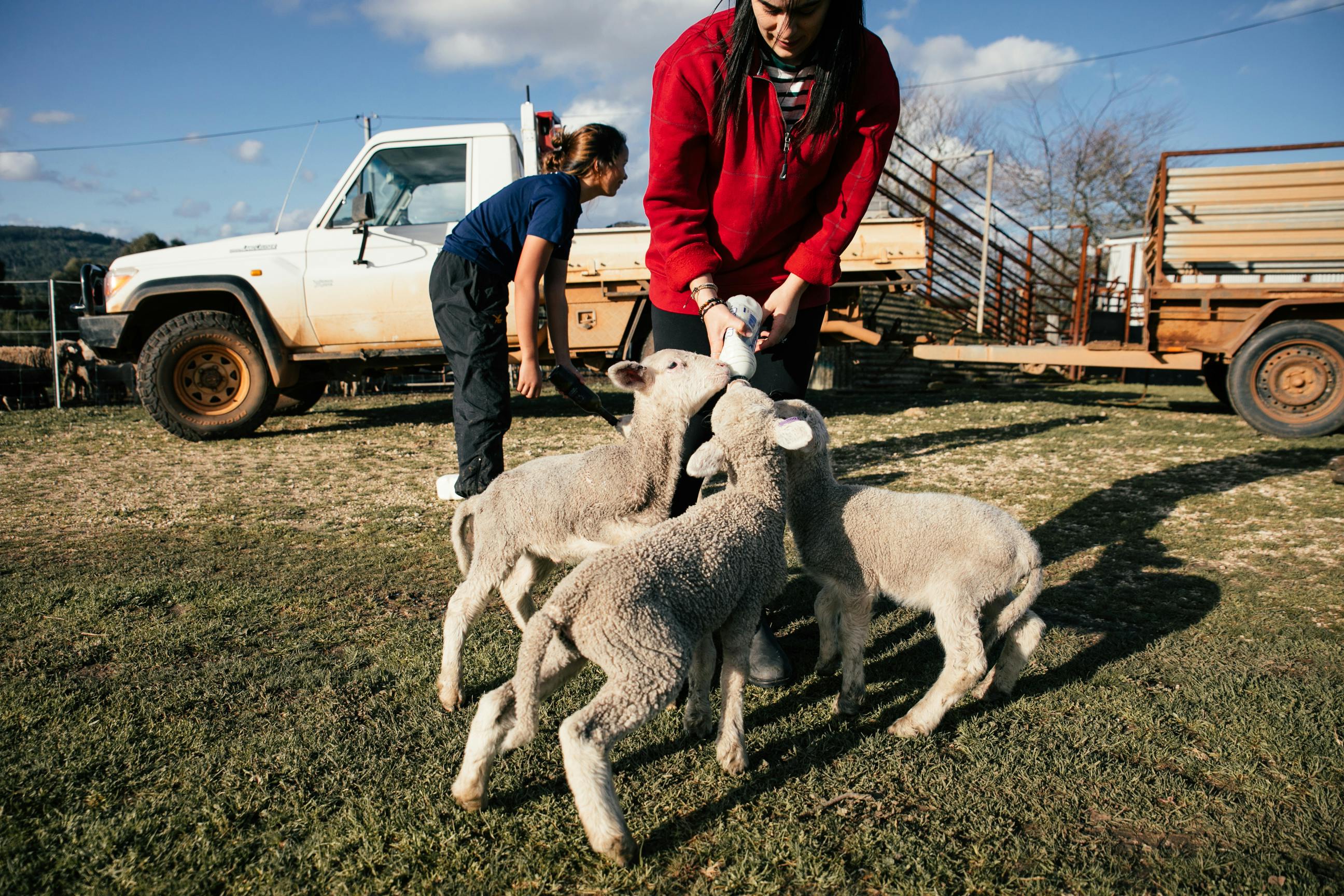
Figure 3. Farmer feeding lambs. Photo credit: www.pexels.com/photo/farmer-feeding-cute-lambs-with-milk-5490711/ |
Agricultural businesses with employees
Any business structure can operate with employees. Under some business structures, owners can be employed by their business. Having employees necessitates certain employer tax filings. It is important to note that workers may be classified as farm or non-farm employees based on their work activities. Labor laws and procedures for withholding and wage reporting may be different for farm workers and nonfarm workers. For example, workers harvesting crops would be classified as farm workers, while workers processing those products would be considered nonfarm workers. See your tax preparer for more information about how these provisions might apply to your farm.
Choosing to operate as a hobby farm
Some farmers may choose to file taxes as a hobby farm rather than a farm business. In this case, they must report the income from their farm may not be able to deduct the expenses. A hobby farmer reports their income on their individual tax return and does not file Form 1040 Schedule F.
Farmers with small operations may choose to file as hobby farms if they do not intend to manage their operation with a profit motive. They would not meet the criteria of being a farm business since they are not managing their operation as if it were a business. Individuals may choose not to file their taxes as a farm business if they are primarily operating their farm for the lifestyle benefits of farming. They may be producing food primarily for their own consumption. This may also be chosen if the farm operation has limited income and expenses. The farmer may also have other sources of income and not be relying on the business to support their financial needs.
Ex: Samantha has 20 hens in a backyard coop. She uses some of the eggs for her family and sells the remaining eggs to neighbors. Her income and expenses are limited, and she is not really attempting to make a profit. Samantha will file her taxes as a hobby farm, reporting her farm income on her individual tax return and not deducting her expenses.
Conclusion
Farms have unique rules for filing taxes based upon their potential status as a qualified farmer, their status as a farm business, and their business structure. The criteria for being a qualified farmer are different from the criteria for being a farm business. The IRS judges a qualified farmer based on their sources of income. Intent to make a profit defines a farm operation as a farm business or a hobby farm. Each has different methods for reporting farm income and implications for deducting farm expenses. The IRS evaluates the farmer’s operation as a farm business based on nine criteria for operating the farm with a profit motive. The business structure of a farm similarly has implications for how taxes are filed. Farmers should tailor their choices based on their goals and the nature of their operation. See your tax preparer for more information about how these rules apply to your farm.