Crayfish Wise Retailer Factsheet
DOWNLOADJune 25, 2026 - Paige Filice
 Print
Print Email
EmailBe a Crayfish Wise Retailer
This project was funded by the United States Environmental Protection Agency through the Great Lakes Restoration Initiative.
Protect What Matters Most
Crayfish are unique aquarium companions. However, several crayfish species sold in the pet trade are appearing in our local waterways far outside their natural ranges. Aquarium retailers, suppliers, and hobbyists are in a unique and powerful position to assist in the detection and prevention of these invasive crayfish. Be a wise crayfish retailer and help us protect the Great Lakes and our inland waters.
Sell crayfish with caution
Crayfish are notoriously difficult to identify even for experts. Some crayfish species commonly found in the aquarium trade are nearly impossible to tell apart from other highly invasive species. Due to their invasive potential, exercise caution when selling crayfish.
Tips for retailers
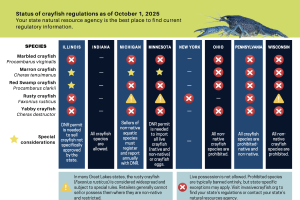
Be familiar with regulations: It is your responsibility to know crayfish regulations and verify your shipments. Beware, crayfish regulations vary between states. This can cause confusion for wholesalers, retailers, and hobbyists. The best place to find information is your state natural resources agency.
Know the invaders and who to contact: Invasive crayfish pose a serious risk. The Great Lakes Almanac to Invasive Crayfish can be used as an aid in the identification of invasive crayfish of greatest concern in the region. Contact your state's natural resource agency for this resource and a list of invasive crayfish.
Request scientific names: Anytime you receive a crayfish from a wholesaler or other seller, request their scientific names. Many species are sold under indistinguishable common names (e.g., vanilla crayfish) making it impossible to determine the species. Note: mislabeling of crayfish (even with scientific names) is a recurring issue, attempts should be made to identify the species. Possessing illegal species can lead to enforcement action by your state natural resources agency.
Humanely dispose of hitchhiking crayfish: Crayfish that were not originally ordered but found in shipments of other fish or plants should be euthanized if they cannot be identified. To humanely euthanize a crayfish, place it in a sealable container (like a ziploc bag), and leave it in the freezer overnight. Hitchhiking crayfish are most common in goldfish shipments.
Secure crayfish tanks: Crayfish are natural escape artists and can easily crawl out of tanks. Use secure covers.
Share the "don't let it loose" message: Hobbyists are ultimately responsible for keeping non-native crayfish out of our waterways. Always remind them to keep crayfish securely contained and to never release crayfish, or any other aquarium species, into natural waterways.
Buyer beware: Crayfish trade names
Crayfish trade names (e.g., red crayfish) are unreliable. Beware that prohibited species are often marketed under the same trade names as permitted species.
Crayfish have been bred to have diverse colors, color patterns, and shapes which can make identification extremely difficult. This is complicated by the variety of non-descriptive trade names given to various color morphs.
A scientific name is part of a system called binomial nomenclature. It includes a two-part name (genus and species). This system ensures a consistent way to refer to a species, regardless of language or location.
Common names vary across regions or cultures and typically allow clear communication about a species within a particular context.
Trade names are descriptive labels used to highlight characteristics, intended to enhance the appeal of a species in the retail market. Trade names often overlap across multiple species (e.g., blue crayfish) if they share similar physical features; thus, trade names should not be relied upon for species identification.
Summary of crayfish trade names
This section includes a summary of crayfish trade names compiled from visits to over 250 aquarium stores in Illinois, Indiana, Michigan, New York, Ohio, and Pennsylvania.
Scientific name: Cambarellus species
Common name: Mexican dwarf crayfish
Sometimes sold as:
- Dwarf/mini crayfish
- Blue/orange mini
- Mexican crayfish
- CPO crayfish
Scientific name: Cherax quadricarinatus
Common name: Red claw crayfish
Sometimes sold as:
- Vanilla crayfish/lobster
- Tangerine crayfish/lobster
- XL blue lobster
- Blue quad crayfish/lobster
Scientific name: Procambarus alleni
Common name: Everglades crayfish*
Sometimes sold as:
- Blue/electric blue crayfish
- Color morph names: neon red, orange flame, snow white, tangerine, white, vanilla
- Feeder crayfish
Scientific name: Procambarus paeninsulanus
Common name: Peninsula crayfish
Sometimes sold as:
- Blue crayfish/lobster/clarkii
- Electric blue crayfish/lobster
- Blue alleni lobster
Note: Many states prohibit the possession of these two species due to their invasive potential.
Scientific name: Procambarus virginalis
Common name: Marbled crayfish*
Sometimes sold as:
- Marmokreb
- Self-cloning crayfish
- Tricolor crayfish
- Zebra crayfish
- Blue crayfish
Scientific name: Procambarus clarkii
Common name: Red swamp crayfish
Sometimes sold as:
- Clarkii crayfish/lobster
- Color morph names: fireball, red, orange, tangerine, ghost, white, vanilla
- Feeder crayfish
*Caution
Everglades crayfish (Procambarus alleni) and marbled crayfish (Procambarus virginalis) can be extremely difficult to tell apart without the use of a microscope. Both are sold in a range of color morphs.