“Get Moving” Physical Activity Early Childhood Facilitator Guide
DOWNLOADApril 8, 2026 - Leena Abouzahr, Michigan State University Extension
 Print
Print Email
EmailReady to access the full Get Moving Early Childhood Facilitator Guide (accessible for screen reader use)? Click on the download button above for the full version.
Wondering if this resource is right for you? Learn more about the guide below.
What is this Facilitator Guide?
The MSU Extension Nutrition and Physical Activity team is committed to enhancing the physical activity and health literacy of children aged 3-5 and supporting integration of the Physical Activity Guidelines for Americans into their everyday lives and reducing future rates of obesity and chronic disease. Our goal is to deliver clear, consistent messaging that aligns with evidence-based best practices, meaning we promote teaching strategies that are supported by research and commonly used by experienced educators because they help participants learn, stay engaged, and apply what they’ve learned. As part of this initiative, we have:
- Developed six lessons to support child care providers in intentionally teaching young children about the importance of physical activity for their health.
- Provided printable teaching support resources that correspond with each lesson.
- Provided six family communication newsletters and additional resources that correspond with each lesson.
We aim to provide both home-based and center-based child care providers with the confidence and resources they need to teach and lead lessons on physical activity in their programs, no matter their own experience or fitness level. This guide corresponds with MSU Extension’s Get Moving Facilitator Guide, which provides six physical activity lessons for adults, and was adapted to meet best-practices guidelines for preschool-aged children.
Rationale for intentionally targeting screen time usage among 3- to- 5-year-olds
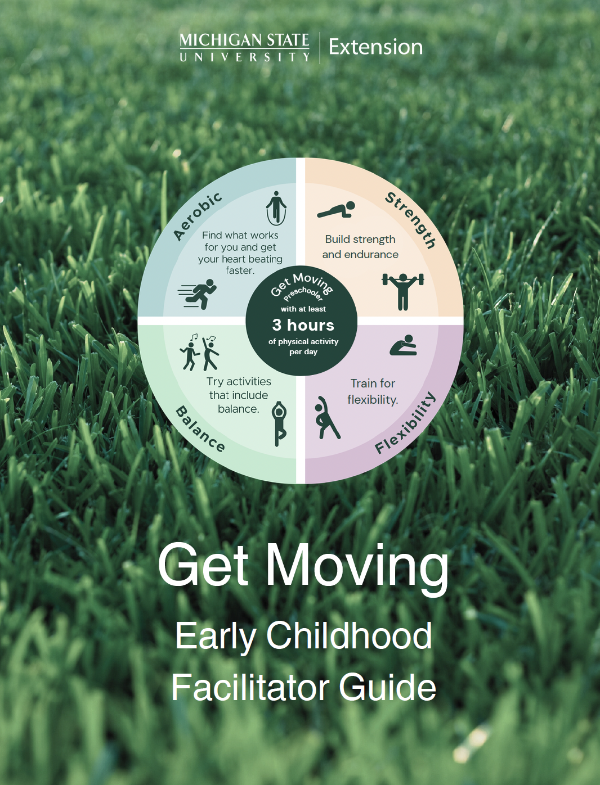
The Physical Activity Guidelines for Americans emphasizes that movement for preschool-aged children should be integrated throughout the day. Movement can take place through both active free play and structured child- or adult-led activities. 3-to-5-year-olds should get about 3 hours of physical activity each day, including both light activity and more energetic play. This recommendation is higher than those for any other age group, highlighting how much young children’s growing bodies and minds need movement.
The first five years are a critical window for rapid brain and physical development, laying the foundation for lifelong physical and mental well-being, learning, and success. Regular physical activity enhances children’s bone health, muscular development, and motor skills. It also contributes to a healthy weight and reduces the risk of chronic diseases. Learning to be physically active through play, whether independently or with others, can also promote children’s social-emotional development and mental health. The earlier these habits are instilled in children, the more likely it is they will continue to use them to grow into healthy adults. Intentionally teaching children the importance of physical activity sets them on the road to understanding the why and how of their own long-term health as early as possible.
Know your audience — and yourself
As you guide participants through activities, remember that everyone has unique abilities and potential barriers to physical activity. Physical activity, especially in group settings, can feel intimidating or make some feel self-conscious about their ability level. It can also highlight physical and sensory processing differences or disabilities and trigger a variety of responses to the activities themselves and other participants. Knowing how to adjust activities based on children’s needs — and giving them space to express those needs — is essential to helping them feel physically and emotionally safe.
Encourage children to participate while modeling respect and avoiding pressure. Watch for hesitancy and use language that communicates that they can decide what’s best for their bodies during group movements, such as:
- "You can try this next movement if it feels steady. I’m going to show you what steady looks like.” [Teacher models movement of choice.] “Now you show me what steady looks like."
- “Now it’s time to listen to your body.” [Teacher models: hand on heart/belly, takes a breath, checks in.] “Show me you are listening to your body.”
- “If you need a break, that’s okay — you can stop and rest anytime.”
Remember that you, too, can differentiate lessons based on your own ability. Most activities in this guide can be done standing, sitting, or lying down. There are also multiple activities to choose from for each lesson. Alternatively, ask for a participant to help you lead and demonstrate the movements, use visual aids to prompt children on what to do, or suggest your own alternative movements and activities. Empower yourself to find physical activities that work for everyone, teachers and students alike.
Structure of each facilitator lesson
To help make the lessons engaging and relatable, we have structured each one to be both informative and interactive. This structure ensures the material is presented in a way that is accessible, functional, and directly tied to participants’ daily lives.
Here is a breakdown of the key sections of each lesson:
- Key Teaching Point: The central message or concept that participants should learn and remember. This sets the foundation for the lesson.
- Materials: Recommended supplies such as visual aids and physical activity props to support lesson concepts and enhance learning.
- The Hook: A way to grab participants' attention right at the start. This could be a question, an interesting fact, or a relatable scenario that sparks curiosity about the lesson.
- Why This Matters: This section connects the key teaching point to participants' lives by explaining why the topic is relevant and how it can impact their health and well-being. It answers the question, "Why should I care?" in a way that they can understand.
- Check Your Knowledge/Participant Voice: In this section, we encourage active participation by prompting questions or discussions. This allows participants to reflect on what they already know and share their thoughts, making the lesson more engaging.
- Get Moving Your Way: Here, we provide practical examples or activities that show how the lesson’s key points apply in real life. The aim is to show participants how to integrate the information into their daily routines in a functional and meaningful way.
- Try It: This is where participants get the chance to practice what they’ve learned through hands-on activities. The Try It section includes functional activities that can be done individually or with a group, reinforcing the lesson’s key message.
- Wrap-Up: The final section ties everything together. It reinforces the key points of the lesson, provides a call to action, and gives participants something to think about or apply in the future.
By structuring the lessons this way, we aim to make each one relatable, achievable, and actionable. Our goal is not just to educate but to inspire participants to take practical steps toward improving their health and physical activity habits. This structure also keeps the lessons dynamic and ensures that participants are actively engaged throughout.
Lessons summary
These lessons introduce young children to the foundational elements of physical fitness in a developmentally appropriate, engaging, and inclusive way. Each lesson is designed to promote physical literacy (knowing different ways to move and feeling confident and capable of being active), body awareness, and healthy habits through movement, storytelling, and play. Lessons include intentional teaching of fitness, discussion of barriers to fitness, and application of lessons through interactive participation. Appendices also include extended learning resources for teachers and outreach to parents.
Lesson 1: Body Composition – “Every Body is Special”
- Teaches that our bodies are made of muscles, bones, fat, and more, and that all bodies are special.
- Promotes healthy habits like moving daily, eating a variety of foods, and self-love.
Lesson 2: Safe Physical Activity – “Safe and Strong”
- Teaches children how to move their bodies safely during physical activity.
- Covers warming-up, using space, listening to our bodies, and helping others stay safe.
Lesson 3: Muscular Strength/Endurance – “Strong Muscles, Strong Me”
- Introduces the idea that muscles help us lift, push, and climb. Also introduces the idea that we want our muscles to be able to work longer, not just harder.
- Activities include tug-of-war and carrying light objects.
Lesson 4: Cardiovascular Endurance – “Moving Our Hearts”
- Focuses on activities that get the heart beating faster, like dancing and jumping.
- Teaches children that the heart is a muscle that gets stronger with movement.
Lesson 5: Balance – “Steady Muscles and Bones”
- Emphasizes muscles and bones working together to keep us steady.
- Children practice holding poses and repeating movements.
Lesson 6: Flexibility – “Stretch Like a Star”
- Encourages children to explore how their bodies bend and stretch.
- Includes yoga-inspired poses, animal stretches, and dancing.