Managing Ambrosia Beetles in Apple
DOWNLOADAugust 19, 2026 - Heather Leach, Jenna Byrne and Julianna Wilson, Tree Fruit Entomology Program, Michigan State University
 Print
Print Email
EmailAmbrosia beetles are opportunistic pests that attack stressed apple trees, boring into trunks and introducing specialized fungi[1]. In Michigan, two species are found in apple orchards.
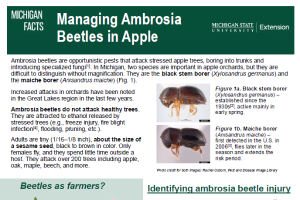
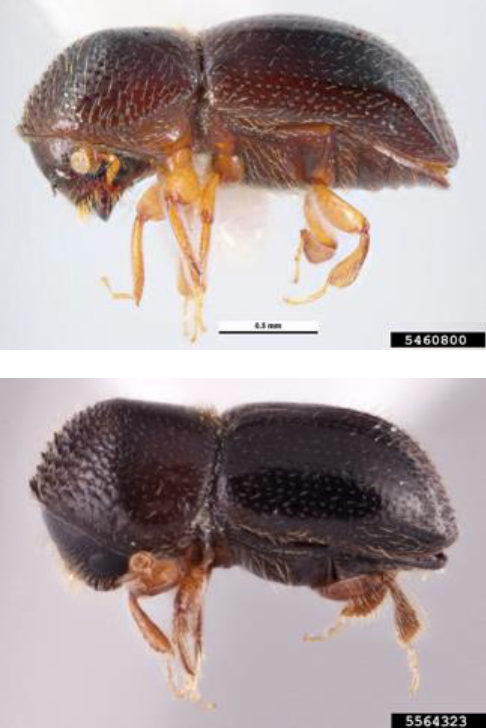
(1) Black stem borer (BSB) (Xylosandrus germanus) – established since the 1930s[2], active mainly in early spring.
(2) Maiche borer (Anisandrus maiche) – first detected in the U.S. in 2006[3], flies later in the season and extends the risk period.
Increased attacks in orchards have been noted in the Great Lakes region in the last few years.
Ambrosia beetles do not attack healthy trees. They are attracted to ethanol released by stressed trees (e.g., freeze injury, fire blight infection[4], flooding, pruning, etc.).
Adults are tiny (1/16–1/8 inch), black to brown (Fig. 1); only females fly, and they spend little time outside a host. They attack over 200 trees including apple, oak, maple, beech, and more.
Beetles as farmers?
These beetles don’t eat trees - at least not directly. They carry species-specific fungi in specialized “pockets” on their body called mycangia. When females bore into the xylem, they create galleries and inoculate the wood with that fungus. That fungus (not the tree) feeds both the adults and their young.
Identifying ambrosia beetle injury
Both borers only attack trees that are stressed[5], though this stress may not be visible to humans. Stressed trees release ethanol, attracting the beetles.
Beetles colonize trees that are already compromised in some way, meaning their presence may act as a signal that the orchard is experiencing stress. Beetles alone are likely not causing tree death.
Boring holes may cause sap to ooze from the tree as part of its defensive response. These sap deposits cause growth of black sooty mold on the bark (Fig. 2).
In Michigan, boring holes are often concentrated on the trunk above the graft union, which may indicate stress from freeze injury, herbicide injury, or other factors. Attacks and trap captures are typically higher along orchard edges, near woodlots, on poor soils, and in trees with weaker rootstocks.
What to look for:
(1) Small, round holes (≈ toothpick size) in the trunk or scaffold wood.
(2) Oozing sap or dark staining (sooty mold) below holes.
(3) Limb flagging or branch die-back (this is less commonly observed).
Seasonal activity
Females emerge and search for new hosts, boring into trees to establish fungal colonies and lay eggs. Management is only effective during this activity or flight period, when females are actively seeking hosts and are exposed outside the wood.
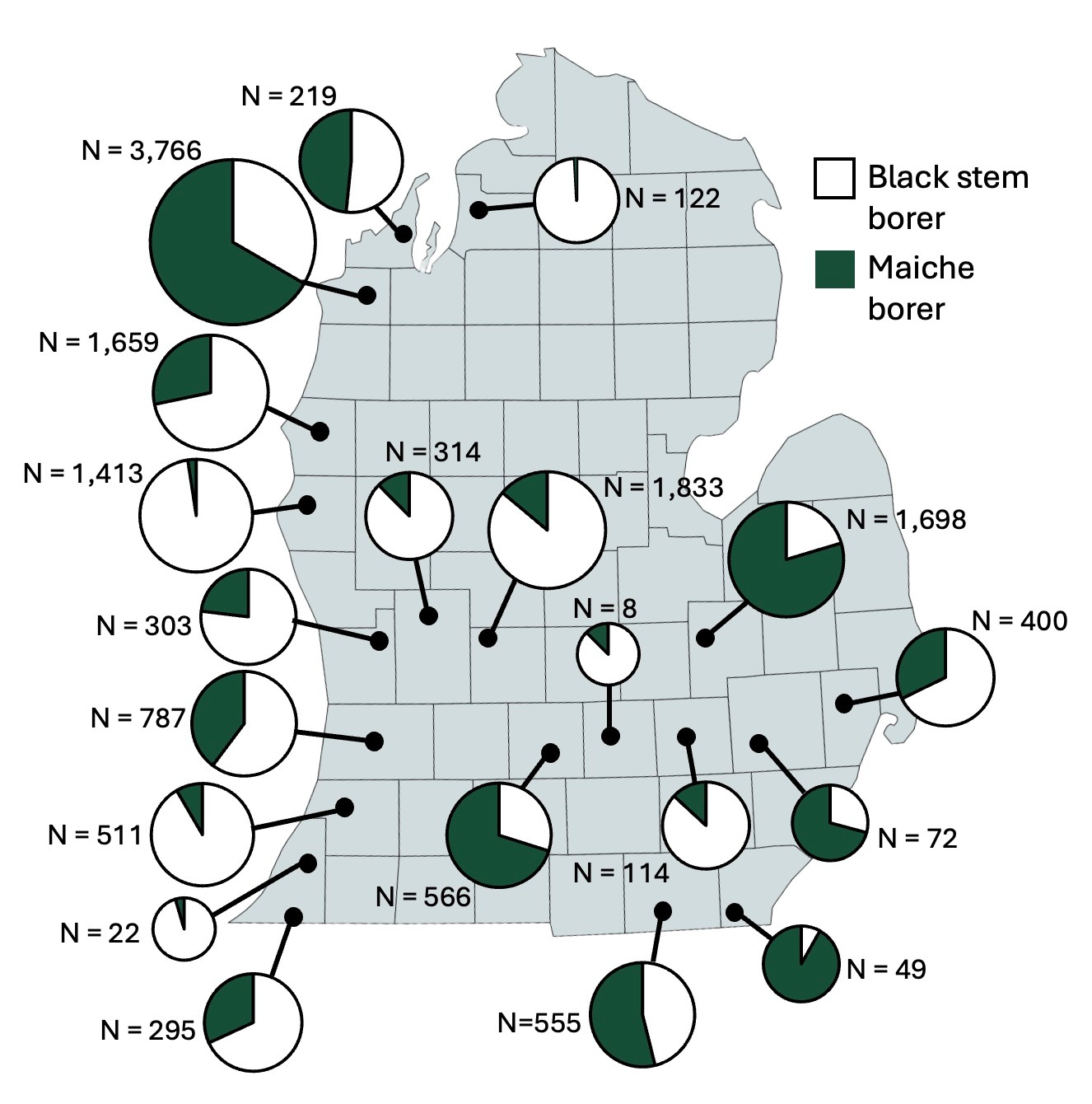
Both borer species are found throughout Michigan apple orchards, though the dominant species and their overall abundance varies (Figure 3).
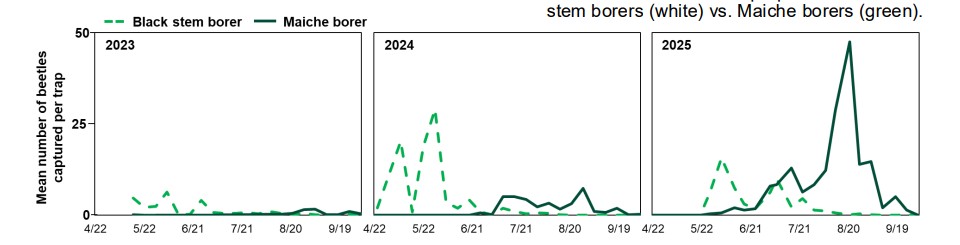
Black stem borers (BSB) overwinter as adults, becoming active in late April or early May, typically after two consecutive days ≥68°F or around forsythia bloom. Two activity peaks for BSB usually occur, with most activity ending by late June (Figure 4).
Maiche borers overwinter as juveniles, seeking new hosts starting early June. They also remain active late into the fall, depending on temperatures (Figure 4).
Monitoring
Monitoring for ambrosia beetles is mainly done to determine whether females are active. Ethanol-baited
traps are the standard tool, and commercial lures are widely available. Vodka or hand sanitizer can be
used as substitute lures, but they volatilize quickly and require more frequent replacement.
Bottle traps with a drowning solution (50% glycol or soapy water) or sticky cards can be used to capture beetles. Sticky cards are commercially available. Bottle traps are easy to make from plastic containers (see Figure 5).
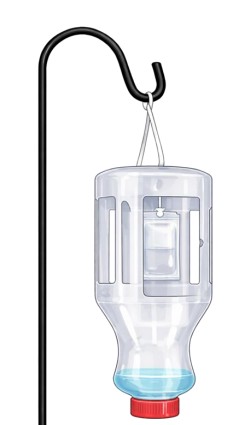
Where and when to trap: Place traps along orchard edges—especially near wooded areas—about 1.5-3 ft above the ground. Deploy traps by mid-April, or earlier if there are warm spring conditions. Check traps at least weekly. First capture signals the start of a management window if warm conditions persist.
How to identify: Most beetles captured in apple orchards in ethanol-baited traps are the two target species attacking apple (black stem borer and Maiche borer) though other species may occasionally be present. Their size will be the most important clue, but a microscope is required for distinguishing among species. Consult your local extension educator for assistance.
Success with trapping
- Use ethanol-baited traps (bottle, panel, or funnel) — ethanol is the key attractant for ambrosia beetles.
- Place traps on orchard edges, especially near woodlots or stressed trees, at ~2-3 feet from the ground.
- Deploy early (late March–early April in Michigan) before first warm spells; check at least weekly.
- Keep unused lures in the freezer and replace in the field when needed.
- Use trap data to detect flight spikes and risk, not as a control method.
Non-chemical management
Ambrosia beetles are attracted to ethanol released by stressed trees, so reducing stress lowers risk.
Common stressors may include freeze injury, weak rootstocks, flooding or poor drainage, topworking, nutrient imbalance, herbicide injury, chemical thinners, and fire blight.
There are no established economic thresholds for this pest complex. Michigan data suggest trees with >6 holes are more likely to be reinfested and may act as ongoing attractants.
Remove dead or dying trees when possible. Burn or properly chip and compost brush piles, which can serve as sources of new infestations.
Ongoing Research into semiochemical repellents including verbenone (e.g., SPLAT® Verb) and methyl salicylate show promise for reducing attacks, but no product is currently registered for use in apple[6]. Current research also aims to better identify stressors driving susceptibility (e.g., rootstock, drought, chemical injury) and determine whether stress-reducing practices can improve prevention.
Chemical Management
|
IRAC
|
Product
|
Active Ingredient
|
Relative non-target toxicity
|
|---|---|---|---|
|
3A
|
Brigade
|
Bifenthrin
|
High
|
|
3A
|
Danitol
|
Fenpropathin
|
High
|
|
3A
|
Warrior II, Lamcap II, etc.
|
Lambda-cyhalothrin
|
High
|
|
3A
|
Perm-up, Permethrin, etc.
|
Permethrin
|
High
|
|
UN
|
Surround
|
Kaolin clay
|
Low
|
Key Points
- Tree stress drives attacks. Managing stress is the foundation of control
- In Michigan, black stem borer flies in early spring and Maiche borer extends risk later into summer/fall.
- Insecticides work only during female flight — once beetles bore into trees, insecticides are ineffective.
- Monitoring with ethanol-baited traps helps time management action.
- Repeated pyrethroid use can cause an imbalance to your IPM program
References
[2] Felt, E.P. (1932) A new pest in greenhouse grown grape stems. Journal of Economic Entomology, 25, 2.
[3] Rabaglia, R.J,. et al. (2009) First records of Anisandrus maiche Stark (Coleoptera: Curculionidae: Scolytinae) from North America. Zootaxa, 2137(1), 23–28.
[4] Tobin, K.N., et al. (2024) First report of Anisandrus maiche (Coleoptera: Curculionidae: Scolytinae) infesting apple trees. Zootaxa, 5506(2), 261–271.
[5] Ranger, C. M., et al. (2015). Non-native ambrosia beetles as opportunistic exploiters of living but weakened trees. PLoS One, 10(7), e0131496.
[6] Leach, H., et al. (2025). Evaluating semiochemical‐based strategies for managing ambrosia beetles in apple orchards.Agricultural and Forest Entomology.
[7] Agnello, A.M., et al.(2017) Xylosandrus germanus (Coleoptera: Curculionidae: Scolytinae) occurrence, fungal associations, and management trials in New York apple orchards. Journal of Economic Entomology, 110(5), 2149–2164.