Partnership Playbook: Strategies for Effective Collaboration
DOWNLOADMay 25, 2026 - Kellie Kieren, Michigan State University Extension
 Print
Print Email
EmailWhat is a partnership?
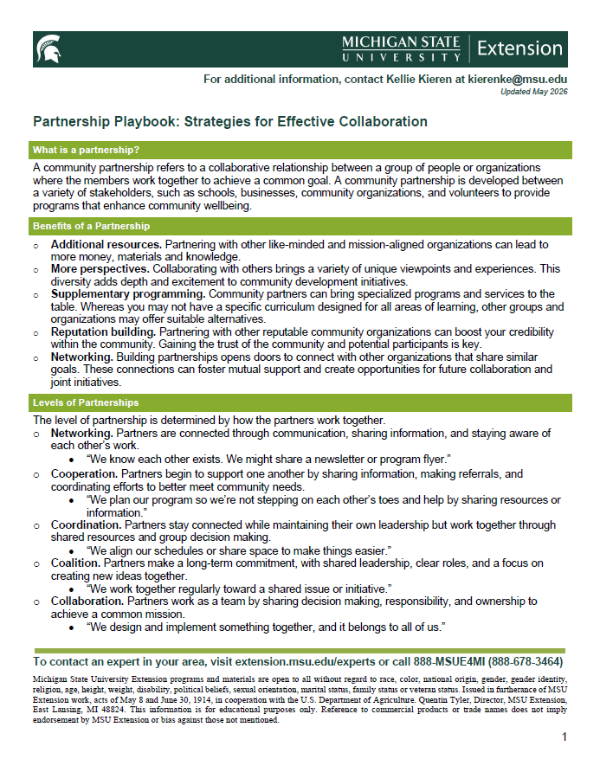
A community partnership refers to a collaborative relationship between a group of people or organizations where the members work together to achieve a common goal. A community partnership is developed between a variety of stakeholders, such as schools, businesses, community organizations and volunteers to provide programs that enhance community wellbeing.
Benefits of a partnership
- Additional resources. Partnering with other like-minded and mission-aligned organizations can lead to more money, materials and knowledge.
- More perspectives. Collaborating with others brings a variety of unique viewpoints and experiences. This diversity adds depth and excitement to community development initiatives.
- Supplementary programming. Community partners can bring specialized programs and services to the table. Whereas you may not have a specific curriculum designed for all areas of learning, other groups and organizations may offer suitable alternatives.
- Reputation-building. Partnering with other reputable community organizations can boost your credibility within the community. Gaining the trust of the community and potential participants is key.
- Networking. Building partnerships opens doors to connect with other organizations that share similar goals. These connections can foster mutual support and create opportunities for future collaboration and joint initiatives.
Levels of Partnerships
The level of partnership is determined by how the partners work together.
- Networking. Partners are connected through communication, sharing information, and staying aware of each other’s work.
- “We know each other exists. We might share a newsletter or program”
- Cooperation. Partners begin to support one another by sharing information, making referrals, and coordinating efforts to better meet community needs.
- “We plan our program so we’re not stepping on each other’s toes and help by sharing resources or information.”
- Coordination. Partners stay connected while maintaining their own leadership but work together through shared resources and group decision making.
- “We align our schedules or share space to make things easier.”
- Coalition. Partners make a long-term commitment, with shared leadership, clear roles, and a focus on creating new ideas together.
- “We work together regularly toward a shared issue or initiative.”
- Collaboration. Partners work as a team by sharing decision making, responsibility, and ownership to achieve a common mission.
- “We design and implement something together, and it belongs to all of us.”
How to initiate a partnership
- Express your needs
- Highlight your shared values.
- Prepare an elevator speech to succinctly describe your organization’s goals.
- Be prepared to share what others might be able to do to aid in the process.
- Bring business cards
- Always have business cards on hand when working.
- Look for opportunities
- Be aware of opportunities and spaces that may bring potential partners together
- Volunteering can lead to more connections.
- Do your research
- Look into community demographics, existing resources and previous initiatives.
- Request
- Ask for an opportunity to have a conversation regarding a potential partnership.
How to participate in a partnership meeting
- Be prepared and honest
- Don’t be shy. Be willing to share what you can provide and what you hope the potential partner can provide.
- Come prepared with potential resources you could share with the potential partner.
- Wear your name tag
- Always wear your organization’s name tag
- Dress appropriately based on the environment
- Have business cards
- Always have business cards when acting on behalf of your organization
- Be ready to take notes
- Computer notes
- Notebook
- Meeting notebook
- Send a follow-up email
- Utilize the meeting notes
- Send a summary of the meeting to participants
The follow-up email
- Send within two business days
- Include the following:
- Your role
- Partner role
- Desired timeframe
- Curriculum and/or resources to be used/shared
- Actionable item assignments
Building trust and rapport
- Utilize active listening strategies
- Give full attention to the speaker, put away distractions
- Paraphrase to confirm understanding
- Reflect feelings
- Be mindful of nonverbal cues
- Provide feedback
- Listen for understanding, not to respond
- Be transparent
- Be transparent about the goals and objectives of your team
- Maintain open lines of communication
- Create an environment where potential partners feel comfortable expressing their ideas, feedback and concerns
- Be reliable
- Follow through on commitments
- Be consistent in your actions and communication
- Only make commitments you can keep
- Show respect and appreciation
- Respect each other’s expertise and contributions
- Acknowledge the importance of involvement from each participant
- Demonstrate a commitment to equity and inclusivity
- Engage diverse stakeholders
- Listen to marginalized voices
- Strive to address barriers of inequalities
- Ensure that all parties have opportunities to participate, contribute and benefit from the partnership
Partnership goal-setting
- Identify shared priorities
- Partnerships should include groups/organizations that have similar missions.
- Identify overlap within the organizational missions that could guide the partnership.
- Set SMART goals
- Specific: Goals should be clear, distinct and answer the question of what you want to achieve.
- Measurable: Ensure you have a way of measuring progress towards or completion of goals.
- Attainable: Make sure your goals are realistic and achievable.
- Relevant: Goals should be mission-aligned and important to the partnering organizations.
- Time-bound: Set a clear and identified time frame for goals.
- Brainstorm and create goals together
- Schedule a collaborative brainstorming session or discussion to generate potential goals based on your shared priorities.
- Prioritize when multiple goals are desired
- Review the list of goals created and prioritize them based on their importance.
- When priorities do not align, utilize active listening to reach a consensus.
- Define success criteria
- Clearly define success criteria that is measurable.
- Criteria could include quantitative data, qualitative data or observable changes in behavior or conditions.
- Create actionable steps
- Break down large goals into smaller, more manageable tasks to increase progress tracking and ensure accountability.
- Reflect and revise
- Schedule check-ins with your partner to review progress toward goals.
- Be open to feedback that may lead to adjustments based on needed or new information.
- Celebrate achievements
- Celebrate little victories along the way.
- Recognize the contributions of your partner to show your appreciation.
- Evaluate impact
- Conduct an evaluation of the project and the process.
- Utilize stakeholder feedback.
Partnership evaluation and continuous improvement
- Refer to SMART goals set with partner(s)
- Use the goals created to evaluate the success of the partnership.
- Define what will be evaluated and how
- Create an evaluation that centers on the goals of the participating partners.
- Use multiple methods
- Collect data through a variety of methods, such as surveys, interviews, focus groups, observations and program material reviews.
- Utilize stakeholder input
- Involve stakeholders in the evaluation process, including program participants and partners.
- Use results for continuous improvement
- Utilize the evaluation process to inform your decision-making for future programming and partnerships.
- Be willing to discontinue a partnership when the goals are not met and/or it did not work.
Partnership discontinuation
It may be time to discontinue your partnership if one or more of these issues arise:
- Misaligned goals
- When two organizations no longer share the same vision or objective, it can be difficult to continue working together effectively.
- Lack of results
- If the partnership isn’t producing the intended outcome as identified in the partnership goals, it may not be worth continuing.
- Resource constraints
- When resources such as time, money or personnel are limited and unsustainable, it may be time to walk away.
- Communication issues
- Poor communication can lead to misunderstandings, frustration and a breakdown in communication.
- Change in priorities
- If either organization shifts focus or priorities, the partnership may no longer align.
Communicating partnership discontinuation
When communicating the discontinuation of a partnership, it is important to keep the following things in mind.
- Be clear and professional
- Use concise language
- Avoid overly emotional phrasing
- Clearly communicate key details such as what is ending, when, and who may be impacted
- Express gratitude for the contributions made
- Identify and acknowledge specific contributions or successes
- Recognize the value of the relationship to show respect
- Be direct but diplomatic
- Use neutral and respectful language
- Frame the decision as thoughtful and intentional
- Avoid placing blame or assigning faults
- Offer a reason, if appropriate
- Providing context can help the partner understand the bigger picture
- Keep the explanation brief and relevant
- Avoid unnecessary details that may trigger debate or attribute to defensiveness
- Keep the door open
- Use language like, “we hope to work together again in the future,” or “we remain open to the possibility of partnering again,” if appropriate
Circumstances may change, preserving a positive relationship may make future collaboration possible
Conclusion
Community partnerships are a powerful tool for creating meaningful, lasting change. By combining resources, perspectives, and expertise, partnerships allow groups and organizations to better address the diverse needs of the communities they serve. Whether short-term, long-term, or intermittent, effective partnerships are built on trust, shared goals, and clear communication. From initiating the first conversation to setting SMART goals and evaluating progress, each step contributes to a stronger, more impactful collaboration. While not every partnership will last forever, intentional efforts in relationship-building and continuous improvement can maximize the success and sustainability of those that do. By embracing the principles and practices outlined in the Partnership Playbook, you’ll be well-equipped to create partnerships that are mission-aligned, equitable, and rooted in community.