SNAP-Ed Overall Impact, 2001-2025
DOWNLOADJune 5, 2026 - Michigan State University Extension
 Print
Print Email
EmailSNAP-Ed
Overall impact, 2001-2025
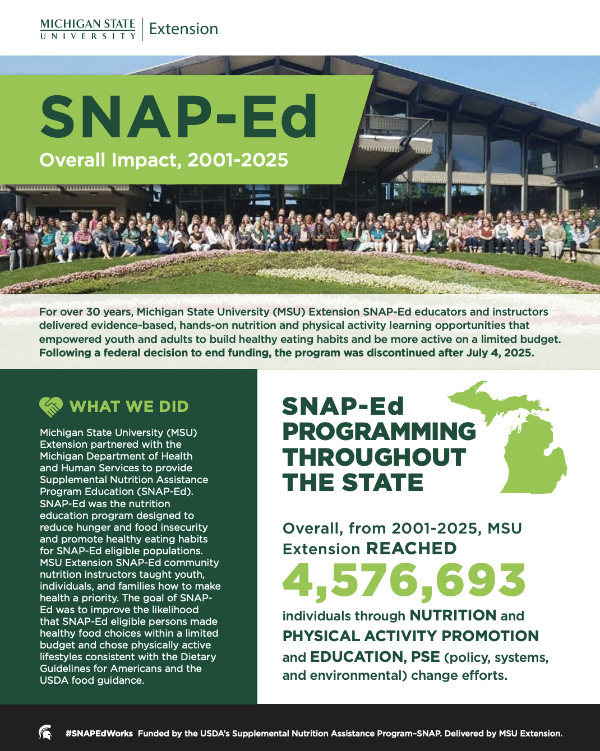
For over 30 years, Michigan State University (MSU) Extension SNAP-Ed educators and instructors delivered evidence-based, hands-on nutrition and physical activity learning opportunities that empowered youth and adults to build healthy eating habits and be more active on a limited budget. Following a federal decision to end funding, the program was discontinued after July 4, 2025.
What we did
Michigan State University (MSU) Extension partnered with the Michigan Department of Health and Human Services to provide Supplemental Nutrition Assistance Program Education (SNAP-Ed).
SNAP-Ed was the nutrition education program designed to reduce hunger and food insecurity and promote healthy eating habits for SNAP-Ed eligible populations. MSU Extension SNAP-Ed community nutrition instructors taught youth, individuals, and families how to make health a priority. The goal of SNAP- Ed was to improve the likelihood that SNAP-Ed eligible persons made healthy food choices within a limited budget and chose physically active lifestyles consistent with the Dietary Guidelines for Americans and the USDA food guidance.
SNAP-Ed programming throughout the state
Overall, from 2001-2025, MSU Extension reached 4,576,693 individuals through nutrition and physical activity promotion and education, PSE (policy, systems, and environmental) change efforts.
Demographics
People served within direct education
GENDER
- Female . 55.1%
- Male . 44.9%
AGE
- Under 5 . 8.3%
- Youth (5 to 17) . 67.1%
- Adults (18 to 59) . 16.7%
- Older Adults 60+ . 7.9%
Race
- White . 66.1%
- Black or African
- American . 27.9%
- More than One Race/
- Multicultural . 2.6%
- American Indian/
- Alaska Native . 1.8%
- Asian/Native Hawaiian
- or Pacific Islander . 1.5%
Ethnicity
- Hispanic or Latino 10.4%
Direct education
4,170,836 People Reached
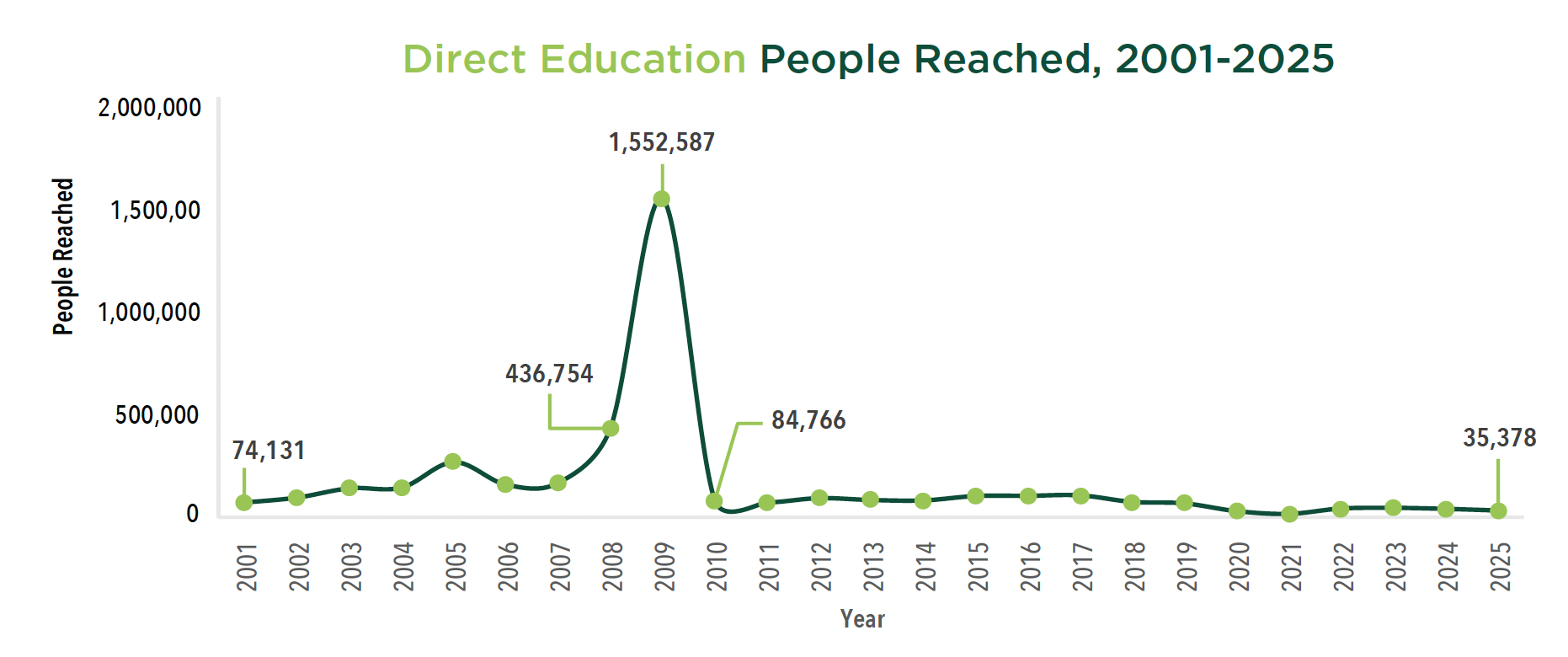
The graph represents the number of people reached through direct education. In 2009, the greatest amount of funding expenditure occurred which resulted in many people being reached. Conversely, the SNAP-Ed program restructured in 2010 with funding allocated to a new Implementing Agency which resulted in less people being reached within the MSU Extension SNAP-Ed program.
Youth nutrition and physical activity outcomes 3rd-12th grade
Among 3rd – 12th graders, 1 in 3 youth:
- Increased vegetable consumption
- Decreased soda consumption
- Increased physical activity
- Decreased screen time
Youth K-2nd grade impact
Are now eating more fruits and vegetables
- 2020 - 87%
- 2021 – 77%
- 2022 – 88%
- 2023 – 90%
- 2024 – 92%
- 2025 – 90%
Increased physical activity
- 2020 - 85%
- 2021 – 83%
- 2022 – 82%
- 2023 – 81%
- 2024 – 85%
- 2025 – 85%
Adult nutrition and physical activity outcomes
Ate more fruits per day
- 2020 - 41%
- 2021 – 43%
- 2022 – 43%
- 2023 – 39%
- 2024 – 40%
- 2025 – 41%
Ate more vegetables per day
- 2020 - 38%
- 2021 – 42%
- 2022 – 39%
- 2023 – 36%
- 2024 – 39%
- 2025 – 39%
Consumed less soda per day
- 2020 - 21%
- 2021 – 19%
- 2022 – 22%
- 2023 – 17%
- 2024 – 43%
- 2025 – 37%
Increased moderate physical activity
- 2020 - 41%
- 2021 – 44%
- 2022 – 43%
- 2023 – 39%
- 2024 – 43%
- 2025 – 37%
Increased strength training activities
- 2020 - 37%
- 2021 – 38%
- 2022 – 38%
- 2023 – 32%
- 2024 – 40%
- 2025 – 33%
Policy, systems, and environmental (PSE) change
405,857 children & adults reached
PSE site changes PSE impact 2017-2025
- 3,769 Nutrition
- 1,091 Physical Activity
- 29 Both Nutrition and Physical Activity
- 716 Policy Changes
- 2,256 Environmental Changes
- 1,658 System Changes
Social marketing & media
5,045,049 estimated people reached
Move Your Way® - MSU Extension partnered with the Office of Disease Prevention and Health Promotion (ODPHP) to promote the Move Your Way campaign as a social marketing effort to encourage physical activity participation among SNAP-Ed eligible adults.
Campaign length – 15 months (Mar – Sep 2024 & Jan – Aug 2025)
Estimated eligible population – 935,676 adults among 28 targeted counties in Michigan.
Total impressions – 29,946,473 with an average click through rate (CTR) of 0.06-0.08%.
Facebook, Instagram, and YouTube were utilized to promote nutrition and physical activity educational videos and materials.
Key Takeaways and programmatic insights from 30 years of SNAP-Ed
The SNAP-Ed multi-component interventions reached statewide impact and were effective in changing nutrition and physical activity behaviors among youth and adults.
Through practical, hands-on education, local partnerships, and assisting people with limited resources, direct education built lifelong skills around nutrition, cooking, physical activity and budgeting for healthy meals.
But sustainable changes take more than knowledge. SNAP-Ed created lasting improvements through policy, systems, and environmental (PSE) changes which reshaped the places where people live, learn, and work so that healthier choices became easier and affordable. Combined with promotional social marketing and social media initiatives, the SNAP-Ed multi-component interventions created sustainable change with meaningful impact.
A key takeaway is intentional promotion and advocacy are essential to program sustainability. Rather than being “the best-kept secret,” programs should prioritize outreach not only to target audiences, but also through regular educational briefings and hill visits with local, state and federal legislators and decision-makers.
Program reach corresponded with program expenditures and was statistically significant,
F (1, 23) = 79.33, p <.001, r2 = .60, which indicates funding had a strong relationship with program reach. The inverse is true – less funding may be associated with less program reach. The future of nutrition and physical activity reach is contingent on the funding landscape.
Continuing the work beyond SNAP-Ed
Resources are available to continue implementing nutrition and physical activity community change interventions beyond SNAP-Ed. The following resources were developed to guide and inform future efforts:
Community Change Hub
Ready to champion change in your community? Welcome to a practical, step-by-step resource that helps communities create lasting change. From parents and educators to volunteers and local leaders, everyone has a role to play. Explore practical ways to improve the spaces and routines that shape nutrition, physical activity, and health. Use our six-step approach, practical tools, and selected resources to help strengthen the health of your community. extension.msu.edu/changehub
Food budgeting
Eat well for less with practical skills for creating a food budget, planning meals, shopping for groceries, and finding and using food assistance dollars. extension.msu.edu/foodbudgeting
Cook Healthy, Spend Less email series
Cook Healthy, Spend Less is a free 6-week email lesson series for adults of all ages. The lessons provides simple nutrition tips and basic cooking skills and are sent directly to your email inbox each week. Each lesson includes ways to eat nutritiously, stretch your food dollars, cook foods you enjoy and add more movement to your day. extension.msu.edu/cookhealthyspendless
Healthier Childcare Environments Toolkit
This curated list of online resources helps early care and education (ECE) providers create healthy, high-quality spaces for children. Compiled by Michigan State University Extension, it offers a comprehensive list of free tools from trusted sources for improving nutrition, physical activity, and emotional wellness of infants, toddlers, and preschoolers. extension.msu.edu/healthierchildcaretoolkit
Physical activity
Looking for ways to be active? Whether you’re just getting started or searching for new ideas, MSU Extension offers fun, practical ways to build movement into your day. extension.msu.edu/physicalactivity
Success stories
This page features the inspiring stories behind that work — from tackling food insecurity in high schools to launching creative partnerships that bring local farmers’ produce to children through early care and education centers. We invite you to explore these videos and articles and see what’s possible when education, partnership, and policy come together to support a healthier Michigan. extension.msu.edu/SNAPEdSuccess
Michigan State University Extension programs and materials are open to all without regard to race, color, national origin, gender, gender identity, religion, age, height, weight, disability, political beliefs, sexual orientation, marital status, family status or veteran status. Issued in furtherance of MSU Extension work, acts of May 8 and June 30, 1914, in cooperation with the U.S. Department of Agriculture. Quentin Tyler, Director, MSU Extension, East Lansing, MI 48824. This information is for educational purposes only. Reference to commercial products or trade names does not imply endorsement by MSU Extension or bias against those not mentioned.
#SNAPEdWorks Funded by USDA’s Supplemental Nutrition Assistance Program-SNAP. Delivered by MSU Extension.