Stinkgrass
September 9, 2015
 Print
Print Email
EmailEragrostis cilianensis (All.) Vign. ex Janchen
Life cycle
Erect to spreading summer annual.
Leaves
Leaves are usually hairless and up to 6 inches long with a tuft of long, soft hair at the collar region. Tiny, warty glands on the leaf margins and sheath release an unpleasant odor.
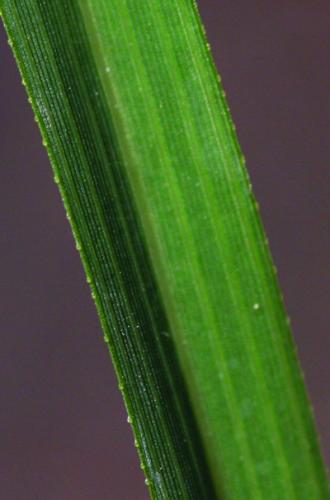
Tiny, warty glands on the leaf margins of stinkgrass.
Ligule
Hairy.
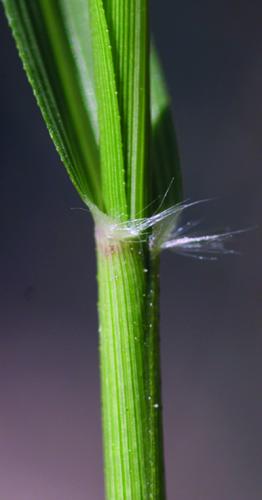
Stinkgrass collar region.
Stems
Erect to spreading, up to 2-foot-tall, slender stems are branched at the base. Stems have a ring of tiny glands just below the nodes, which release an unpleasant odor.
Flowers and fruit
The seedhead is a dense to open, tan, gray-green to purple, pyramid-shaped panicle. Flattened and oblong, spikelets contain up to 40 reddish orange to brown, egg-shaped seeds.
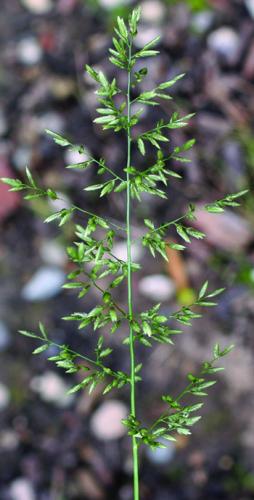
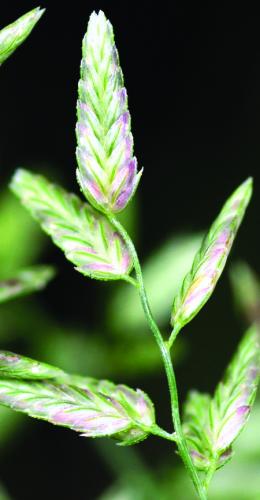
Stinkgrass seedhead (left). Stinkgrass spikelets (right).
Reproduction
Seeds.
Print a PDF of this page: Stinkgrass