Aren't all green algal blooms harmful?
 Print
Print Email
EmailLearn about filamentous green algae -- it may be green but it’s not hazardous
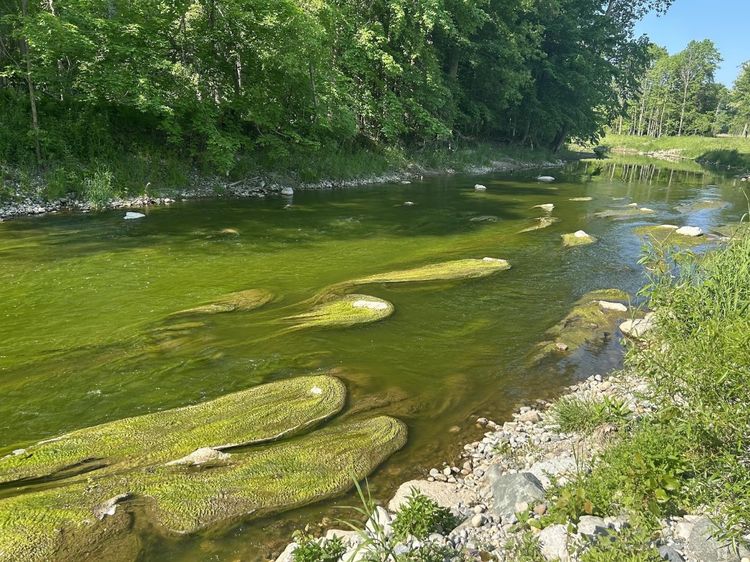
You may have heard that something green in your lake could be a harmful algal bloom. However, there are a lot of different types of algae and most of them do not produce toxins. One type of algae that is not harmful is filamentous green algae.
How to ID filamentous green algae
Filamentous green algae are clumpier than most cyanobacteria and one way to distinguish it is to use the stick test. You can put a stick into the water with the algae and see if you can grab the algae on the stick. If you can pick it up and it is green, it is likely filamentous green algae. If you can’t pick it up it’s likely cyanobacteria. Make sure not to touch algae with your hand directly, use the stick instead. In this video, senior aquatic biologist Aaron Parker from the Michigan Department of Environment, Great Lakes, and Energy, shows what filamentous green algae looks like and demonstrates how to do a stick test.
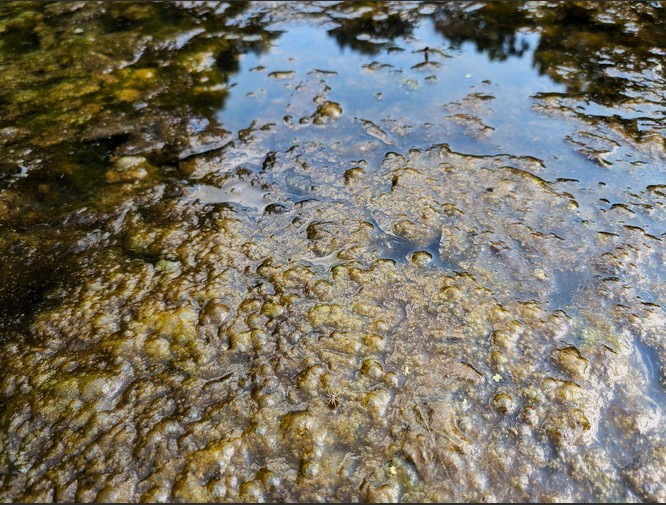
Green algae are beneficial to your lake and provide the base of the food chain. They also provide shelter and food for insects and fish. They are also more likely to dominate lakes at certain times of the year (typically June and July). Though they aren’t harmful and don’t produce toxins, the presence of excess filamentous green algae can be an indicator of extra nutrients in that environment. In this 2024 webinar presentation, Marcella Domka of the Tip of the Mitt Watershed Council discusses when filamentous green algae might become a nuisance and what to do to reduce nutrients.
It is important to note that cyanobacteria and filamentous green algae can both be present at the same time. If the water without the filamentous green algae in it looks like spilled paint, there could be cyanobacteria and thus toxins present as well. When in doubt, stay out. You can also report the algae as described below and receive a response about whether it could be toxic or not.
What to do if you suspect there is a harmful algal bloom (HAB)?
Report information online to Michigan.gov/HABs or call EGLE’s Environmental Assistance Center at 800-662-9278. Take clear pictures that show the bloom close up, with a leaf or familiar object to show scale. Get photos of the surroundings, too, and try using your map or camera app to pinpoint the location.
If you suspect a HAB is present, don't touch the water. HABs can cause human health impacts like skin rashes, runny noses, stomach pain, and headaches. Also keep livestock and pets away from the water. If you think a domestic or wild animal is ill or dead because of a HAB, submit one of the forms on the EGLE HABs webpage.
Learn more
Michigan Sea Grant’s short introduction video offers basic facts and describes how to recognize HABs. You can also view resources about HABs on the Michigan Sea Grant HABs 101 resources website.
Michigan Sea Grant helps to foster economic growth and protect Michigan’s coastal, Great Lakes resources through education, research and outreach. A collaborative effort of the University of Michigan and Michigan State University and its MSU Extension, Michigan Sea Grant is part of the NOAA-National Sea Grant network of 34 university-based programs.
This article was prepared by Michigan Sea Grant under award NA24OARX417C0157-T1-01 from the National Oceanic and Atmospheric Administration, U.S. Department of Commerce through the Regents of the University of Michigan. The statement, findings, conclusions, and recommendations are those of the author(s) and do not necessarily reflect the views of the National Oceanic and Atmospheric Administration, the Department of Commerce, or the Regents of the University of Michigan.