Dirt to Glass 2026: A two-day conference for better decisions and better wines
 Print
Print Email
EmailDirt to Glass has grown into Michigan’s statewide platform connecting growers, winemakers, researchers and industry leaders to drive measurable improvements from vineyard to glass. Registration is open for the Aug. 20–21, 2026 conference in Traverse City.
Dirt to Glass 2026, held Aug. 20–21 in Traverse City, Michigan, is designed as a two-day conference with a clear purpose: define what “better” looks like, identify which decisions drive it, and then test those decisions in Michigan vineyards. This year, the conference intentionally moves from quality targets to metrics and implementation in the vineyards. Participants will leave not only inspired but equipped with practices and decision frameworks they can apply immediately.
Day 1: Setting the bar high, but with the pathway to reach it
The educational program on Aug. 20 begins by setting research insights in fruit quality and vineyard performance. A presentation by Nick Dokoozlian, PhD (E. J. Gallo) focuses on assessing and enhancing grape and wine quality, anchoring the day in a practical reality: quality must be defined, measured and repeatedly achieved.
From there, the program moves to what often separates “good intentions” from progress: measurable systems that improve efficiency and resilience. Bruno Basso, PhD (Michigan State University) connects vineyard sustainability to carbon farming efficiency, helping participants think about soil and carbon not only as values, but as operational levers that can be tracked and improved.
That scientific framing transitions directly into real-world decision making through the panel discussion “Precision, Performance and Place: Refining Vineyard Practices in Pursuit of Stronger Regional Identity.” Moderated by Joe Herman, the panel features Michigan growers and producers who can speak from experience about what works under Michigan constraints and how choices translate into quality and identity.
The day then addresses two critical questions facing vineyards everywhere, and especially in humid cool-climate regions: how to improve efficiency without compromising quality and how to innovate responsibly. The session on PIWI by Diego Barison (Herrick Grape Vines) and Tom Plocher (Plocher Vines) is designed to move beyond “interest” into evaluation, pairing a scientific presentation with tasting so that adoption can be discussed through both performance and wine outcomes.
After lunch, the program makes the accountability connection that every industry needs: does the market reward these improvements? The tasting panel “What Quality Commands: What Decisions Yield Better Wines and Does the Market Pay for It?” brings wine evaluation and market reality into the technical conversation, helping the industry focus on changes that are both meaningful and economically durable.
Day one then turns to long-term vineyard performance through Jacopo Miolo (Simonit & Sirch) and efficiency-driven vineyard management systems, connecting grapevine architecture and management choices to outcomes that matter across seasons: consistency, vine health and operational efficiency.
The last “Dirt to Glass, and Back Again,” led by Paolo Sabbatini, PhD (Michigan State University) is designed to ensure the conference does not end as a collection of good ideas. It is a structured moment where the industry is asked to take ownership of direction 1) to name the constraints that most limit progress, 2) to identify which decisions are ready to be tested next season, and 3) to propose the topics, speakers, demonstrations and field activities that will matter most for Michigan’s future.
Crucially, the discussion also tests the industry’s readiness to 1) keep evolving the conference itself, 2) how strongly stakeholders want Dirt to Glass to travel to different regions of Michigan, 3) how much they want the “Michigan voice” to be heard consistently between visiting speakers and Michigan State University (MSU), and 4) how deeply they care about using this platform to strengthen not just individual businesses, but the quality, unity and long-term growth of the entire Michigan grape and wine industry.
Most importantly, it reinforces a principle at the heart of Dirt to Glass from the first edition of 2022: the quality of the conference will be measured by the quality of industry engagement in the process, how many stakeholders contribute, how well they collaborate across regions and roles, and how clearly they help define priorities that the Michigan State University Extension grape team can translate into research questions, Extension programming, and practical decision tools.
The closing remarks, “Research, Innovation and the Discipline to Matter,” delivered by Doug Gage, PhD (Vice President for Research and Innovation, MSU) will reinforce the message of Dirt to Glass: progress in a grape and wine industry does not come from isolated breakthroughs, but from a shared system that turns questions into evidence and evidence into practice.
Under the Dirt to Glass model, an increasingly united Michigan grape and wine community can engage with MSU in the way a high-performing agriculture sector should: industry leaders and grower organizations help define the constraints that truly limit quality and profitability. MSU will bring the rigor to frame those constraints as testable research questions, build the measurements and tools needed to evaluate solutions, and translate results into decision-ready guidance. The Dirt to Glass conference becomes the annual checkpoint where the industry compares outcomes, aligns priorities and commits to support research and innovation.
The calibration moment: tasting as a quality checkpoint
Dirt to Glass ends day one with a curated walk-around tasting described as “a premier, curated experience showcasing Michigan’s most compelling wines alongside benchmark producers from the world’s leading regions.” This is not a wine testing added onto education, it is calibration. It provides a shared sensory reference point that strengthens the day’s technical discussions: what we do in the vineyard and winery must ultimately hold up in the glass.
Day 2: Turning the framework into field-ready practice
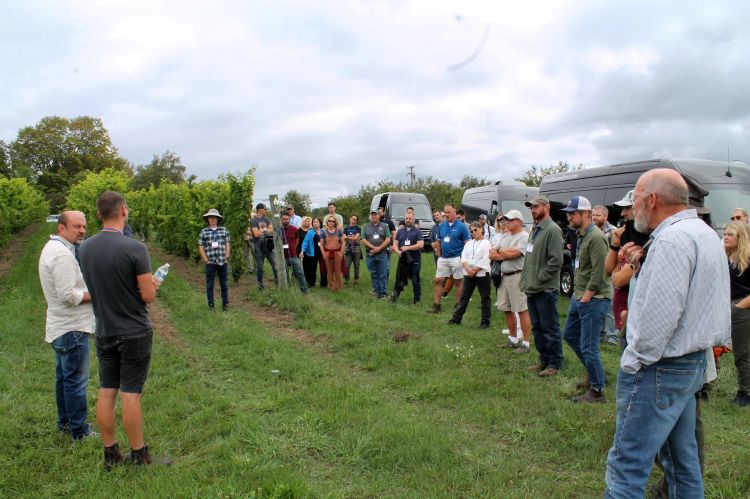
If day one defines the why and the what, day two is the how. On Aug. 21, participants move through field sessions that translate the major themes, soil function, vine architecture, precision decision tools and soil biology, into direct observations and hands-on learning at commercial sites. Field visits may occur in different orders as buses follow different routes, with all participants gathering for lunch and reconvening at the day’s end.
At Lone Silo Vineyard, participants will dig into vineyard performance through soil pits that reveal how soil horizons, structure and rooting patterns regulate water dynamics and vine function. Hosts Larry and Sandy Tiefenbach guide the site interpretation, and Andrew Backlin (Modales Wines) connects those soil realities to wine style through tasting, closing the loop from root zone to fruit pathway to wine expression.
At Black Star Farms, the emphasis shifts to how day-to-day vineyard systems create efficiency. Jacopo Miolo joins Ben and Jen Bremer to connect pruning and canopy decisions with vineyard floor strategies and mechanization, showing how operational choices can reduce labor pressure while protecting fruit quality and long-term sustainability.
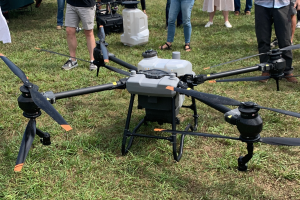
At Shady Lane Cellars, Rich Price (MSU) and Kasey Wierzba (Shady Lane Cellars) will demonstrate how satellite and drone-derived imagery can quantify spatial variability, helping growers decide where targeted interventions are most likely to improve outcomes. The value is not the map itself; it is the ability to turn variability into a manageable system rather than a chronic uncertainty.
Finally, at Leelanau Cellars, Alexa Kipper, Christie Lee Apple and Marcel S. Lenz, PhD, connect soil biology indicators and field-based assessment tools to nutrient cycling, water availability, vine vigor and resilience, translating “soil health” into biological function and practical management choices such as compost, cover crops and reduced disturbance.
Registration
Registration is open for the fifth annual Dirt to Glass conference on Aug. 20–21, 2026, in Traverse City, Michigan. Discounted registration is available for the first 50 registrants for days one and two, after which regular pricing applies.