Explaining the new H-2A Wage Rule for Michigan growers
 Print
Print Email
EmailThe H-2A program provides a legal pathway for U.S. agricultural employers to hire seasonal foreign workers when domestic labor is not available.
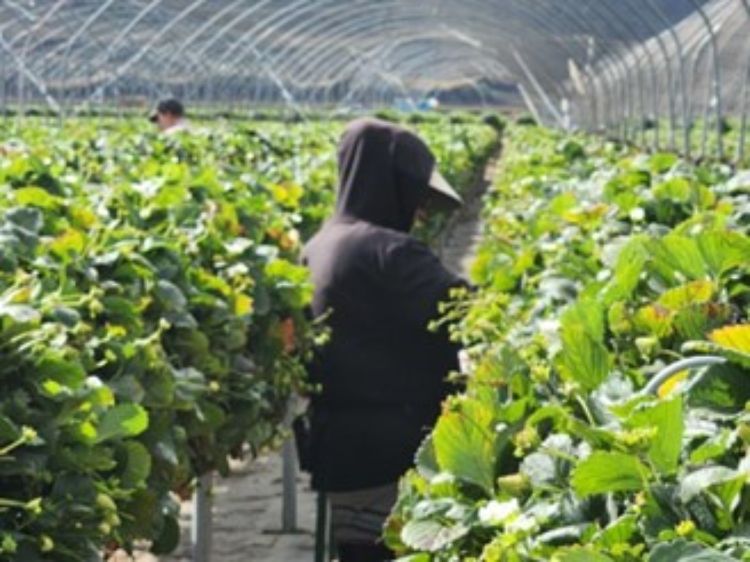
Over the past two decades, U.S. farmers have experienced persistent labor shortages (Figure 1). A sharp decline in immigration, rising education levels in the U.S. and abroad, increased competition from non-farm sectors, and the aging of foreign-born farmworkers are among the key forces driving this trend. Although farm wages have risen faster than wages in much of the broader economy, these increases have not been sufficient to attract a large enough domestic workforce into seasonal, physically demanding agricultural jobs.

The H-2A program provides a legal pathway for U.S. agricultural employers to hire seasonal foreign workers when domestic labor is not available. As the supply of U.S. farmworkers continues to decline, the program has become a critical part of the agricultural workforce.
Michigan mirrors national trends. The state produces many labor-intensive specialty crops — such as apples, blueberries, cucumbers, squash and asparagus — that require a large workforce during short, time-sensitive harvest periods. In 2024, Michigan farms employed about 15,000 H-2A workers, underscoring the program’s essential role in sustaining the state’s agricultural production.
Background on the H-2A Visa Program
The H-2A visa program was established in 1986 to allow foreign workers to enter the U.S. temporarily for low-skilled, seasonal agricultural jobs. Under this program, farm employers may hire foreign workers for seasonal agricultural work — typically up to 10 months — under the following conditions:
- Employers must demonstrate that they cannot find sufficient domestic workers.
- Workers must leave the U.S. when their visas expire.
- Jobs must be seasonal, which excludes year-round industries such as dairy.
- Employers must provide free housing for H-2A workers.
- Employers must pay for workers’ transportation between their home country and the work site.
- Employers must pay the Adverse Effect Wage Rate (AEWR), a special minimum wage intended to ensure that hiring foreign workers does not negatively impact U.S. farmworkers.
These requirements mean that H-2A workers are often more expensive than domestic workers once housing, transportation, and application costs are included. Recent research estimates that total H-2A employment costs are 20% to 50% higher than hiring U.S. workers, including unauthorized workers who have settled in the U.S. according to Castillo, Martin, and Rutledge, 2024.
Surge in the use of the H-2A Visa program in Michigan
Michigan agriculture depends heavily on seasonal labor, especially in fruit, vegetable, and nursery production. H-2A workers fill essential roles in harvesting, pruning, packing and field tasks during peak seasons.
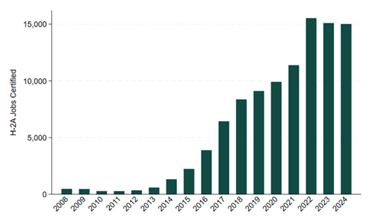
Use of the H-2A program has grown rapidly in the state (Figure 2). Michigan had less than 1,000 certified H-2A positions in FY 2008, but by FY 2024, that number had increased to over 15,000.
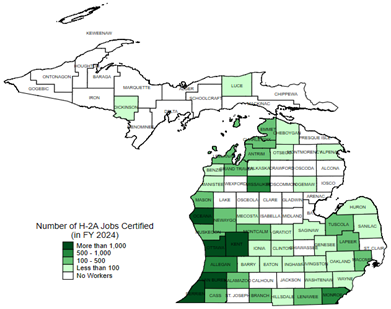
Many of these jobs were concentrated in counties with large fruit and vegetable industries—such as Oceana, Kent, Ottawa, Berrien and Monroe — where seasonal labor demand is highest (Figure 3). This rapid expansion underscores the central role of the H-2A program in sustaining Michigan’s specialty crop production.
To prevent the H-2A program from lowering wages for U.S. workers, the Department of Labor requires employers to pay the Adverse Effect Wage Rate (AEWR), which serves as a minimum wage for most H-2A employment. Historically, the AEWR was derived from the U.S. Department of Agriculture’s (USDA) Farm Labor Survey (FLS).
Under the previous system, the AEWR was calculated as follows:
- The FLS collected quarterly data on wages and employment from a sample of farm employers.
- USDA used these data to estimate the average hourly earnings of field and livestock workers within each state or multistate region.
- The Department of Labor (DOL) adopted these wage estimates as the AEWR for the following year for most crop and livestock jobs.
Because the AEWR was tied directly to the FLS average wage of field and livestock workers, any year-to-year changes in the survey results — such as shifts in sample composition or low response rates — could lead to significant fluctuations in year-to-year AEWR levels.
New AEWR methodology effective October 2, 2025
USDA discontinued the FLS in August 2025, forcing DOL to develop a new method for setting AEWRs. On October 2, 2025, DOL issued an interim final rule, effective immediately, that introduced major changes to the AEWR system. Table 1 summarizes the key differences under the new system.
AEWRs Are now based on OEWS data
Under the new H-2A rule change, the DOL will use the Occupational Employment and Wage Statistics (OEWS) survey to determine AEWRs. OEWS reports wage data for more than 830 occupations across states and multistate regions. Although OEWS will begin surveying farm establishments in 2026, it currently collects detailed wage information from nonfarm employers, including farm labor contractors that employ workers across multiple farms.
The DOL now derives each state’s AEWR by weighting the statewide hourly wages for five farm-related occupations (i.e., farmworkers, ranch workers, equipment operators, packers and packagers, and graders and sorters) by the employment in each occupation. A key issue is that two-thirds of the 955,000 U.S. workers in these five occupations are hand packers, most of whom work in nonfarm warehouses (e.g., Amazon). As a result, hand-packer wages carry substantial weight in determining AEWRs in many states.
Table 1. Comparison of the old and new AEWR systems
|
Category |
Previous System |
New System |
|
Data source to construct AEWR |
USDA Farm Labor Survey |
OEWS wage data for five farm occupations |
|
Number of wage rates |
One AEWR applied to most H-2A jobs |
Two AEWRs: Skill Level I (entry-level) and Skill Level II (experienced) |
|
Adverse Compensation Adjustment (ACA) |
None |
AEWR reduced by $1.32/hour for employer-provided housing in Michigan |
|
AEWR levels (before ACA) |
2025 AEWR = $18.15 |
Skill I = $13.78; Skill II = $17.47 |
|
ACA-adjusted AEWR in Michigan (Rate employers pay) |
Not applicable |
Skill Level I = $13.73; Skill Level II = $16.15 Note: The ACA-adjusted AEWR for Skill Level I is $12.46, which is below Michigan’s 2026 minimum wage of $13.73. Therefore, the employer must pay at least the minimum wage for Skill Level I positions. |
Two AEWRs based on skill level
The new system introduces two separate AEWRs based on job requirements.
- Skill Level I (entry-level) jobs require less than three months of experience and some on-the-job training. AEWRs are set at the 17th percentile wage (the midpoint between the 10th and 25th percentiles) based on OEWS data.
- Skill Level II (experienced) jobs require at least three months of experience and prior training or certification. AEWRs are set at the 50th percentile wage (mean value) using OEWS data.
Introduction of the Adverse Compensation Adjustment (ACA)
The new rule also introduces the Adverse Compensation Adjustment (ACA), which accounts for the value of the employer-provided housing. Using housing cost data from the Department of Housing and Urban Development (HUD)’s Fair Market Rent database, DOL calculates the hourly ACA amount — typically between $1 and $3 per hour — based on the cost of a four-bedroom rental unit, assuming two workers per bedroom and a 172-hour work month. Importantly:
- The ACA reduces the AEWR only for H-2A workers.
- It does not apply to U.S. workers, even if they receive free housing.
- If the ACA-adjusted AEWR falls below a state’s minimum wage, employers must pay at least the state minimum wage.
As the new rates are more narrowly tailored to skill levels and adjusted for housing, DOL expects that this new methodology will generally reduce AEWRs and likely shift employment costs from employers to workers.
What does the new AEWR mean for Michigan?
Under this new rule, the 2026 OEWS-based AEWRs for Michigan are:
- Skill Level I: $13.78 per hour
- Skill Level II: $17.47 per hour
The ACA for Michigan is $1.32 per hour, which is subtracted from the AEWR to determine the applicable H-2A wage. Thus, Michigan’s 2026 applicable H-2A wages are:
- Skill Level I: $13.78 − $1.32 = $12.46
- Skill Level II: $17.47 − $1.32 = $16.15
Michigan’s minimum wage in 2026 will be $13.73 per hour. Because the ACA-adjusted Skill Level I wage falls below the state minimum wage, the minimum wage becomes the binding wage for Skill Level I positions. This means employers must pay:
- At least $13.73 for entry-level H-2A workers (Skill Level I), and
- At least $16.15 for experienced H-2A workers (Skill Level II).
Compared with the 2025 FLS-based AEWR of $18.15 per hour, total wage savings for Michigan employers in 2026 are estimated to range from $24 million to $53 million (11% to 24%), depending on whether workers are classified as Skill Level I or II.
Future direction
If DOL’s new AEWR methodology is sustained, the H-2A program is likely to expand more rapidly because overall H-2A labor costs will be lower. However, many employers may choose to maintain 2025 wage levels or provide bonuses for returning H-2A workers to support morale, productivity, and worker retention.
As with previous AEWR reforms, litigation is also likely to shape how the rule is implemented over time. Legal challenges have already been filed by groups, including the United Farm Workers (UFW) Foundation, against the U.S. Department of Labor, creating uncertainty about the rule’s long-term durability.
Additional Resources
H-2A Adverse Effect Wage Rates
Related MSU Extension Articles
The Farm Workforce Modernization Act and the H-2A Visa Program