Feisty Resilience: Turning Pain into Purpose
 Print
Print Email
EmailHow the “Chemo Cowboy” Gayelord Mankowski found peace, healing and renewal at the MSU Horse Teaching and Research Center.
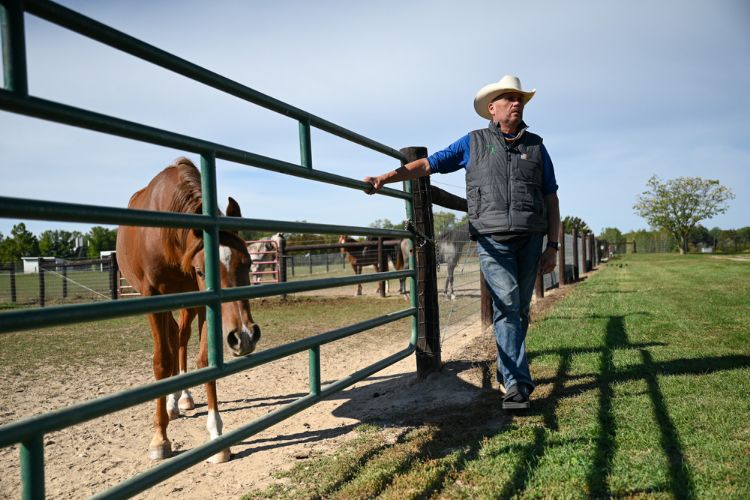
On a quiet stretch of Collins Road, just south of Michigan State University’s main campus, the MSU Horse Teaching and Research Center (HTRC) has stood for generations as a hub of learning and discovery. Today, it's also a place for healing.
For Gayelord Mankowski, a retired Meridian Township police officer and lifelong public servant, the farm has become more than a classroom or research center—it’s a lifeline. For years, the farm was a landmark he’d pass during his hours out on patrol. But about a year ago he decided to stop by.
Diagnosed with stage 4 colon cancer, doctors gave Mankowski six months to two years to live. That was in 2022. After 67 rounds of chemotherapy and countless hours in treatment chairs, Mankowski has found solace in the rhythm of the farm, the kindness of its staff and the company of its horses.
His first visit was simple. He just stopped to take a breath. While there, a mare named Shanel walked up “as if to greet me,” a small moment that led him to introduce himself to the farm manager Paula Hitzler. He decided to return.
Since then, he’s been coming back almost every day. For the staff and students working at the farm, Mankowski has become like part of the family, a regular fixture around the facility and a source of inspiration. For Mankowski, the connection is even deeper.
“If it wasn’t for this place and the love and support I’ve received, I don’t think I’d still be here today.”
A legacy of excellence
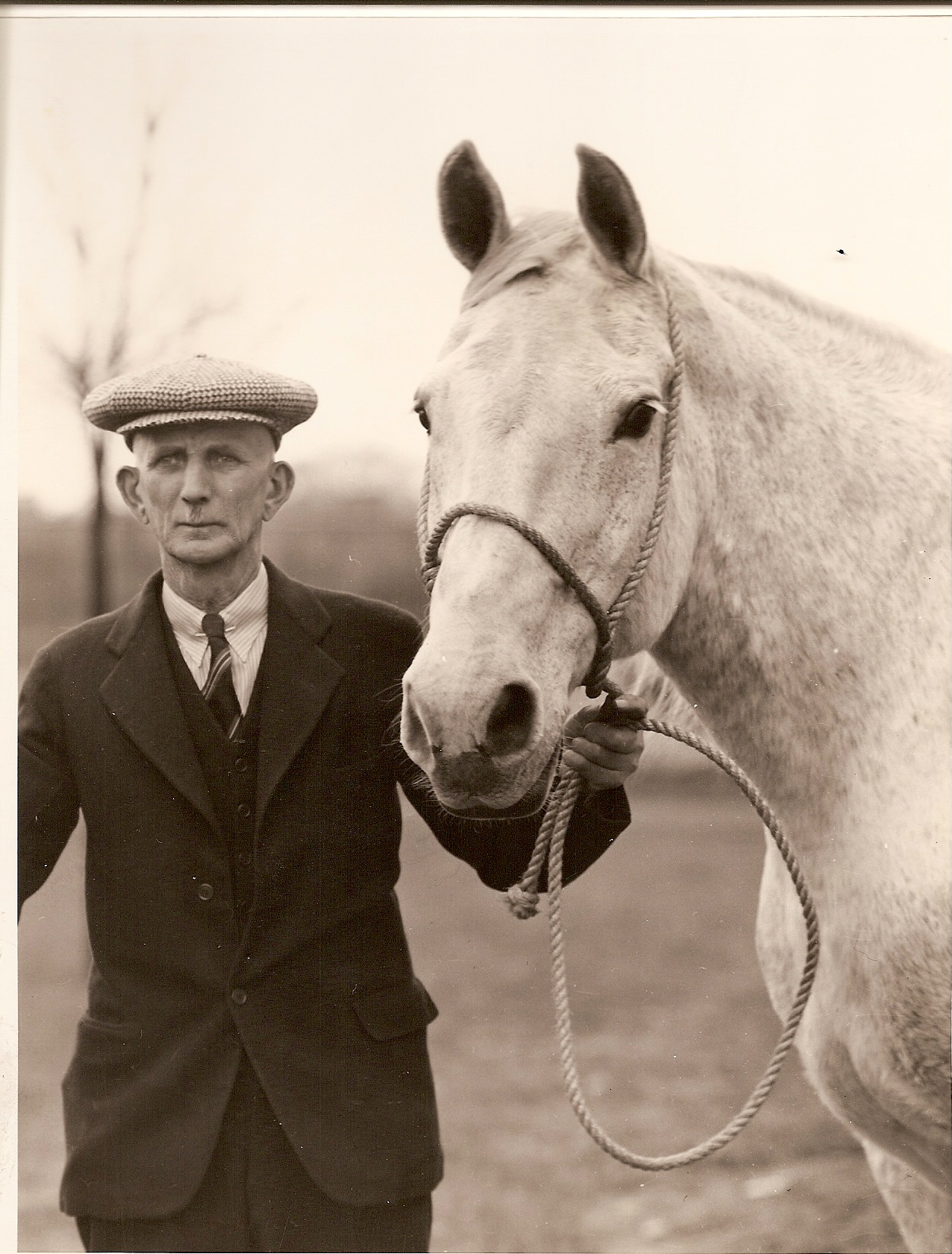
Horses have been part of MSU’s story since 1855. Equine programs at MSU gained prominence due to their excellence in draft horses, with MSU teams earning prestigious national recognition throughout the early twentieth century. When mechanized horsepower replaced draft teams after World War II, university leaders insisted that the horse program continue.
In the mid-twentieth century, W.K. Kellogg helped launch MSU’s Arabian horse breeding program with a donation of the Arabian stallion Amidore, beginning a lineage that endures today. MSU now maintains one of the oldest continuous Arabian horse breeding programs in the nation.
Under Hitzler’s leadership, the farm remains a place where Spartans learn by doing. Students deliver foals, conduct research, manage nutrition and bring well-bred Arabians into training and competition.
As part of MSU AgBioResearch, the center serves as a hands-on learning environment for students in animal science and equine programs, while supporting cutting-edge research in horse health, nutrition, reproduction and management.
Feisty resilience
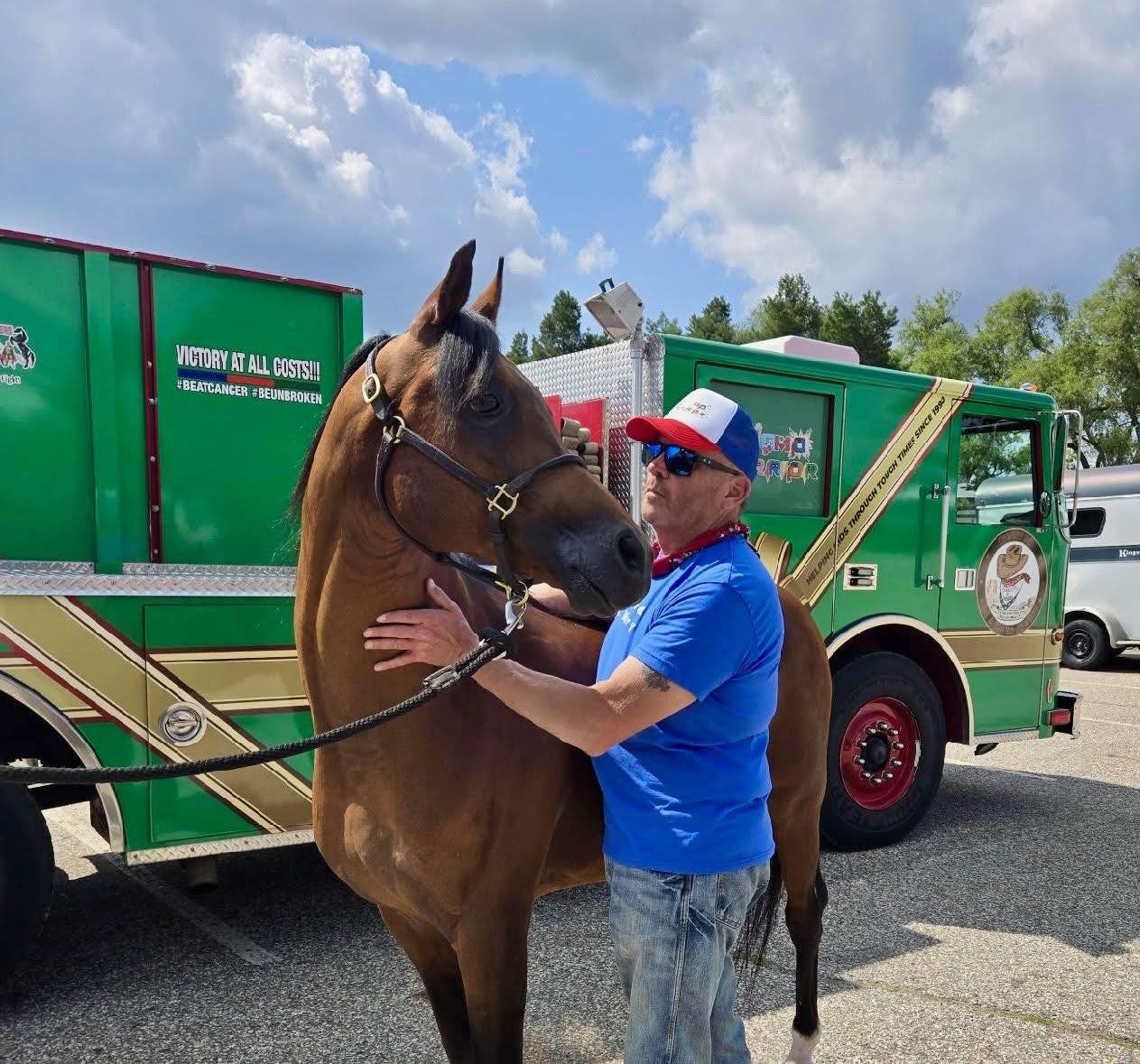
During those early visits to the HTRC, Mankowski quickly formed a bond with Marco. Owned by Connie O’Brien and standing at MSU, Marco commands attention as a strong-willed Arabian stallion and multi-national champion. The two seemed to click right away “At first, Gayelord kind of kept sneaking in here,” said Hitzler, with a smile. “He would get here at 7:30 a.m., walk the fence line and find Marco. You could tell they established a special relationship.”
The farm frequently hosts visitors, both scheduled and unscheduled, so Hitzler and her staff gave Mankowski his space. “On certain days, we would talk, or he would ask questions, but it was very organic,” said Hitzler. “It was clear he did not want to get in our way, but that being here was very personal and therapeutic for him.”
Eventually, they learned of his cancer diagnosis.
It was obvious that spending time with the horses had a profound effect on Mankowski. Hitzler attributes this to their intuitive nature, an innate ability to sense and respond to human emotion.
This phenomenon is well-known to equine industry professionals and is increasingly studied for its therapeutic applications. Research shows that horses’ quiet presence and instinctive, responsive behavior can significantly benefit individuals dealing with a variety of physical and mental health challenges.
Mankowski felt immediately that intuition, especially from Marco. “On my worst chemo days, he’ll meet me right there at the fence. It’s like he knows.” On other days, Marco would go back to being his spirited, independent self.
“Feisty resilience, that’s what Marco’s got,” said Mankowsi.
Marco helps remind him that life is about showing up others and being yourself. “Even in the rain, he’s out there to greet me. If I can come out here, just for five minutes, it gives my brain a chance to refocus and reset. Marco reminds me not to give up. I always say that when the messenger of misery comes to visit, you’ve got to get after it. And this horse keeps me after it.”
The Chemo Cowboy
Gayelord’s resilience is both private and public. He shares his journey on TikTok and Facebook as “Chemo Cowboy,” a persona born from necessity and his own sense of stubborn determination. Early rounds of chemo made his face sensitive to sun, so he wore a cowboy hat.
“I wanted something that represented hope, and Marco, well he inspired it,” he said. He posts videos from the infusion chair explaining ports and pumps, as well as from the pasture showing how horses help him reset. “There’s no mystery to chemo,” he says. “Don’t let a diagnosis pigeonhole you. Be the master of your domain. You define who you are, not the cancer.”
With guidance from younger volunteers, he’s developed a dedicated following on social media, creating a platform that inspires others facing challenges. He posts a weekly video series called “Mondays with Marco” which features words of encouragement and reflection while interacting with Marco and other horses at the HRTC.
After hearing him use incorrect horse terms in one of his videos, Hitzler loaned him a textbook she used in college. “I said, Gayelord, ‘I expect you to read this book, so when you are doing your Chemo Cowboy videos, you are using the proper vocabulary.’”
In turn, Mankowski jokes that he has been given more privileges at the farm than he ever expected. “Thanks to people like Paula and her amazing staff, I’ve gotten a world class education that I probably don’t deserve,” he said. “I even threatened to take a class here.”
To Hannah Brink, a staff member who helps manage daily operations at the farm, Mankowski’s approach to life is an inspiration. “Every day he shows up with a good attitude,” she said. “You’d never know he’s been through so much and had so many rounds of chemo. If he can do it, we can get through tough days too.”

A steadfast commitment to community
Mankowski’s mission to serve and inspire others began long before his cancer diagnosis. As a Meridian Township community police officer and a K9 handler, he spent decades helping families through their hardest days. In 1990, he founded Santa’s First Responders, a nonprofit dedicated to bringing joy to children facing serious illness and families in need.
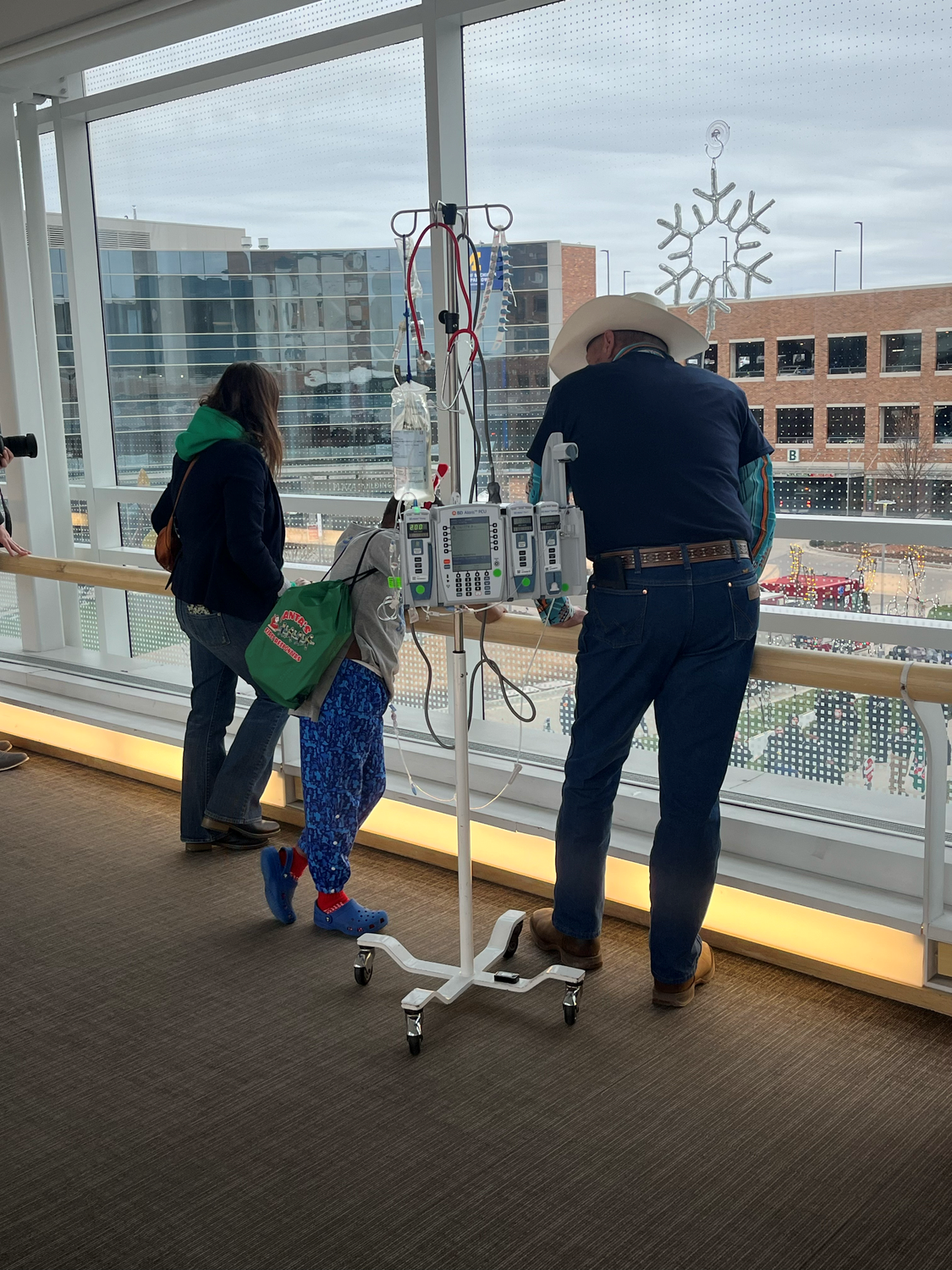
“Our objective is simple,” said Mankowski. “We are here to help tough kids get through tough times.”
Santa’s First Responders organizes holiday parades and gift drives for pediatric cancer patients and underserved families across mid-Michigan. Each year, hundreds of volunteers participate in festive events to deliver gifts and raise spirits.
His efforts extend beyond the holidays. Mankowski has raised funds to provide specialized chemo chairs for kids, ensuring comfort during long treatments. He also coordinates community partnerships to support families year-round, leveraging his network of first responders and local businesses. Drawing on his personal experience, Mankowski has organized trips for pediatric cancer patients to the HTRC and other horse farms around the country.
Throughout his own treatment, Mankowski continues to lead fundraising events and outreach for Santa’s First Responders. And with the farm’s proximity to McClaren Hospital, Mankowski is working on a new initiative aimed at making the HTRC more accessible for patients and medical staff.
“The idea is to create quiet spaces where patients, nurses, doctors and first responders can rest and recharge,” he said. “I want this to be a place for anyone who needs it. Somewhere accommodating for those with mobility issues that allows them to experience the peace this place can offer. I know from experience, a couple minutes here with a horse or a foal can change an entire day.”
Keep Showing Up
Mankowski doesn’t sugarcoat his situation. He's realistic about what he’s up against, and his daily experience is one often filled with pain and uncertainty. But it’s also full of joy, purpose and community he loves. And that’s where he chooses to focus.
“The way I see it, I am no different from anyone else. We are all dying of something, I just happen to know what will probably get me in the end.”
While determination and optimism have always been some of Gayelord's most defining qualities, everyone can use an occasional reminder.
And for that, he can thank his feisty friend Marco.
“When life gets hard, you don’t give up, you keep showing up. Honestly, I feel like the luckiest guy in the world. Not because I get to see these horses, but because I get to share their magic with others. If we can bring one smile, one moment of peace, it’s worth it.”
Learn more about the MSU Horse Teaching & Research Center.
Learn more about Santa's First Responders.
Photo Credits: Amanda Zlotek, Paula Hitzler and Gayelord Mankowski.