Freshwater drum: The overlooked native fish that has been crushing trillions of invasive mussels in Lake Erie
 Print
Print Email
EmailThe invasion of zebra and quagga mussels dealt a heavy blow to many Great Lakes fisheries, but new research suggests that the humble sheephead has been a key player in the recent decline of invasive mussels in western Lake Erie.
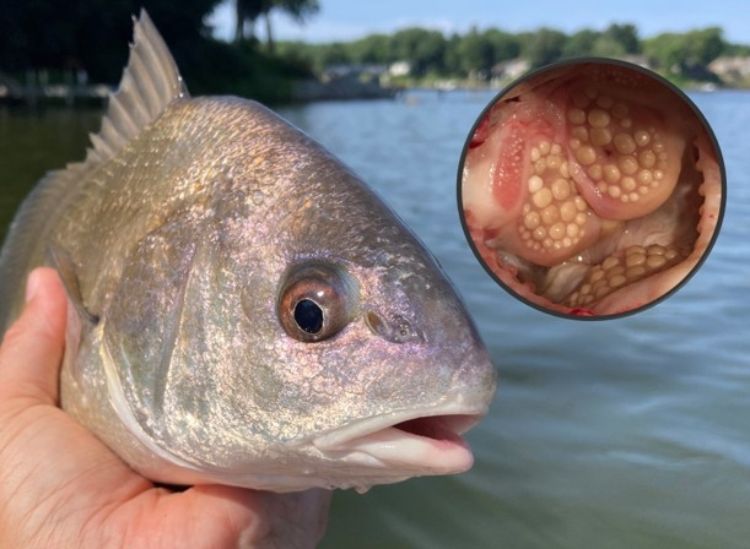
The zebra mussel and its close cousin the quagga mussel are two of the most destructive Great Lakes invaders. Collectively known as dreissenid mussels, these filter-feeding pests remove microscopic algae and other suspended material from the water. This led to dramatic increases in water clarity in Lake Huron, Lake Ontario, and Lake Michigan after the dreissenid invasion. While clear water may look inviting, it is not very productive and can’t support much life.
Invasive mussels have been implicated in the decline of native invertebrates like Diporeia (a scud), Mysis (a small shrimp) and Daphnia (a water flea) Lake Michigan. This, in turn, means less food available for prey fish and the young of many gamefish. Lake Michigan has seen declines in the harvest of yellow perch, lake whitefish, and most trout and salmon species since the 1980s, and food web changes following the mussel invasion are one of the major contributing factors.
Soon after the initial invasion of zebra mussels, biologists realized that only a handful native fish species were well-equipped to feed on invasive mussels. Some fish species have teeth in the back of their throats that are built for crushing shells. These molar-like pharyngeal teeth are only found in a few North American fish. Pumpkinseed and redear sunfish have them, but they also have small mouths that are not suitable for eating large mussels. River redhorse and copper redhorse also have molar-like pharyngeal teeth, but they are only found in a few high-quality rivers in the Great Lakes region.
The only other native fish with potential to prey heavily on these shelled invaders is the freshwater drum. Drum, also known as sheephead, are fairly abundant in warm, shallow waters of the Great Lakes and connected waterways. The West Basin of Lake Erie, Saginaw Bay, and drowned river mouth lakes of West Michigan provide good habitat for drum, while the offshore waters of lakes Superior, Michigan, and Huron are too deep and cold. Early research suggested that drum might be able to control zebra mussels in certain areas, but hopes were not high for anything beyond localized effects.
New research shows impact
A new scientific paper by Kevin Keretz and other researchers shows that drum have been having a much larger impact than we thought. Keretz and crew conduct annual bottom trawl surveys in the West Basin of Lake Erie. Large trawl nets are dragged through the water, and they do a good job of catching whatever fish species happen to be present. In 2014, this meant a whole lot of freshwater drum.
When researchers started to put numbers on the prevalence of invasive mussels in drum diet together with the biomass of drum in the West Basin of Lake Erie from their trawl surveys, they realized that drum consume far more mussels than originally assumed. Drum are somewhat opportunistic feeders. They can and do consume a variety of invertebrates and small fish, which is one reason that there was some initial skepticism regarding their ability to control invasives.
Although at least 16 different food items were consumed by drum in Lake Erie, diet analysis found that 88% of drum over 19 inches long and 100% of drum over 23 inches long had consumed mussels. The only food item that was more important than dreissenid mussels was Hexagenia – the super-abundant giant mayfly or ‘fishfly’ that is a sign of a healthy lake but can also be considered a nuisance when swarms hatch in early summer.
Eye-opening results
Keretz and coauthors calculated the total biomass of mussels consumed by drum on an annual basis from 2013 to 2023. The results were eye-opening. On average, drum consumed over 512,602 pounds of dreissenid mussels per square mile in western Lake Erie. Consumption was highest in 2013, the first year of the study, at 1.2 million pounds per square mile. This equated to 1.31 trillion mussels consumed by drum in the West Basin alone in 2013.
Other studies have shown a steady decline in dreissenid biomass in the West Basin, dropping from 125,619 lbs/mi2 in 2004 to as low as 6,852 lbs/mi2 in 2019. This suggests that drum predation has been able to exert considerable influence on mussel populations in Lake Erie, outdoing even the invasive round goby. The round goby was an accidental import native to the same waters as dreissenid mussels, which also has crushing pharyngeal teeth adapted to eating mussels. Estimates of peak round goby consumption in the Central Basin of Lake Erie were only about 25% of peak drum consumption, though.
The standing stock of dreissenid mussels present in the West Basin actually appears to be lower than the amount of mussels consumed on an annual basis. At first, this sounds unlikely – but dreissenid mussels also reproduce at a very high rate. This suggests that drum are consuming enough mussels to not only keep up with their high annual production, but also to reduce their standing biomass. While other factors like low oxygen levels and high temperatures may also have had a role in the decline of dreissenid mussels in Lake Erie’s West Basin, the evidence points to our native freshwater drum as an unlikely hero in the fight against Great Lakes invaders.
Michigan Sea Grant helps to foster economic growth and protect Michigan’s coastal, Great Lakes resources through education, research, and outreach. A collaborative effort of the University of Michigan and Michigan State University and its MSU Extension, Michigan Sea Grant is part of the NOAA-National Sea Grant network of 34 university-based programs. This report was prepared by Michigan Sea Grant under award NA24OARX417C0157-T1-01 from the National Oceanic and Atmospheric Administration, U.S. Department of Commerce through the Regents of the University of Michigan. The statements, findings, conclusions, and recommendations are those of the author(s) and do not necessarily reflect the views of the National Oceanic and Atmospheric Administration, the Department of Commerce, or the Regents of the University of Michigan.