Growing the Local Food Movement: 2026 Northwest Food Hub Network Summit
 Print
Print Email
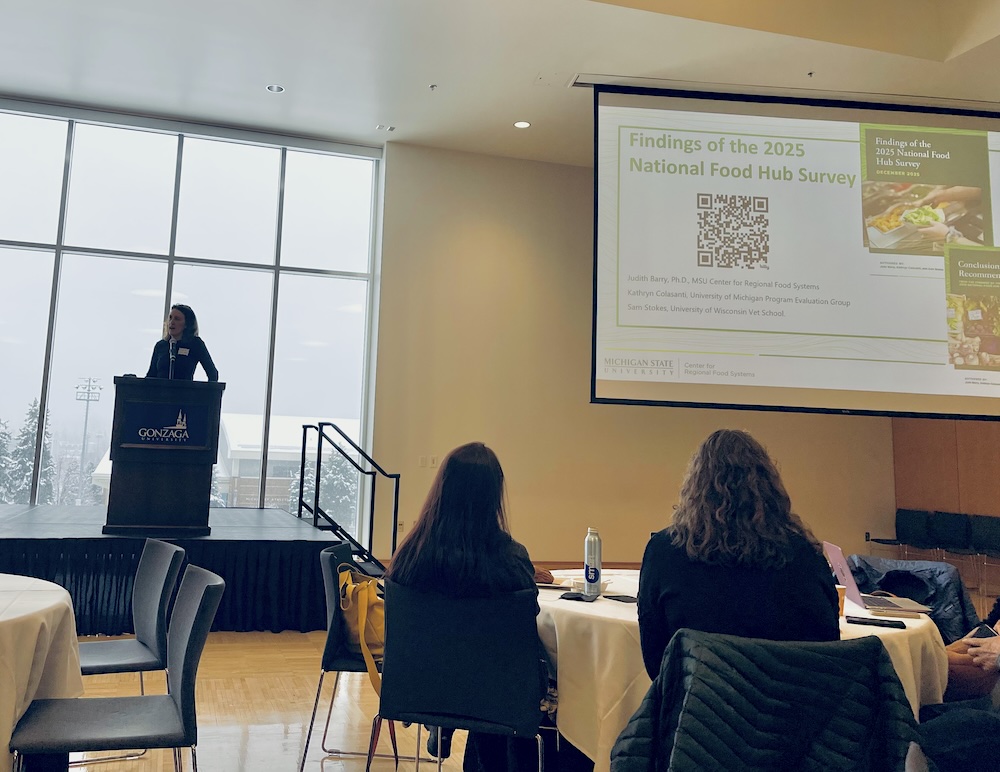
EmailMichigan Food Hub Network Co-coordinators Jamie Rahrig and Lewis Hughes joined Jude Barry of CRFS at the Northwest Food Hub Network Summit to highlight findings of the 2025 National Food Hub Survey and engage with other food hub network leaders.

Per Findings of the 2025 National Food Hub Survey report, 73% of surveyed food hubs participate in a food hub network. Individually, food hubs are businesses or organizations that manage the aggregation, distribution, and marketing of locally and regionally produced food products. A food hub network connects these unique entities from their state or region and serves them through shared learning, networking, and, in some circumstances, shared trade routes, and other opportunities in support of shared goals.
To encourage nationwide food systems leaders to connect and collaborate, the Northwest Food Hub Network brought together over 180 participants, including farmers, food hub managers, and food hub network leaders, to their fifth annual summit. Held at Gonzaga University in Spokane, WA over March 12-13, 2026, this two-day conference offered local food hub and farm tours, as well as breakout session and innovation panels. Kicking off the conversation on Growing the Local Food Movement, Jude Barry, Associate Director of Michigan State University Center for Regional Food Systems, presented on the latest findings from the 2025 National Food Hub Survey. This led to a generative panel discussion on supporting the needs of food hubs and the opportunities for regional food hub networks.
“Food Hubs are a necessary sector in supporting food and farm businesses, feeding local communities' local food, and strengthening local economies. Our survey helped identify the needs of food hubs as they seek to serve farmers through new market channels such as schools, institutions, retail outlets, and direct markets,” Barry said. “It was powerful to share the results and engage in such rich conversation with hubs and networks!”
As part of an interactive forum, food hub network leaders from across the country explored common interests and aligned on shared priorities. This included representatives from nine organizations, including California Food Hub Network, Eastern Food Hub Collaborative, Kansas City Food Hub, Michigan Food Hub Network, New York Food Hub Collaborative, Northwest Food Hub Network, Northwest Indiana Food Council, Oregon Food Hub Network, and Washington Food Hub Network. Jamie Rahrig of CRFS and Michigan State University Extension and Lewis Hughes of Michigan State University Extension, co-coordinators of the Michigan Food Hub Network, attended the summit and the interactive forum to learn from other food hub networks.
“It was great to connect with so many networks from across the country,” Hughes said. “Hearing how others are tackling similar challenges - and where they’re innovating - gave us new ideas and affirmed the importance of staying connected as a national community. We’re excited to bring these insights back to Michigan as we continue strengthening coordination, market access, and overall support for our state’s food hubs."
The Northwest Food Hub Network summit provided the opportunity for participants to establish connections across the country and to tour food hubs to see successful models first-hand. Through attending this summit, CRFS was able to learn from fellow food system leaders and coordinate towards strengthening local food systems in Michigan and beyond.
“Connecting with so many network leaders from across the country provided us with ideas to better support the Michigan Food Hub Network!” Rahrig said. “We look forward to taking these ideas, such as how MSU can provide cross-collaboration opportunities to support values-based procurement in Michigan.”
About the Michigan State University Center for Regional Food Systems
The Michigan State University Center for Regional Food Systems advances regionally-rooted food systems through applied research, education, and outreach. We do this by uniting the knowledge and experience of diverse stakeholders with that of MSU faculty and staff. Our work fosters a thriving economy, equity, and sustainability for Michigan, the nation, and the planet by advancing systems that produce food that is healthy, green, fair, and affordable. Learn more: foodsystems.msu.edu