Inside John Fricke’s Work in MSU’s Arthropod Collection
 Print
Print Email
EmailAdjunct curator John Fricke reflects on more than 15 years at MSU’s A.J. Cook Arthropod Research Collection
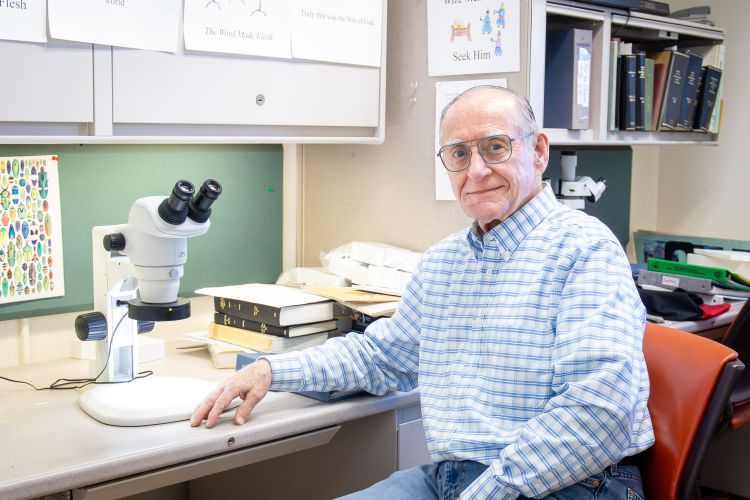
John Fricke is an adjunct curator in Michigan State University’s Albert J. Cook Arthropod Research Collection, where he has spent more than 15 years carefully identifying and organizing insect specimens, especially within the Hymenoptera. His work relies on detailed observation and the use of scientific keys, which are guides that help curators identify species based on physical traits like shape, structure and coloration. With a background rooted in early hands-on biology experiences, Fricke brings a patient, methodical approach to curatorial work and a deep appreciation for the role these collections play in supporting research and preservation.
Q: What originally sparked your interest in arthropods? Was there an early experience that set you on this path?
A: I was a sophomore in high school. (1960) During study hall, my biology teacher allowed me to go to the biology lab. There, I made slides of material from the classroom aquarium. The first thing that I saw was a strand of Spirogyra. The details were just as clear as those in our biology text. So, what is the connection to the arthropods? In curation, details make the difference. A knowledge of insect external morphology is the foundation for making accurate determinations.
Q: What first drew you to the A. J. Cook Arthropod Research Collection, and what has kept you involved over the years?
A: I worked one day a week in the University of Michigan "Insect Range". I knew I wanted to continue that kind of work at MSU. I asked Mark O'Brien, collection manager at U of M, to let the collection manager at MSU (Gary Parsons) know that I wanted to work on the Hymenoptera collection. After the meeting with Gary Parsons, I walked out with a key to the Hymenoptera room. I am now in my 16th year of this work, and I never tire of it. The mass of undetermined material is more than I can curate in the next 16 years.
Q: Has there been a particular moment or project that made you feel especially proud of the collection’s growth or direction?
A: While working on the collection, I was thrilled to find material collected by Dr. Roland Fischer. He was an invertebrate collector traveling much of the U.S. during the summers. I discovered material he had collected from the early 1950s to the year before his death in 1991. My first real experience with insects was during the second year of a three-year program for high school teachers sponsored by the National Science Foundation. This enabled high school biology teachers to earn a Master of Arts degree in science education. I took Dr. Fischer's field course in Entomology. This was just the beginning of a long association with Dr. Fischer.
Q: What does a typical day look like for you in your adjunct curator role?
A: My work begins at about 9:00 am and I leave between 11:30 and 12:00 noon. I spend between 10 and 15 hours per week on the collection. I usually work on one family at a time. The last family I finished work on were the Eurytomidae. I was able to find a key for this family, and it took nearly a year to determine the available material. About 10 years ago I, by accident, found a drawer of 1,000 undetermined Perilampidae. Fortunately, I had previously worked on this group and had a key for this family. Sometimes keys are not available, but determined material is included in the current collection holdings. In this situation, I study the determined material in the collection and make notes on their morphology and coloration of the species in the collection. I then examine the undetermined material and look for matches with my notes. When determinations are complete for a group, a determination label is prepared for each specimen. This is added to the pin bearing the insect. Then this is placed species by species into the collection.
Q: Do you have a favorite part of your weekly routine in the collection?
A: My favorite part of my work is finding matches between specimens and descriptions in published keys or in matches between my notes on species and the material at hand.
Q: What’s something about curatorial work that you wish more people understood?
A: Curatorial work requires patience, persistence, and quality stereo-microscopes paired with bright diffuse light. Proper light is required to disclose the details of the surfaces of these small arthropods. Additionally, curatorial work requires the availability of diagnostic keys to the material in question. When no keys are available, a curator must rely on the work of previous curators and match new material to those previously determined. Perfect matches require excellent equipment.
Q: Which taxonomic groups or projects do you most enjoy working with?
A: My first ten years working on the collection included Crabronidae, Sphecidae, Megachilidae, Perilampidae, and wasps in general. I avoided bees in particular, but in the last 5 years I broke down and began working on bees. I would work on any group for which I could obtain appropriate keys.
My more recent projects have concentrated on Braconidae and Ichneumonidae. My current work focuses on undetermined material of the Pimplinae. Here is another case where I do not yet have a key for this group, but I have many previously determined species in the collection that I can compare to this undetermined material.
Q: What challenges do you face in maintaining or expanding the collection?
A: The greatest challenge I have is finding keys.
Q: How have relationships with students, colleagues or visitors shaped your experience here?
A: University students very rarely visit the Hymenoptera collection. I have had small groups of elementary students from my church visit the collection. When they do, I also show them the rooms for beetles, butterflies and moths, and the true flies. Nevertheless, I warmly greet all the visitors to the collection and encourage them to examine material I have on hand under the stereo-microscope.