Is this aquatic plant invasive?
 Print
Print Email
EmailLearn to distinguish between invasive and native aquatic plants of Michigan with our series of illustrated identification cards.
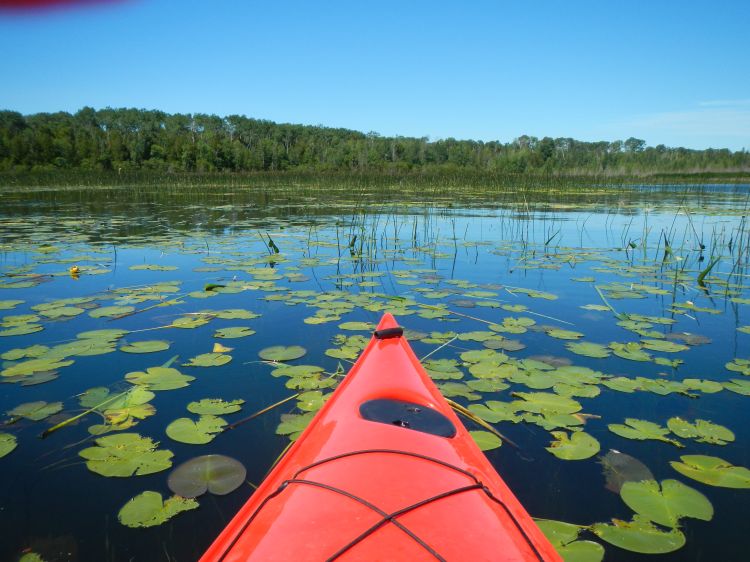
With its abundance of lakes, rivers, and wetlands, Michigan is vulnerable to the impacts of aquatic invasive plants. Invasive plants can negatively impact habitat, water quality, and biodiversity. Fortunately, new invasions can often be stopped if caught early. To help Michiganders identify invasive aquatic plants, Michigan State University Extension created a series of illustrated identification cards.
Each card includes a full-color illustration of an invasive aquatic plant, highlighting key features that distinguish it from other Michigan species. In most cases, the opposite side of the card features a similar-looking native plant for comparison. Each card also includes instructions on how to report the invasive species if you suspect you have found it.
Eurasian watermilfoil
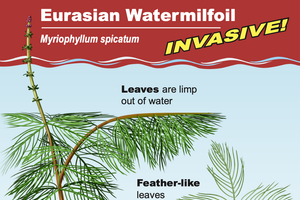
Eurasian watermilfoil is among the most widespread invasive plants in Michigan’s waters. Unfortunately, it can easily be confused with many of Michigan’s 6 native watermilfoil species that have similar green, feather-like leaves arranged in whorls around the stem. Eurasian watermilfoil is distinguished by having more than 12 pairs of leaflets per leaf, and these leaves fall limp when removed from the water. It also tends to have a reddish-brown stem. A hybrid form may also be encountered, which leads to intermediate traits with native Northern watermilfoil.
Curly-leaf pondweed
Curly-leaf pondweed is another well-established invasive plant in Michigan. It is sometimes confused with some of the over two dozen native Michigan pondweeds, but a few key characteristics set it apart. Curly-leaf pondweed is the only pondweed found in Michigan whose leaves have serrated edges. It gets its name from its wavy-edged leaves that resemble lasagna noodles. Curly-leaf pondweed forms a rigid, spiky structure called a turion in mid- to late summer for overwintering.
Hydrilla
Hydrilla is a very recent invader to Michigan waters; in fact, it is currently only known from one invasion of ponds in southwest Michigan. It has simple green, serrated leaves and a long flexible stem; spines are also sometimes found on the underside of the leaf along the midvein. These visible serrations set it part from Elodea (waterweed), a native beneficial plant. Hydrilla also differs in that it produces tubers in the sediment.
Starry stonewort
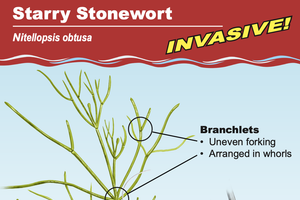
Starry stonewort is an invasive macroalga (large algae that are visually similar to rooted plants) that has rapidly invaded lakes in Michigan’s Lower Peninsula and appears to be moving northward. Starry stonewort has smooth green “stems” and unevenly forking branches arranged in whorls. Its most unique feature is the tiny white, star-shaped bulbils (reproductive structures) that it produces on clear filaments that look like fishing line in the sediment. These stars, along with its smoothness and uneven branching, distinguish starry stonewort from its native relative, Chara (muskgrass).
European frog-bit
European frog-bit is a free-floating invasive plant that was previously known only from along the Lake Huron coast and connecting waters but has recently spread across the Lower Peninsula. Appearing somewhat like a tiny water lily plant, European frog-bit has small, notched leaves that are 1-2 inches across. It produces small white flowers with three petals and yellow centers, and runners create large floating mats of this plant. Frog-bit should not be confused with Michigan’s native white water lily, which produces much larger leaves (lily pads) and large, complex flowers.
Water lettuce and water hyacinth
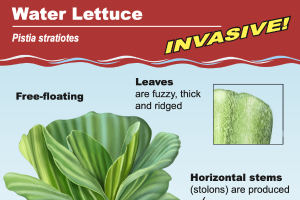
Water lettuce and water hyacinth are two free-floating invasive plants that are occasionally found in Michigan waters because of their use in water gardens and ornamental ponds. Both are easily identified and difficult to confuse with any Michigan native plants. Water lettuce has thick, fuzzy, ridged green leaves and long brown roots. Water hyacinth has round, waxy green leaves held above the water by inflated green petioles. It also produces showy upright flower clusters that range from purple to white, and dense, feathery roots.
Learning to identify aquatic invasive plants is critical to slowing their spread in Michigan lakes, rivers, and wetlands. If your organization is interested in large quantities of any of these identification cards for distribution, they are currently available in packs of 100 of each design at no cost by filling out our request form at bit.ly/aiscards. You may also be interested in our more detailed 2025 publication, “Aquatic Invasive Plants: A Field Guide for Michigan Lakes, Streams, and Ponds.”