The milfoils: The good, the bad, and the ugly
 Print
Print Email
EmailDiscover the differences between Michigan’s native, beneficial watermilfoil plant species and their non-native counterparts.
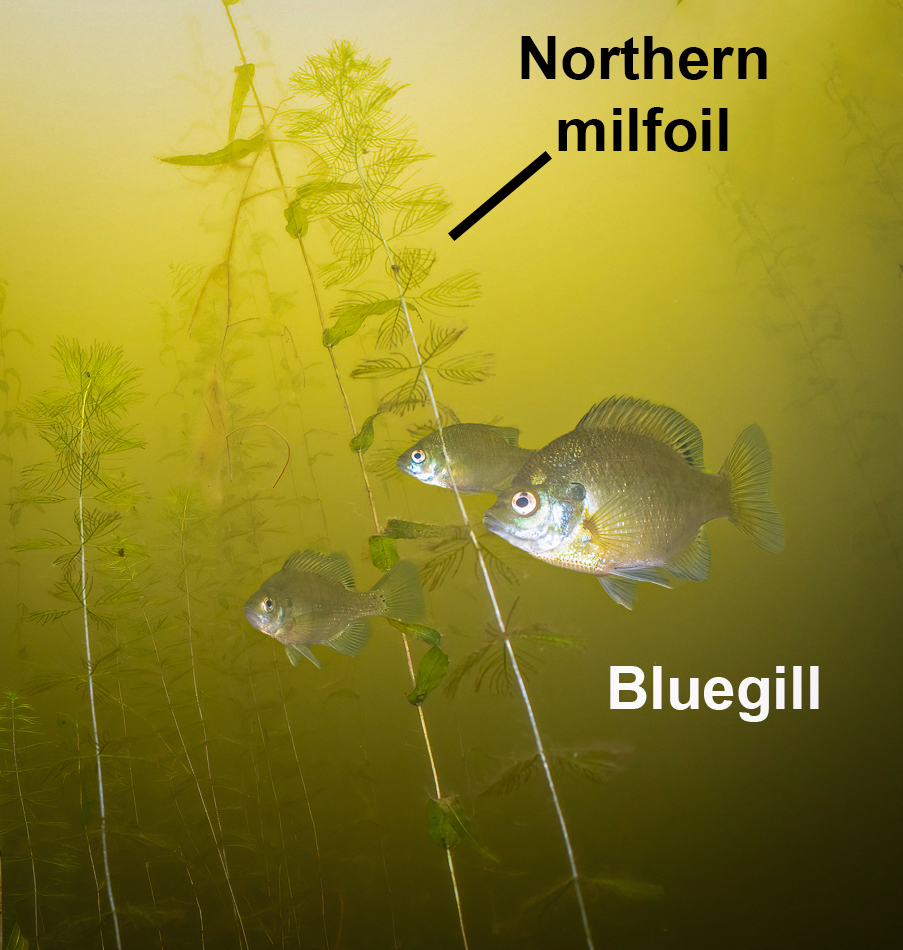
“The sunlight cuts a swath through the feathery leaves of the watermilfoil. A school of Bluegill gleams golden as they swim from the shadows through the sunrays, like actors moving through the spotlight on a stage.”
– Modified from Borman et al. (2014), "Through the Looking Glass: A field guide to aquatic plants"
If you spend time on Michigan’s inland lakes — casting a line, paddling a kayak, or enjoying time at the family cabin, you’ve probably crossed paths with a milfoil (Figure 2). For many riparians and anglers, that single word triggers dread — tangled propellers, clogged swimming areas, and a looming fear of “that invasive plant.”
But here’s a twist worthy of a classic western: not all milfoils are villains. In fact, most milfoils in Michigan are native, beautiful, and ecologically important. To really understand milfoil in Michigan, we need to separate the heroes from the outlaws — and yes, there’s an ugly one too.
The good: Michigan’s native milfoils
Let’s start with the good guys: the native milfoils.
Michigan has six native milfoil species (Table 1). The four most common include: Northern milfoil (Myriophyllum sibiricum), various-leaved milfoil (M. heterophyllum), whorled milfoil (M. verticillatum), and slender milfoil (M. tenellum). The other two species — Farwell’s milfoil (M. farwellii) and alternate-flowered milfoil (M. alterniflorum) — are found primarily in Michigan’s Upper Peninsula.
Table 1: Michigan's milfoil species
| Common Name | Scientific Name | Status |
| Northern milfoil | Myriophyllum sibiricum | The Good |
| Various-leaved milfoil | Myriophyllum heterophyllum | The Good |
| Whorled milfoil | Myriophyllum verticillatum | The Good |
| Slender milfoil | Myriophyllum tenellum | The Good |
| Farwell's milfoil | Myriophyllum farwellii | The Good |
| Alternate-leaved milfoil | Myriophyllum alterniflorum | The Good |
| Eurasian milfoil* | Myriophyllum spicatum | The Bad |
| Hybrid milfoil* | Myriophyllum sibiricum x spicatum | The Bad |
| Parrot feather* | Myriophyllum aquaticum | The Ugly |
*Denotes an aquatic invasive species.
Except for slender milfoil, which more closely resembles tiny asparagus, all of these milfoils share a characteristic column-like growth form, with feathery leaves arranged along upright stems. These species grow entirely submersed, with only their flowering structures emerging several inches above the water’s surface.
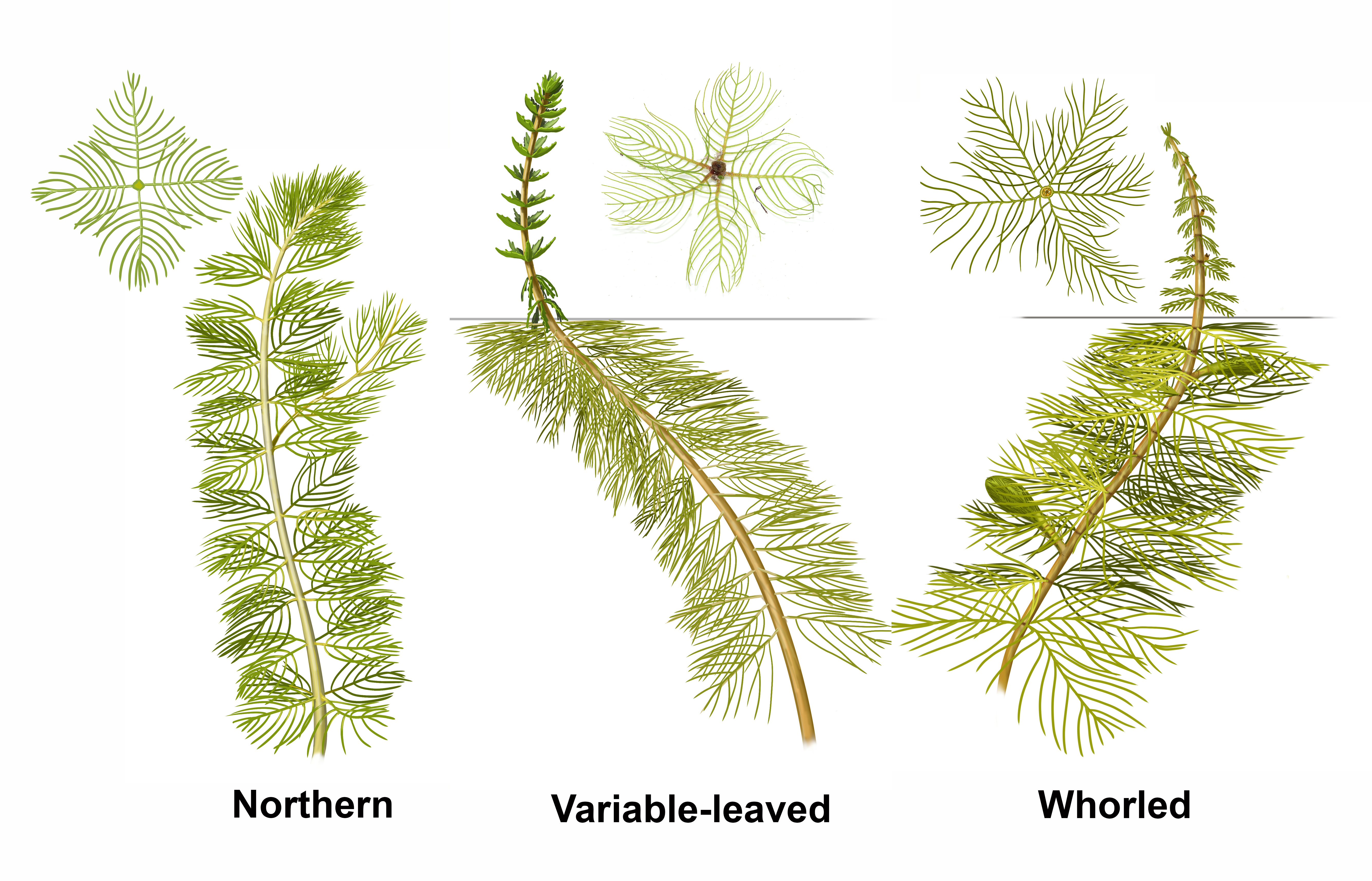
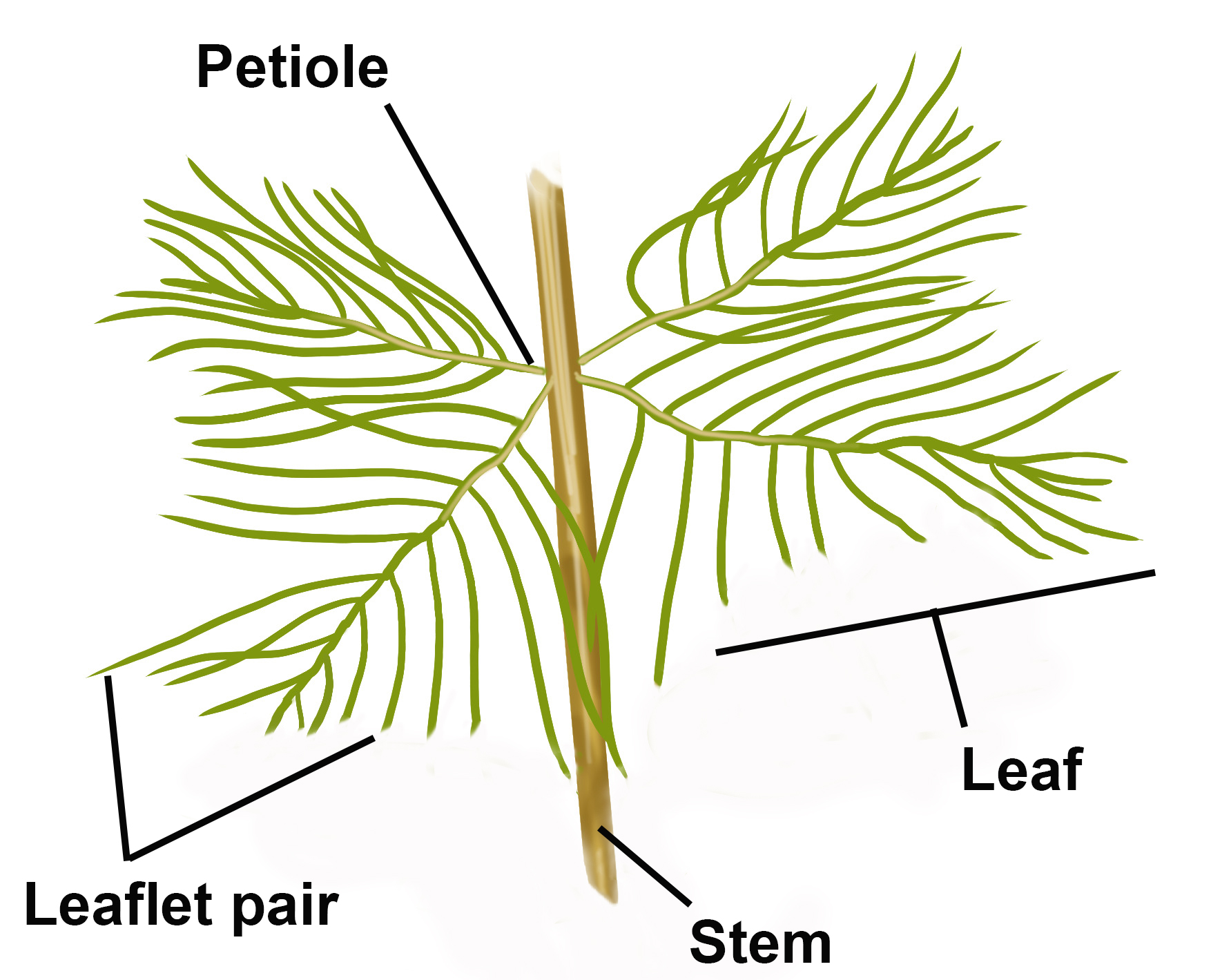
To help identify which native milfoil is present in your lake, examine the stem color, the arrangement of leaves around the stem, and the number of leaflets. Figure 3 illustrates three common native milfoil species, and Figure 4 provides detailed views of their leaf anatomy.
Native milfoil species are valuable members of the aquatic ecosystem. They provide habitat for fish and aquatic insects, and their fruits and foliage are consumed by a variety of waterfowl. They also stabilize sediments, which helps to keep the water clean and clear. In fact, a study in Canada showed that macroinvertebrates like snails actually grow larger and more abundantly on native milfoil species than the invasive Eurasian milfoil.
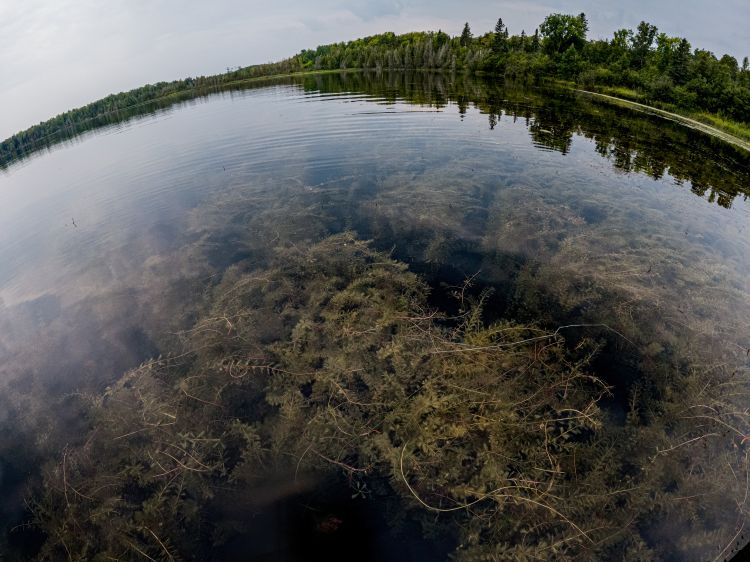
Native milfoil species usually grow in patches, coexist with other aquatic plants, and don’t form the thick, surface-choking mats that hinder recreation (Figure 1/cover photo). Our native milfoils are just one part of a diverse aquatic plant community that provide many functions and services to our lakes.
However, like the protagonists of many spaghetti westerns, native milfoil species can be misunderstood, misidentified, and blamed for problems they didn’t cause. In this lake story, it can be a case of mistaken identity simply because the good guys share the same last name with the outlaws.
The bad: Eurasian milfoil and its hybrid kin
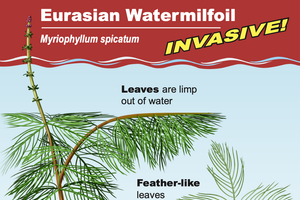
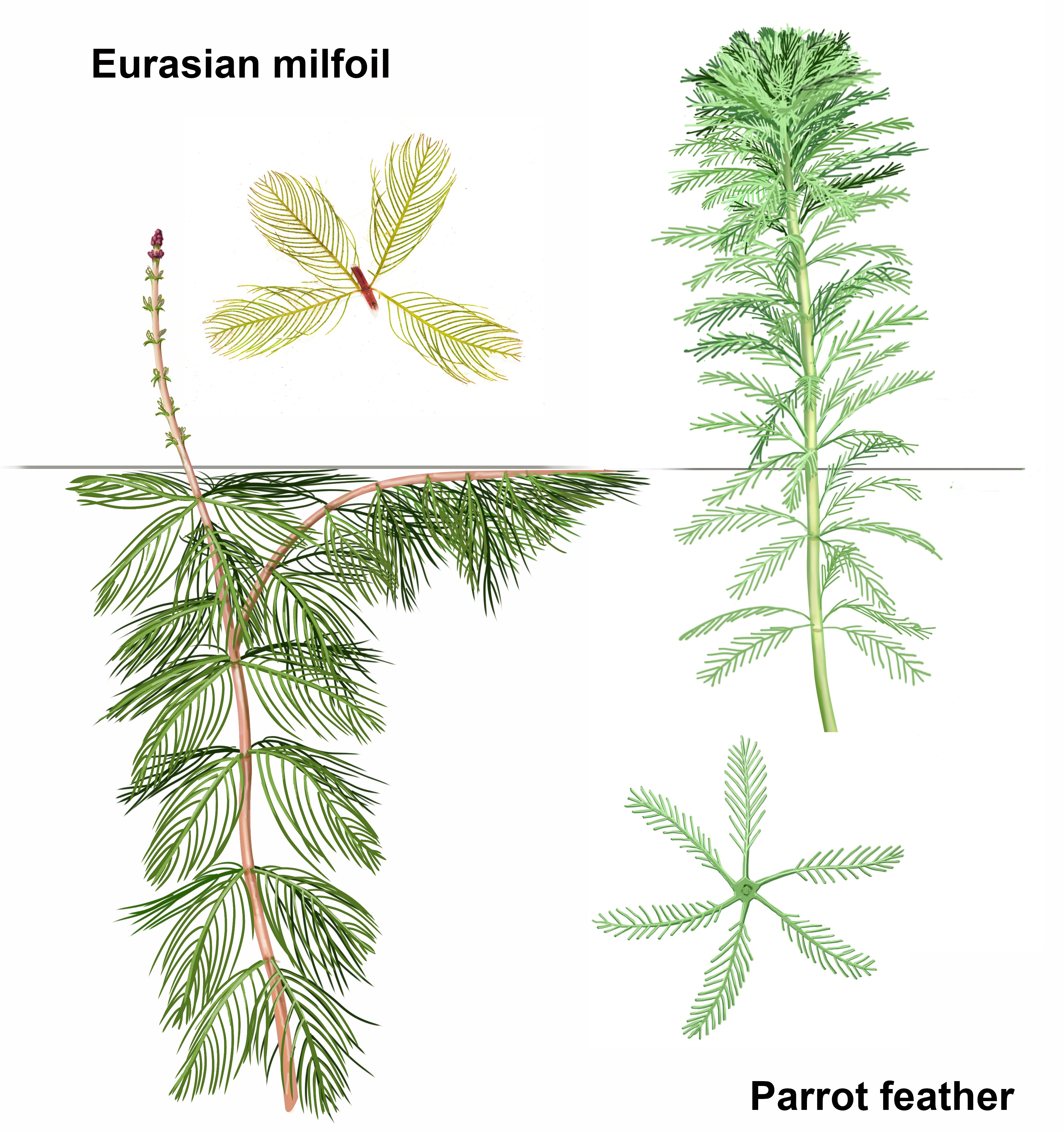
Now we get to The Bad — the species that earned milfoil’s invasive reputation. Eurasian milfoil (Myriophyllum spicatum) is one of Michigan’s most notorious aquatic invaders (Figure 5).
Introduced from Europe and Asia to the Great Lakes region in the 1940s, it has spread widely across the landscape. One of its primary mechanisms of spreading is through fragmentation, meaning that a single broken stem can float away, root, and start a new infestation.
This is why using a plant harvester is not recommended on lakes with small infestations of Eurasian milfoil, as the harvester may inadvertently spread fragments around the lake. The small fragments may also hitch a ride on boats, trailers, or fishing gear and accidentally jump from lake to lake. This is why the “Clean, Drain, Dry” message is so important to Michigan’s lake culture.
Once established, Eurasian milfoil can grow quickly, form dense, branching surface mats, and shade out native plants below. In some lakes, monocultures of Eurasian milfoil reduce biodiversity, alter fish habitat, and interfere with recreation.
To tell Eurasian milfoil from other milfoil species, look for a submersed plant with feathery leaves that are arranged in perfect whorls around the stem. The leaves will have 12 or more leaflet pairs and have a stem that is often pinkish in color.
Unfortunately, there is also hybrid milfoil (Myriophyllum sibiricum x spicatum) — a cross between Eurasian milfoil and our native northern milfoil. This hybrid can be difficult to identify and manage, as some strains are resistant to commonly used herbicides.
From a management perspective, these “bad” milfoils are costly. Lakes spend significant time and money trying to contain them, often with mixed results. And once established, eradication is rarely realistic; control and long-term management become the primary options.
In true western fashion, these are the gunslingers that ride in fast, take over the town, and don’t play fair.
The ugly: Parrot feather enters the scene
Every great western needs a truly ugly antagonist, and in Michigan’s milfoil saga, that role belongs to Myriophyllum aquaticum, better known as “parrot feather.” Unlike other milfoils, parrot feather grows above the water’s surface (Figures 5 & 6), forming thick, feathery mats that look almost ornamental — and that’s exactly how it arrived.
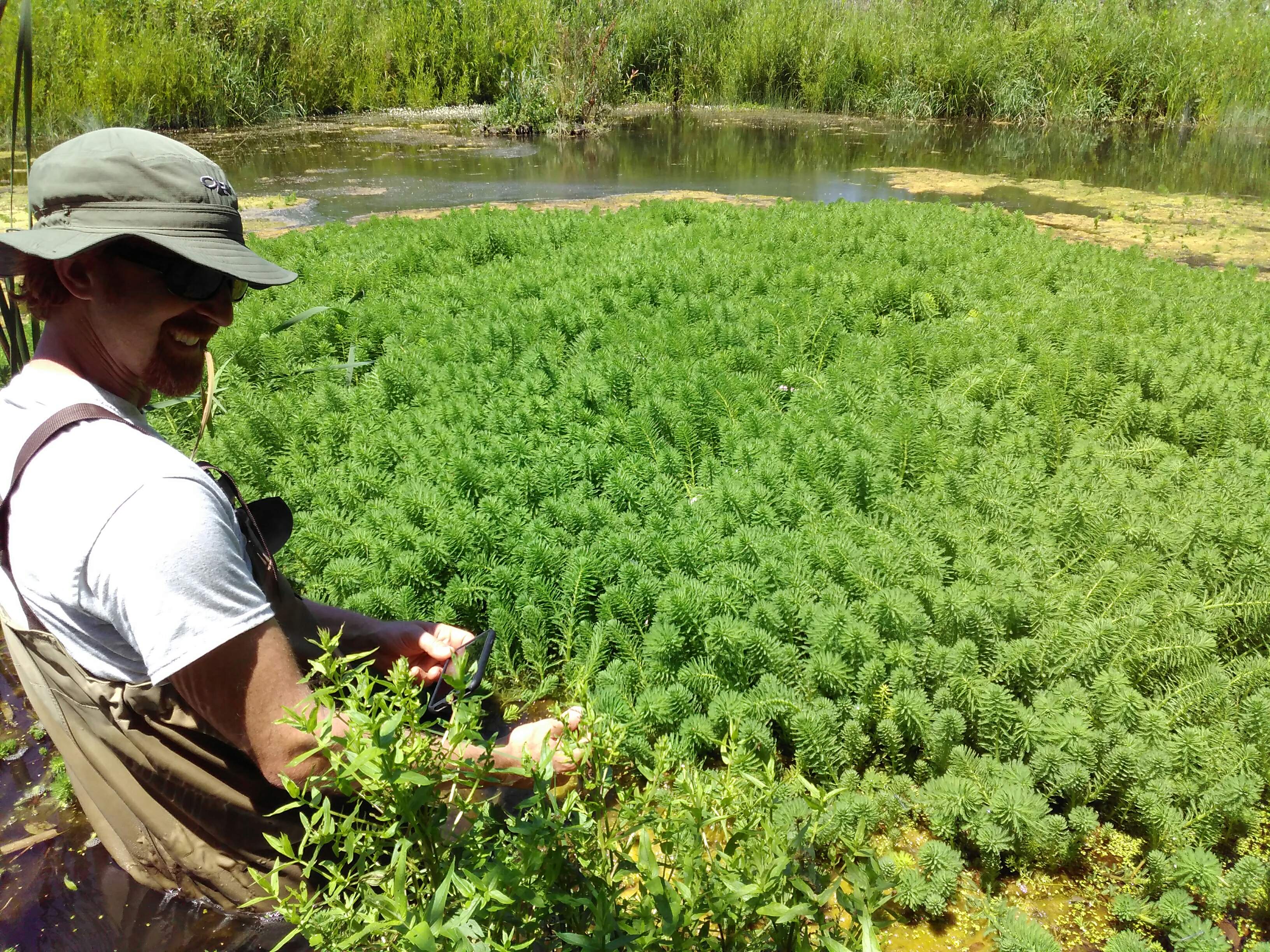
Sold historically for water gardens and backyard ponds, parrot feather escaped cultivation and found its way into natural waters. Parrot feather was originally documented in Michigan in 1962, but the record was largely overlooked. Newer infestations were discovered in 2013, which prompted an immediate eradication response from what is now the Department of Environment, Great Lakes, and Energy (EGLE) in southeast Michigan.
Once established, parrot feather can dominate shorelines, wetlands, pond margins, and even moist soil. Its dense growth can interfere with recreation, reduce oxygen levels in the water column, suppress native plant growth, and decrease macroinvertebrate diversity. There is also evidence that mosquitoes benefit from its thick growth.
Parrot feather is on Michigan’s Invasive Species Watch List, which is akin to being plastered on wanted posters around the state. We haven’t found it in too many places, but the threat of this species to our waterways is high.
If you think you discovered this prohibited species, report its location as soon as possible to EGLE at egle-wrd-aip@mi.gov. If possible, include pictures with reports.
The final scene: A smarter way forward
In “The Good, the Bad, and the Ugly” film, survival depends on knowing who you’re dealing with. Michigan’s lakes are no different. One of the biggest takeaways for lake homeowners and enthusiasts is this: not all milfoils should be treated the same. Proper identification — often with the help of trained professionals — is essential before making management decisions.
In conclusion, native milfoils are foundational plants of the underwater forest. They often fill a role like large oaks, or a Saguaro cactus in a spaghetti western desert — shaping the ecosystem as the iconic backdrop against which everything else unfolds.
Fade to black. Cue the harmonica. And let’s give Michigan’s native milfoils the credit they deserve.
A note from the authors
We recognize that the “Bad” and “Ugly” milfoil species parodied in this article are not inherently bad — they are simply growing outside of their native geographic range.
The Michigan State University Extension Center for Lakes and Streams provides resources and support to lakefront property owners and managers. Visit our website at canr.msu.edu/cls to learn more.
This article was originally published in the Spring 2026 issue of the Michigan Riparian magazine, a publication produced by the Michigan Lakes and Streams Association.