Long-term cover cropping can clear the way for earlier corn planting
 Print
Print Email
EmailRemote sensing data reveals connection between long-term cover crop use and timely planting in Michigan.
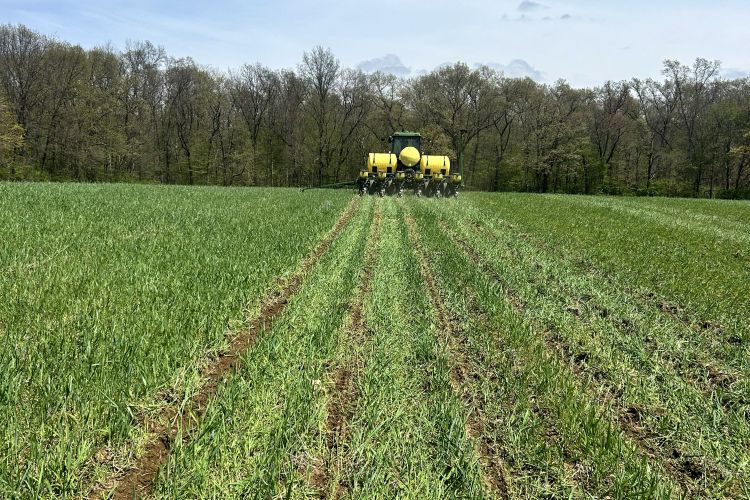
Planting conditions are crucial to setting up for a bountiful harvest. Earlier planting can provide corn and soybean with a longer growing season leading to better yields and an earlier harvest, but the risk of cold and wet conditions that reduce seedling vigor remain high during earlier planting windows. Making the call to plant or wait is challenging enough; adding a cover crop to the mix may make those decisions even harder.
No matter the environmental benefit of cover crops, considering the impact that cover crops have on the subsequent main crop remains a driving factor in practice adoption. However, a new University of Michigan study reveals interesting patterns in cover crop use and planting dates in Michigan that may address this spring uncertainty.
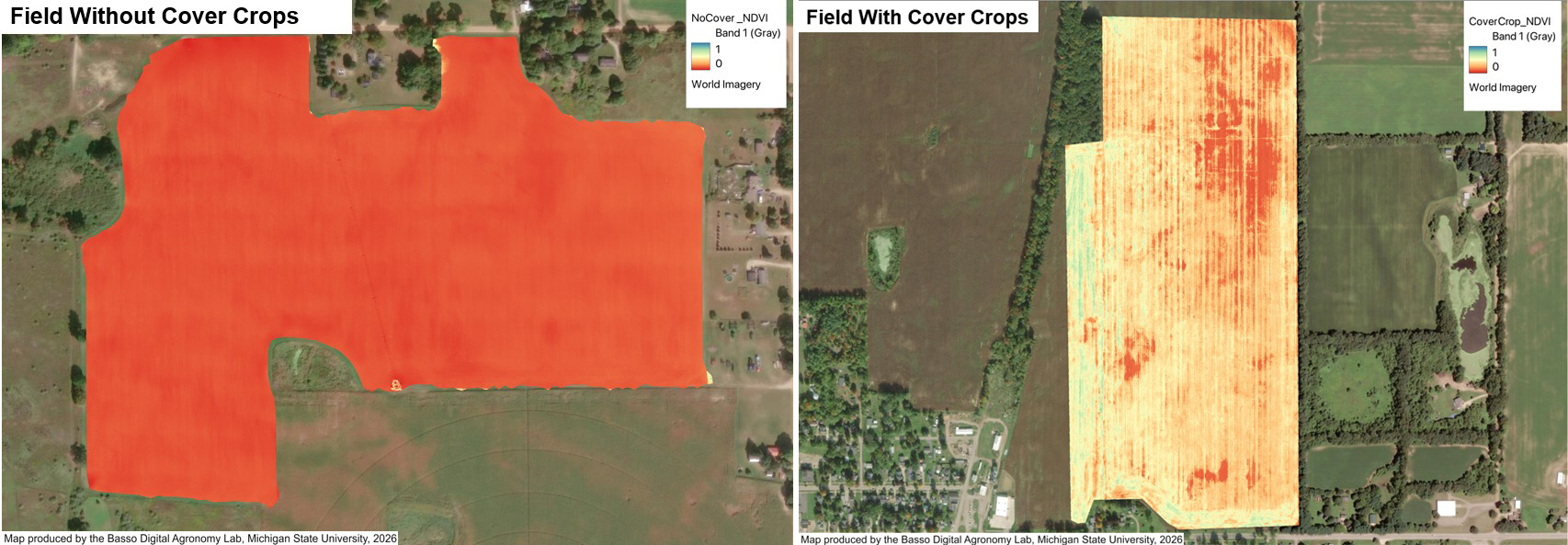
Etienne Sutton, PhD, lead researcher on the project, used satellite imagery of Michigan fields between 2008 and 2019 to determine how cover crops and planting dates interact. Data layers from the United States Department of Agriculture National Agricultural Statistics Service and Landsat Satellite data were combined to analyze corn, soybean and wheat fields in Michigan’s Lower Peninsula. The data was then used to classify different types of winter and early spring cover: bare/fallow, winter wheat, alfalfa hay, low biomass cover (weedy fallow or unsuccessful cover crops), and high biomass cover (successful cover crops).
The model distinguishes cover crops from bare fields and other vegetation types because of distinct Normalized Difference Vegetation Index (NDVI) signatures. A successful, high biomass cover crop looks “greener” to satellites.
“In the past, land use data has come from survey responses or ‘boots on the ground’ visual surveys,” Sutton explains. “Satellite imagery allows researchers to gain insight into land use and management patterns at a scale previously not feasible.”
Impact of cover crop history on corn planting date
In springs with above average precipitation in April and May (more than 9 inches), planting timing can be a challenge as farmers wait for fields to dry out. With limited days to plant, it can be tempting to plant into wetter-than-ideal conditions, which can cause stress to the crop that lasts throughout the growing season. The study found that in wet springs, fields with a long-term history of cover crops were able to be planted significantly earlier than fields just starting out with cover crops. Corn fields with a cover crop history of at least three years were planted seven days earlier, on average, than fields with no history of cover crop use. Corn fields with cover crops planted for at least six years were planted 13 days earlier in wet years, on average, than fields without any prior cover crop use (Table 1).
In dry springs (less than 9 inches of rain in April and May), fields with a long-term history of cover crops were planted into corn 11 days later than fields with no history of cover crops (Table 1). This may be because farmers with cover crops may choose to wait longer to plant in dry years. Researchers suggest that farmers with more diversified systems tend to use adaptive management to make management decisions throughout the year. Adaptive management, or the combination of on-farm monitoring and evaluation to inform management strategies that reduce risk, may lead a farmer to wait longer for rain before planting even if this delays planting, according to research by Petersen-Rockney et al., 2021. Sutton et al., 2025 suggests that this trend may also be attributed to farmers with more cover crop experience having higher biomass goals for their cover crops, which may take longer to achieve during dry years.
Table 1. Change in corn planting dates for fields with three and six years of prior cover crop use relative to fields with no history of cover crops between 2008-2019, comparing across different spring weather conditions. Interaction term between cover crop use and planting date was p<0.001.
|
Spring precipitation |
3 years of prior cover crop use |
6 years of prior cover crop use |
|---|---|---|
|
Dry |
5 days later |
11 days later |
|
Average |
3 days earlier |
5 days earlier |
|
Wet |
7 days earlier |
13 days earlier |
Impact of cover crop history on soybean planting date
For soybeans, regardless of whether spring conditions were wet, average or dry, fields with a long-term history of cover crops were planted only two to four days earlier than fields without cover crops. Similar to patterns we see in corn planting dates, in dry springs soybeans are planted later in fields with a history of cover crops compared to fields with no cover crop history. In wet springs, soybeans are planted earlier in fields with a history of cover crops.
Table 2. Change in soybean planting dates for fields with three and six years of prior cover crop use relative to fields with no history of cover crops between 2008-2019, comparing across different spring weather conditions. Interaction term between cover crop use and planting date was p<0.001.
|
Spring precipitation |
3 years of prior cover crop use |
6 years of prior cover crop use |
|---|---|---|
|
Dry |
2 days later |
4 days later |
|
Average |
1 day later |
2 days later |
|
Wet |
2 days earlier |
4 days earlier |
Field conditions and cover crops
Cover crop impacts on spring field conditions is a topic of interest across the Midwest. Among farmers who don’t use cover crops, the impact of cover crops on spring planting is a major concern. The Conservation Technology Information Center's 2022-2023 National Cover Crop Survey found that 36% of surveyed farmers not using cover crops cited fields being too wet in the spring as a major concern preventing cover crop use. Additionally, 42% of surveyed farmers not using cover crops cited cover crop water use in the spring as a major concern preventing their cover crop use.
However, observations, trends and farmer experience can address these real concerns. Practical Farmers of Iowa on-farm research found that farmers with cover cropped fields reported more days suitable for fieldwork compared to their district average in 2024. They especially exceeded the number of days suitable for fieldwork in June, September and October compared to their district average.
Such a large, statewide and multi-year long dataset from this study strengthens and adds nuance to these on-farm observations. Suitable days for field work are incredibly valuable during the growing season. This study demonstrates the potential for long-term cover crop usage to improve field conditions and support resilient planting windows for corn and soybeans. For tips on how to set up your planter to successfully planting into cover crops, check out this video from Get Rid of Weeds.