M-AAA investment powers MSU discoveries advancing dairy cow fertility and farm success
 Print
Print Email
EmailM-AAA support enables MSU researchers to develop fertility programs that raise conception rates, reduce herd turnover and strengthen the long-term viability of Michigan dairy farms.
*This story is part of a series highlighting the impact of MSU AgBioResearch’s work with Michigan agriculture and natural resources told through our stakeholders' perspectives. Through partnerships with the State of Michigan and industries, MSU AgBioResearch is finding solutions to some of the timeliest problems facing our state. To view the entire series, visit agbioresearch.msu.edu.
In addition to the written story, listen to the below podcast with MSU AgBioResearch Director George Smith and Ken Nobis, a Michigan farmer ambassador for the Farm Journal Foundation, on Spotify, Apple Podcasts and YouTube.
EAST LANSING, Mich. — Research from Michigan State University Professor J. Richard Pursley is trailblazing an area within dairy cattle management that Wendell Van Gunst says is essential to keep farms profitable.
“I think almost every dairy farmer would agree that nothing is as critical to the success of a dairy farm than the reproductive success of cows on a farm,” said Van Gunst, owner of Country Dairy, a fourth-generation, 1,200-cow dairy farm in West Michigan.
Reproduction is the key driver of lactation for dairy cows. After a cow gives birth, a new lactation begins. Timely calvings are essential for sustaining high milk production on Michigan dairy farms.
While Michigan dairy farmers rank first in the country for milk production per cow, leading Michigan agriculture by generating roughly $15.7 billion for the state’s economy each year, many operate on tight margins, and the cost of replacing cows not producing milk can become financially burdensome.
"I'm certain for most farms that most cows are culled out of a herd because of reproductive failures, and then farmers end up having to replace them,” Van Gunst said. “Today, a replacement animal is about $4,000, so every time you cull a cow, that's the impact. This means that if you're culling 40% of your herd every year, anything you can do to reduce that down to 34%-35% is just money in your pocket."
As a former dairyman himself, Pursley knows firsthand what farmers are up against daily. That’s why he’s made it a mission with his responsibilities through MSU AgBioResearch and MSU Extension to uncover and share ways dairy farms can grow in their efficiency, profitability and sustainability.
In 1995, he and his colleague, University of Wisconsin Professor Milo C. Wiltbank, revolutionized dairy cattle reproduction when they created a fertility program known as Ovsynch.
Instead of waiting to breed cows until entering a fertility period referred to as estrus (a practice that caused farmers to miss many breeding opportunities if estrus wasn’t noticed), Pursley co-developed a protocol that synchronized artificial insemination in dairy herds, which eliminated the chance farmers had of missing estrus.
Since then, Pursley has fine-tuned Ovsynch and designed additional programs that enhance reproduction on dairy farms using funding support from the Michigan Alliance for Animal Agriculture (M-AAA) — Michigan’s animal ag collaborative connecting animal ag and allied industries, MSU and the Michigan Department of Agriculture and Rural Development to research needs, opportunities and solutions for key sectors of the state’s $125.8 billion agriculture industry.
These programs, Pursley said, have allowed farms to go from conception rates of below 30% to 50% and higher. This has increased profitability on a 1,000-cow dairy farm by about $135,000 each year.
Bob Vlietstra, a retired West Michigan veterinarian of 37 years who also received a reproductive physiology doctorate degree in 2019 from the Pursley Lab, said this research helped keep several of his clients operating.
“I know several farmers who’d tell you very pointedly that it was revolutionary when they started to use Richard’s research as part of their programs in their herds,” Vlietstra said. “I can guarantee you that it kept a couple of them in business. Because of dismal conception rates, they were heading for a different job, a career change.
“I had one farmer who had 850 cows, and his conception rate averaged 16% [prior to implementing research from the Pursley Lab]. When I retired from that farm, he had one of the highest reproduction herds in America.”
Conception rates are significant for multiple reasons. As Van Gunst described, if a farm can sustain its own herd through fertility programs by reducing cull rates and raising its own calves, the need to purchase replacement cows diminishes. The cost to buy a replacement animal, which the U.S. Department of Agriculture reported being an average of $3,220 in Michigan in January 2026, can then become an opportunity to sell and generate profit for a farm rather than having to buy.
These rates also have big ramifications for milk production, according to Pursley.
“This has a big impact on farm profitability because if cows don’t get pregnant soon enough or don’t get pregnant at all, they’re either going to calve in really long calving intervals or get culled,” Pursley said. “If you have too many of those cows, that reduces your average milk per day.
“So, if you can take that window and close it a little bit to where you’re controlling the calving interval, you maintain very high levels of milk production in the herd.”
Through M-AAA-funded research, Pursley conceptualized the high-fertility cycle, which emphasizes the importance of getting cows pregnant before they reach 130 days in milk (the number of days a cow has been producing milk since her last calving).
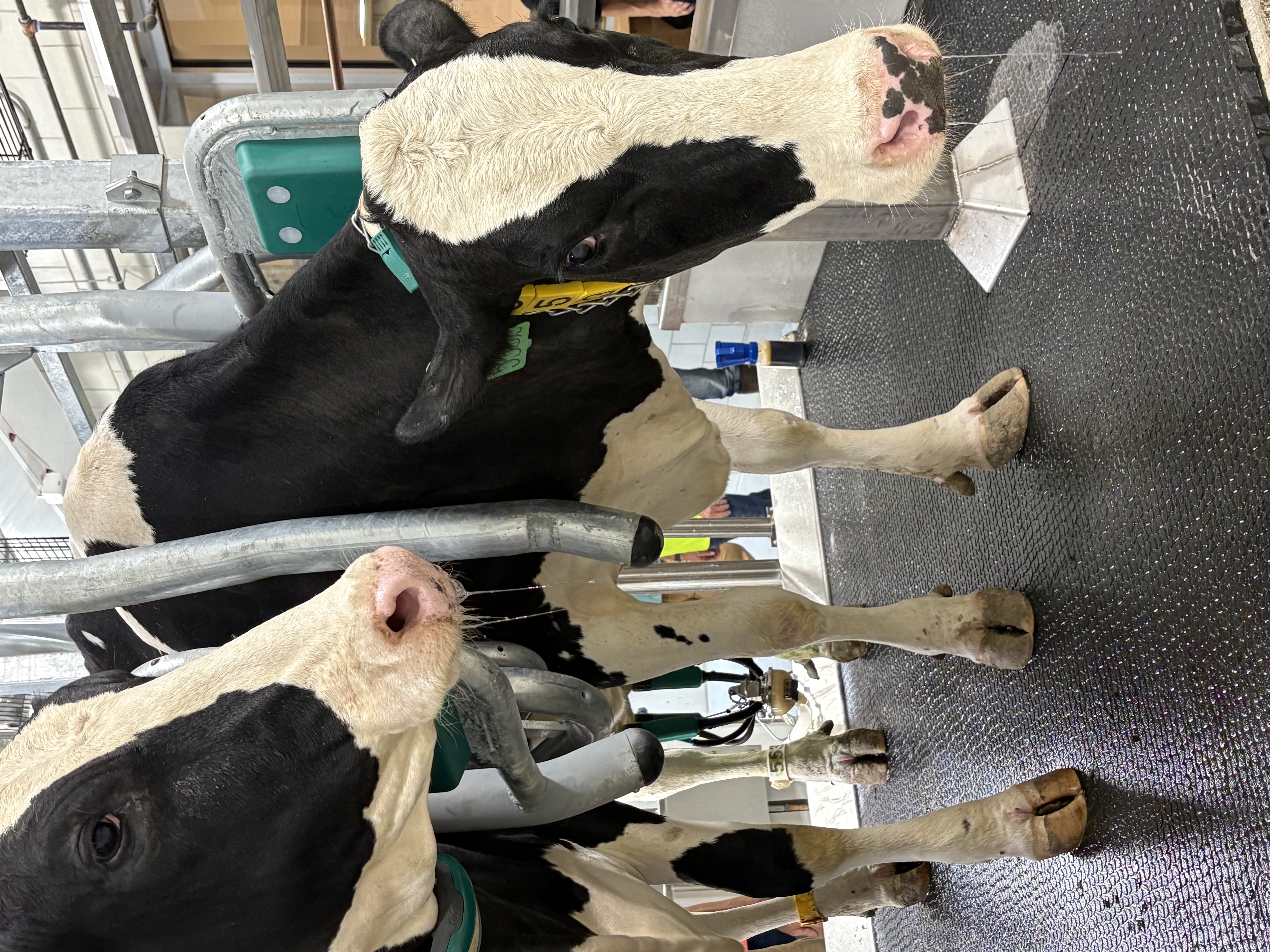
Maintaining the high-fertility cycle isn’t only good for milk production, but it’s good for the health of the animal, too. Keeping the interval from when a cow last calved to when she next becomes pregnant between 70-150 days can keep her from gaining too much weight and help her avoid unintended health issues, leading to greater success in reproduction.
Vlietstra said with the support of Ovsynch and other fertility programs Pursley helped create and refine, if a cow was artificially inseminated on the 70th day after her last calving and wasn’t pregnant 30 days later, it was much easier for him as a veterinarian to restart the process while staying within the 70- to 150-day window necessary to follow the high-fertility cycle.
“In the old days, in my first years of practice, we went from the low 20s in conception rate percentage to — when I left practice — I had a number of farms that were at first conception rates of 70%-80%,” Vlietstra said. “Overall, conception rates on many of the farms I worked with were between 60%-70%. That’s huge. It’s huge not only for the dairy industry, but for those dairy farms themselves. Most of the farmers I worked with were family farmers, and this affected their family life.”
Jen Roberts is also a witness to the increased conception rates she’s seen on farms. As a professional services veterinarian for Boehringer Ingelheim Animal Health, in addition to being a former faculty member in MSU’s College of Veterinary Medicine, she’s collaborated closely with Pursley to bring the most up-to-date information and recommendations regarding dairy cattle reproduction to farmers across Michigan.
She said research backed by M-AAA, like the project on the high-fertility cycle, is not only valuable for the actionable insights it delivers, but also for the next generation of dairy leaders and experts.
“The high-fertility cycle concept came from Richard’s lab and research, when Emily Middleton was his graduate student,” Roberts said. “That’s the other thing his lab has achieved: training some great reproductive physiologists who are now out in the field continuing this work and advising farms on best practices in reproductive management.”
Current research of Pursley’s supported by M-AAA is addressing another key issue in dairy cattle reproduction. While the techniques garnered through his studies have helped boost conception rates among dairy cattle, pregnancy loss remains a challenge.
He and his team recently learned that over 90% of cows artificially inseminated through the fertility programs he co-developed become pregnant, but only 50% remain pregnant weeks after artificial insemination.
“Think about that for a second,” Pursley said. “At 35 days, 50% of our cows are pregnant, but at 14 days, 94% of our cows were pregnant. So, we’re going from day 14 to day 35 losing a lot of pregnancies. More recently, the M-AAA dollars we’ve been using — and even the dollars we’re using now — are being used to gain a greater understanding of why those pregnancy losses are occurring and what’s causing them.
“Once we figure out what’s causing all these losses to happen, then we can start to figure out how to fix this issue, and that’ll have the biggest impact we’ve seen yet.”
Pursley said funding for research has been critical to move this understanding forward, while noting investments into research infrastructure have also been incredibly momentous for progress to be made.
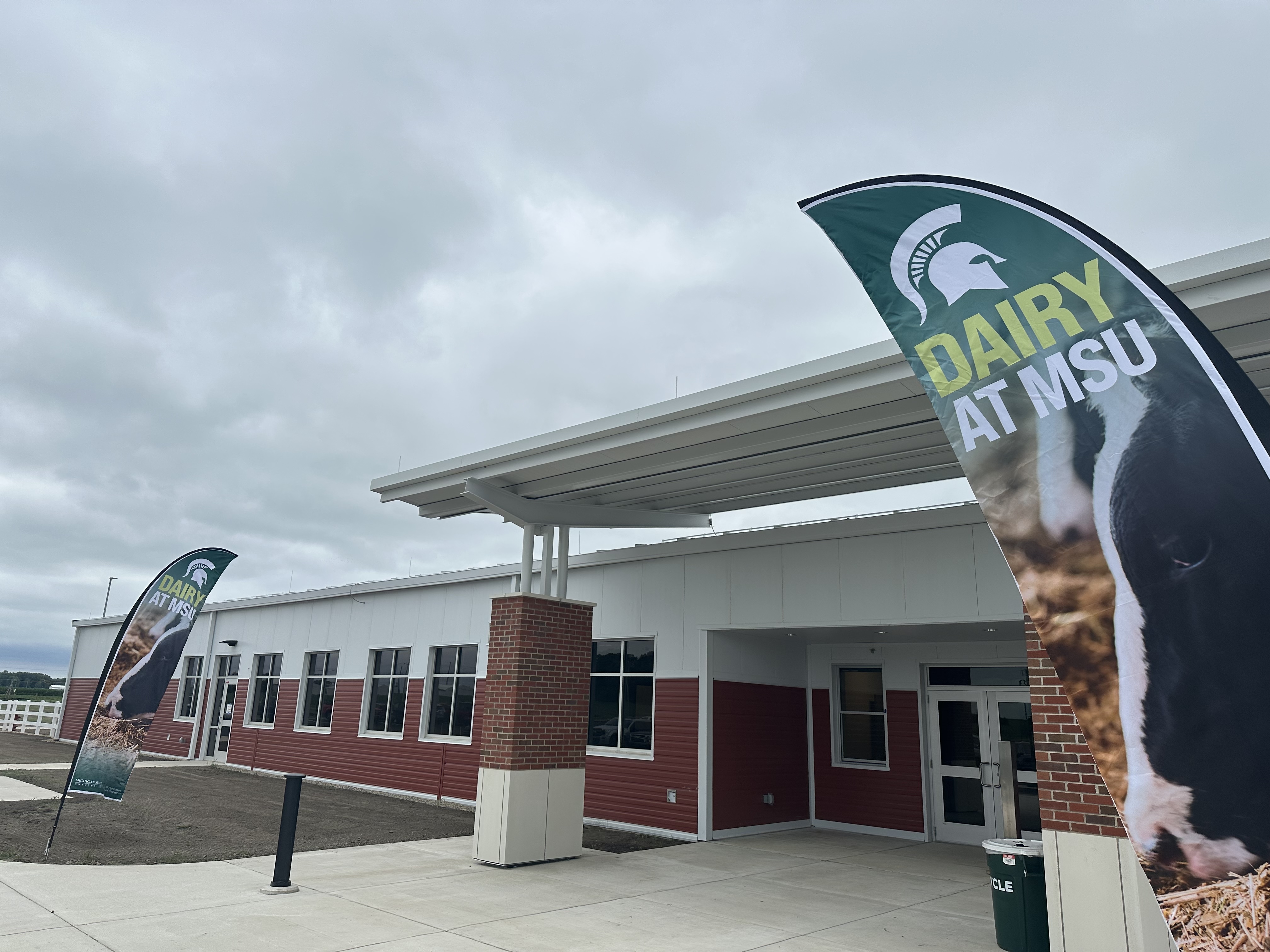
With a $30 million investment made by the State of Michigan, MSU recently built a state-of-the-art, on-campus Dairy Cattle Teaching and Research Center that replaced a decades-old facility that was severely outdated. Over the summer of 2025, the new center became operational and cows moved in.
For past studies, Pursley worked jointly with Ken Nobis, formerly of Nobis Dairy Farms in St. Johns, and conducted research on his farm because of the large herd size (1,000 cows) and expanded space he could offer compared to the old dairy center at MSU.
Nobis, who previously served as president of the Michigan Milk Producers Association, currently is a Michigan farmer ambassador for the Farm Journal Foundation. He said the research done by Pursley on his farm helped to tremendously improve efficiency.
“What we had done before we were synchronizing is we’d check three times a day, 20 minutes each time. That was an hour in each barn, and at that time we had breeding animals in three barns, so that was three hours per day,” Nobis said. “You also had to depend on the person being there and having their eyes wide open to be able to catch cows in estrus, because this was before collars and movement technology could. [Pursley’s research on synchronization] was a great improvement.”
Now, with the new dairy center’s capacity to house over 650 cows and its ability to keep cows cool amid summer heat, Pursley said finding answers to questions on dairy cattle reproduction can become much more streamlined.
“That’s going to really help us in the summertime because we don’t have to worry about summer heat stress as much, which could impact fertility in our cows,” Pursley said.
The $75-million center still requires continued investment from donors and partners. Roberts said to support a cutting-edge facility like this, and to back research funded through initiatives like M-AAA, is to invest in the future of the largest and highest-grossing sector of Michigan’s agricultural industry.
“People look to our faculty at MSU as key opinion leaders and content experts in a variety of areas, and to continue funding these research programs and new ideas that are finding better ways to manage cattle and to produce high-quality dairy products is critical,” Roberts said. “I look at what we've been able to achieve in the last couple years with generating support for the new dairy facility, and I'm so grateful as a veterinarian and a dairy industry professional that the State of Michigan prioritized funding to be able to have a modern dairy facility that’s going to elevate the validity of our research at MSU.
“As someone who's spent my entire career in the cattle industry, the research that comes out of MSU really helps me to inform recommendations that I'm making to producers, and it also helps me to elevate the standard of care that I'm able to provide as a veterinarian.”
Without public investment in ag research like this, Nobis’ message is clear: The U.S. will cease to be a world leader in food production.
“This country led the world in ag research for many, many years, and today China is ahead of us, the EU is ahead of us — I don’t think there’s much difference between us and Brazil, to be honest with you,” Nobis said. “We won’t continue to lead the world in food production if we don’t do the research. Maybe we don’t have to increase it dramatically, but we can’t keep going downhill — we’ll go backwards. It doesn’t just happen. If you don’t do the research, you’re not going to get new results.
“I just have to put it in plain language: If funding went away, it wouldn’t happen overnight, but MSU wouldn’t continue to be the leader in dairy research that it is today.”
Michigan State University AgBioResearch scientists discover dynamic solutions for food systems and the environment. More than 300 MSU faculty conduct leading-edge research on a variety of topics, from health and agriculture to natural resources. Originally formed in 1888 as the Michigan Agricultural Experiment Station, MSU AgBioResearch oversees numerous on-campus research facilities, as well as 15 outlying centers throughout Michigan. To learn more, visit agbioresearch.msu.edu.