Michigan pork industry gains competitive edge through MSU research, outreach
 Print
Print Email
EmailPartnerships and funding made possible by the Michigan Alliance for Animal Agriculture are helping pork producers prepare for disease threats, strengthen emergency responses and advance farm innovation.
*This story is part of a series highlighting the impact of MSU AgBioResearch’s work with Michigan agriculture and natural resources told through our stakeholders' perspectives. Through partnerships with the State of Michigan and industries, MSU AgBioResearch is finding solutions to some of the timeliest problems facing our state. To view the entire series, visit agbioresearch.msu.edu.
In addition to the written story, listen to the below podcast with MSU AgBioResearch Director George Smith and Mary Kelpinski, CEO of the Michigan Pork Producers Association, on Spotify, Apple Podcasts and YouTube.
EAST LANSING, Mich. — Research from Michigan State University is helping shape the future and success of Michigan’s pork industry, starting with how pigs are housed.
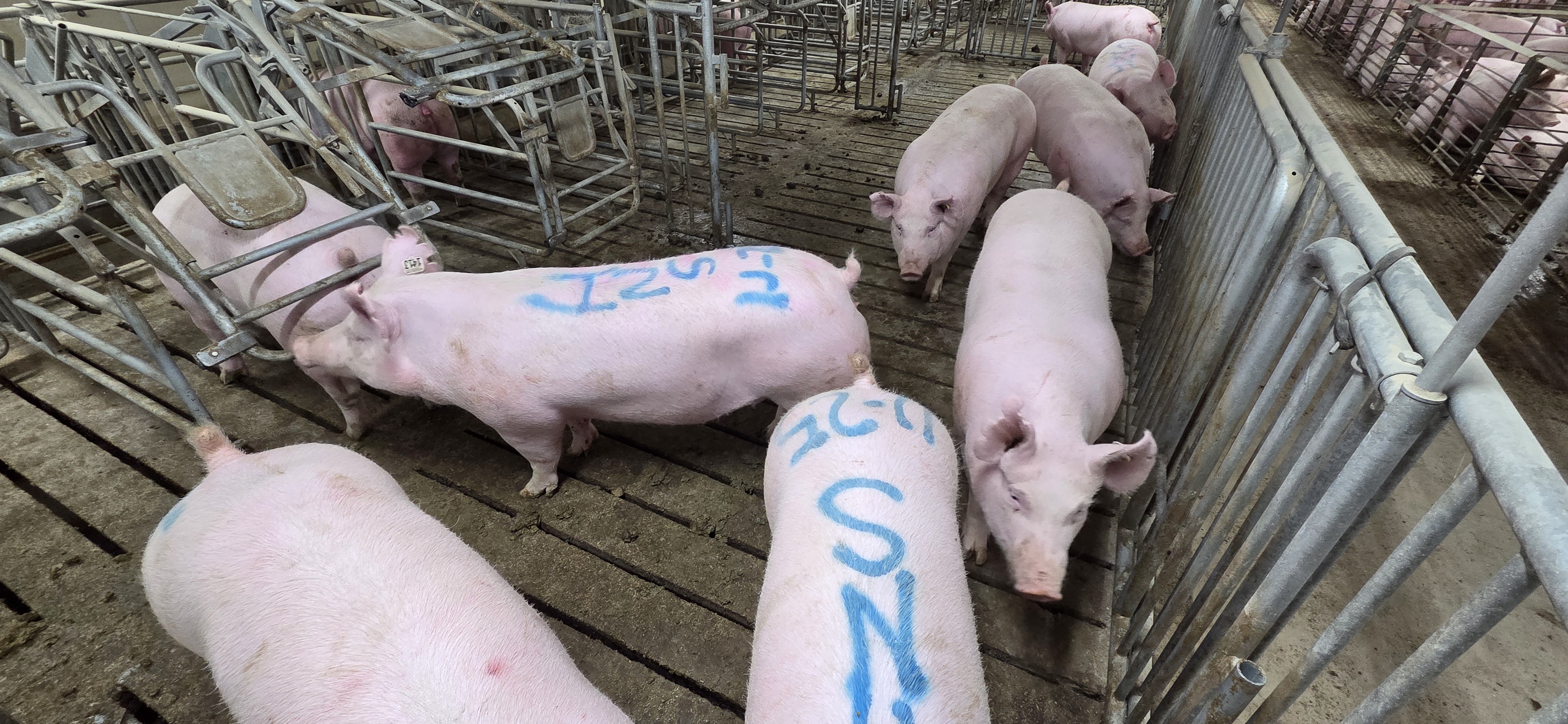
Recent adaptations made to Michigan law require farms to house pregnant sows (female pigs) in ways that allow free movement and avoid confinement, favoring group housing systems.
However, because pigs can be territorial, leaders in the industry have raised questions on how this can be enacted effectively.
MSU AgBioResearch scientists, including Dr. Catherine Ernst in the Department of Animal Science, are using funding from the Michigan Alliance for Animal Agriculture (M-AAA) to study this impact.
M-AAA, a partnership among MSU, Michigan’s animal ag and allied industries, and the Michigan Department of Agriculture and Rural Development (MDARD) focused on the advancement of Michigan’s animal ag economy, has helped Michigan pork adapt, evolve and stay dynamic during this time, said Mary Kelpinski, CEO of the Michigan Pork Producers Association (MPPA).

“We had a law that passed and became active in 2020 that required us to house our sows differently — we had to house them in more group settings,” Kelpinski said. “That raises a lot of concerns. You hear the phrase ‘boss hog,’ and pigs really are territorial. When you put them in a group together, they’ll fight. So, some of the research MSU has done at the swine farm and through M-AAA dollars has helped us look at how we can house our sows to follow the law we have in Michigan.
“All the states have different laws, so we needed something that was specific to Michigan. This research has really helped us remain competitive in the pork industry nationally.”
The need for information on how pigs are housed exemplifies why M-AAA is not only unique in how it functions as a program, Kelpinski said, but is also integral for the success of animal ag industries like Michigan pork, which produces roughly 2.5 million hogs per year and contributes approximately $500 million annually to the state’s economy, according to MPPA.
M-AAA gives representatives from Michigan’s animal ag and allied industries opportunities to connect with MSU researchers, share what the needs or concerns are for their industries, and review and fund research proposals that address the relevant topics that will help advance key sectors of Michigan’s $125.8 billion agriculture industry.
“That’s the driving force,” Kelpinski said. “We’re the ones setting those priorities and research initiatives, and then we’re passing them out to MSU researchers to find out what research ideas they have that could help solve some of these problems we’re experiencing.
“It’s been really great to have that relationship.”
Kelpinski said other instances of MSU research helping move Michigan pork forward include leveraging artificial intelligence and machine learning to address labor shortages when managing and caring for animals, as well as studying different antibiotic-free nutritional additives fed to pigs that cultivate healthy pork products and don’t contribute to human antibiotic resistance.
In addition to research, Kelpinski said outreach done through MSU Extension is an invaluable resource for Michigan pork producers and their operations.
MSU Extension co-administers M-AAA alongside MSU AgBioResearch, with a portion of funding dollars each year going toward outreach projects led by MSU Extension educators and specialists.
Elizabeth Ferry, an MSU Extension swine educator, has helped lead one of those projects by bringing together representatives from MDARD, MPPA, the MSU Veterinary Diagnostic Lab, and U.S. Department of Agriculture Animal and Plant Health Inspection Service to create Michigan’s Secure Pork Supply (SPS) Taskforce.
The taskforce mapped out how an outbreak of an animal disease such as African Swine Fever (ASF) in Michigan could disrupt operations and supply chains, while identifying ways to limit that disruption through testing and other measures. It also developed guidelines and criteria that producers would need to meet to continue operating during an outbreak, and prepared farms by providing the education and resources needed to create and submit enhanced biosecurity plans.
Now, 75% of pigs in Michigan are covered by an SPS on-farm biosecurity plan, strengthening the responses farmers will have to an animal disease outbreak and bolstering supply chains to ensure they can continue moving during difficult times.
While ASF has not yet been detected in the U.S., the thought of it occurring among Michigan swine is daunting for Kelpinski, but she knows her industry is well-positioned in the event of it happening with M-AAA support.
“That’s the one thing that keeps me awake at night,” Kelpinski said. “We keep talking about not if, but when a disease comes to this country and being prepared as possible. Our producers are all busy, making it hard for them to take time to step outside of the box.
“Through some of the work we’ve done with MSU and MDARD, we’ve been able to get packages together so that producers don’t have to put a lot of time into developing a plan. We have some plans that they can work from as a starting point. We really appreciate the ability to work with MSU and do that.”
Another successful initiative that was born through an M-AAA grant and has benefited Michigan’s pork and animal ag industries during challenging situations is MSU Extension’s Emergency Response to Accidents Involving Livestock (ERAIL) program.
First responders already have lots to manage and take into consideration when arriving at the scene of an accident. Mix in livestock, and the situation can quickly become overwhelming.
MSU ERAIL, established in 2019, trains first responders, law enforcement, animal control and others who arrive at the scene of an accident on how to appropriately handle and contain livestock. Likewise, nine MSU ERAIL response trailers are available to emergency response department teams across 18 Michigan counties, providing additional infrastructure to assist with accidents involving livestock.
As of August 2025, 21 MSU ERAIL trainings have helped train over 800 first responders.
“It’s great to have the equipment we need, but we all know that the average Michigander doesn’t know very much about livestock handling during an emergency,” Kelpinski said. “MSU Extension has held meetings where they bring firefighters, police officers and other emergency responders in for a day of classroom training, and then they go out and work with livestock after.
“The knowledge gained from these trainings and the ERAIL trailers have unfortunately needed to be used several times throughout the state, and I’ve heard really positive feedback about the responses they’ve had.”
The efforts of MSU AgBioResearch and MSU Extension through M-AAA to support Michigan pork producers are significant to operations like H&H Farms in Vicksburg, Michigan, said COO Jarred Lorenz. Hear from Lorenz in the Q&A below about what this work has meant to his business.
How does MSU currently support your farm’s goals?
- Lorenz: One big example that first came to mind was MSU ERAIL. We’ve had a few different incidents, unfortunately, over the past 13 years where we've had our trailers get twisted sideways and needed to deal with them. We didn’t have the ERAIL trailers where those accidents occurred. Now, we’re looking to get one here in the Kalamazoo area. Those trainings and trailers are a big deal.
Here’s a close-to-home story. My neighbor is a firefighter in Portage. He went to and did the MSU ERAIL training with Beth Ferry. He’s not an ag guy, but he obviously knew me and knew what I had gone through before with those accidents. When this opportunity came across my desk, I said to him, “If you’re interested, it would be nice to have someone locally trained on this type of situation.” He thought it was super interesting and was able to come home and teach his fire squad what he learned.
What outcomes or benefits do you expect from MSU research?
- Lorenz: Having MSU reach out is a big deal for us to start more conversations that maybe we’d have in our MPPA board meetings. There are about four or five pork producers in Michigan that make up most of the state’s production, so getting our thoughts on issues has been super valuable. MSU is the hometown university, the ag school in Michigan. That’s a big deal, and we want to support that. We’re always looking for things that move the needle for us from a financial standpoint via production. It could be feed related, pig related or animal housing related. It could be anything that we can take home and turn into dollars and happier pigs.
Can you share an example of when MSU has positively affected the industry or helped it overcome a looming challenge?
- Lorenz: The ASF-testing project MSU is working on is a big example from an industry-wide perspective. Any hog farm in the U.S. will need to be testing a lot of samples to continue doing business throughout a potential ASF outbreak. We need to be able to maintain export relationships, so the first thing we’ll look to if ASF does hit here is the quantity and speed of testing.
How can MSU research help to position the industry to thrive moving forward?
- Lorenz: It’s important MSU continue reaching out to MPPA’s board of directors to say, “Here’s a list of what we think maybe some potential projects are. Do you think they're worth your time? Or are they going to move the needle for you if we spend our time on this? And if not, here are some other topics. What do you think? What do you think we should be looking at?” For Michigan producers, we’re well connected to MSU, so we appreciate being able to take home research on topics that are important to production — for example, the projects recently done on evaluating group housing dynamics and managing heat stress in pigs.
What would you say to legislators to advocate on behalf of continued research funding? What would it mean to not have this funding support moving forward?
- Lorenz: It's not hard to sell that we want to keep our animals happy and healthy and we want to stay current with the best in the industry. We want Michigan to be relevant in the swine sector. If we’re engaged with MSU and MSU continues moving the needle for us, we’ve got some big power and influence as an industry here in Michigan.
Michigan State University AgBioResearch scientists discover dynamic solutions for food systems and the environment. More than 300 MSU faculty conduct leading-edge research on a variety of topics, from health and agriculture to natural resources. Originally formed in 1888 as the Michigan Agricultural Experiment Station, MSU AgBioResearch oversees numerous on-campus research facilities, as well as 15 outlying centers throughout Michigan. To learn more, visit agbioresearch.msu.edu.