MSU AgBioResearch adds four faculty to Administrative Fellows Program
 Print
Print Email
EmailThe program helps CANR faculty gain hands-on experience with research administration.
EAST LANSING, Mich. — Four faculty members from the Michigan State University College of Agriculture and Natural Resources (CANR) have been named MSU AgBioResearch Administrative Fellows for 2025-26.
The AgBioResearch Administrative Fellows Program began in 2022 and aims to provide insight and experience to faculty interested in administrative careers.
The four new members of the program are:
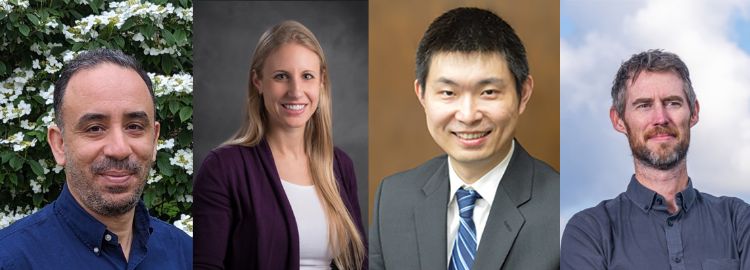
- Hatem Rouached, associate professor in the Department of Plant, Soil and Microbial Sciences.
- Emily Silver, associate professor, associate chairperson and director of graduate studies in the Department of Forestry.
- Dong Zhao, associate professor and director of the doctoral program in the School of Planning, Design and Construction.
- Adam Zwickle, associate professor and graduate program director in the Department of Community Sustainability.
The fellowship lasts for one year with the possibility of extension depending on available space.
Eligibility is limited to tenure-stream or fixed-term CANR faculty who currently hold the role of associate professor or higher. MSU Extension specialists who have received prior approval from the MSU Extension director may also apply.
“This is a great opportunity for CANR faculty to discover the diversity of research supported by AgBioResearch and gain hands-on administrative experience,” said Kang Xia, AgBioResearch associate director and fellowship program coordinator. “Fellows will interact with our vast network of stakeholders, participate in the grant submission process from the administrative perspective, explore research analytics, and see how we support our on- and off-campus research facilities.”
Xia said one of the most rewarding aspects of the program for AgBioResearch leaders is the insight the fellows provide during the strategic planning and decision-making process. While AgBioResearch leaders provide mentorship, fellows deliver important input from current faculty.
Administrative fellows will also have networking opportunities with on- and off-campus leaders of some of AgBioResearch and MSU Extension’s signature programs, including Project GREEEN, the Michigan Alliance for Animal Agriculture, the Agricultural Resiliency Program and the Partnership for Ecosystem Research and Management.
David Ortega, a professor and the Noel W. Stuckman Chair in Food Economics & Policy in the Department of Agricultural, Food and Resource Economics, previously served as a fellow. He said the program offered valuable perspective into how leaders deal with challenges and how AgBioResearch operates within MSU.
“Participating in the program gave me a much deeper appreciation for the breadth and complexity of what it takes to run a research enterprise like AgBioResearch,” Ortega said. “I gained a clearer understanding of the many strategic, operational and financial decisions that support the mission of AgBioResearch, CANR and MSU more broadly, from research administration and funding mechanisms to government relations and partnership development.
“What I found most valuable was the behind-the-scenes perspective on how these pieces come together to advance MSU’s research priorities and the opportunity to engage with leadership and colleagues across units. The experience strengthened my understanding of the institutional ecosystem and the critical role AgBioResearch plays in supporting and growing MSU’s research mission.”
For CANR faculty interested in participating in the future, AgBioResearch leaders will release the next request for applications to join the Administrative Fellows Program in late March 2026.
Michigan State University AgBioResearch scientists discover dynamic solutions for food systems and the environment. More than 300 MSU faculty conduct leading-edge research on a variety of topics, from health and agriculture to natural resources. Originally formed in 1888 as the Michigan Agricultural Experiment Station, MSU AgBioResearch oversees numerous on-campus research facilities, as well as 15 outlying centers throughout Michigan. To learn more, visit agbioresearch.msu.edu.