MSU AgBioResearch, College of Veterinary Medicine team up for One Health research
 Print
Print Email
EmailA strong partnership between AgBioResearch and the College of Veterinary Medicine leads to meaningful breakthroughs in human and animal health, agriculture and beyond.
This story is part of a series highlighting MSU AgBioResearch’s work related to One Health, the concept that the health of humans, animals, plants and the environment is deeply related. MSU has created an initiative called One Team, One Health to promote university-wide efforts in this space. To view the full series, visit agbioresearch.msu.edu.
In addition to the written story, listen to the below podcast with MSU AgBioResearch Director George Smith and Kimberly Dodd, dean of the MSU College of Veterinary Medicine, on Spotify, Apple Podcasts and YouTube.
EAST LANSING, Mich. — When Kimberly Dodd joined Michigan State University in 2021, she brought decades of hands-on experience as a veterinarian and virologist studying and responding to emerging infectious diseases.
As director of the MSU Veterinary Diagnostic Laboratory (VDL), she oversaw one of the country’s leading organizations for animal disease surveillance and outbreak response.
In 2024, Dodd became dean of the MSU College of Veterinary Medicine (CVM) — Michigan’s only veterinary school — in which students train in the Doctor of Veterinary Medicine, Veterinary Nursing and graduate programs. CVM is home to the VDL, the state’s official animal health diagnostic laboratory, and the Veterinary Medical Center, Michigan’s only 24/7 tertiary-care veterinary hospital for large and small animals.
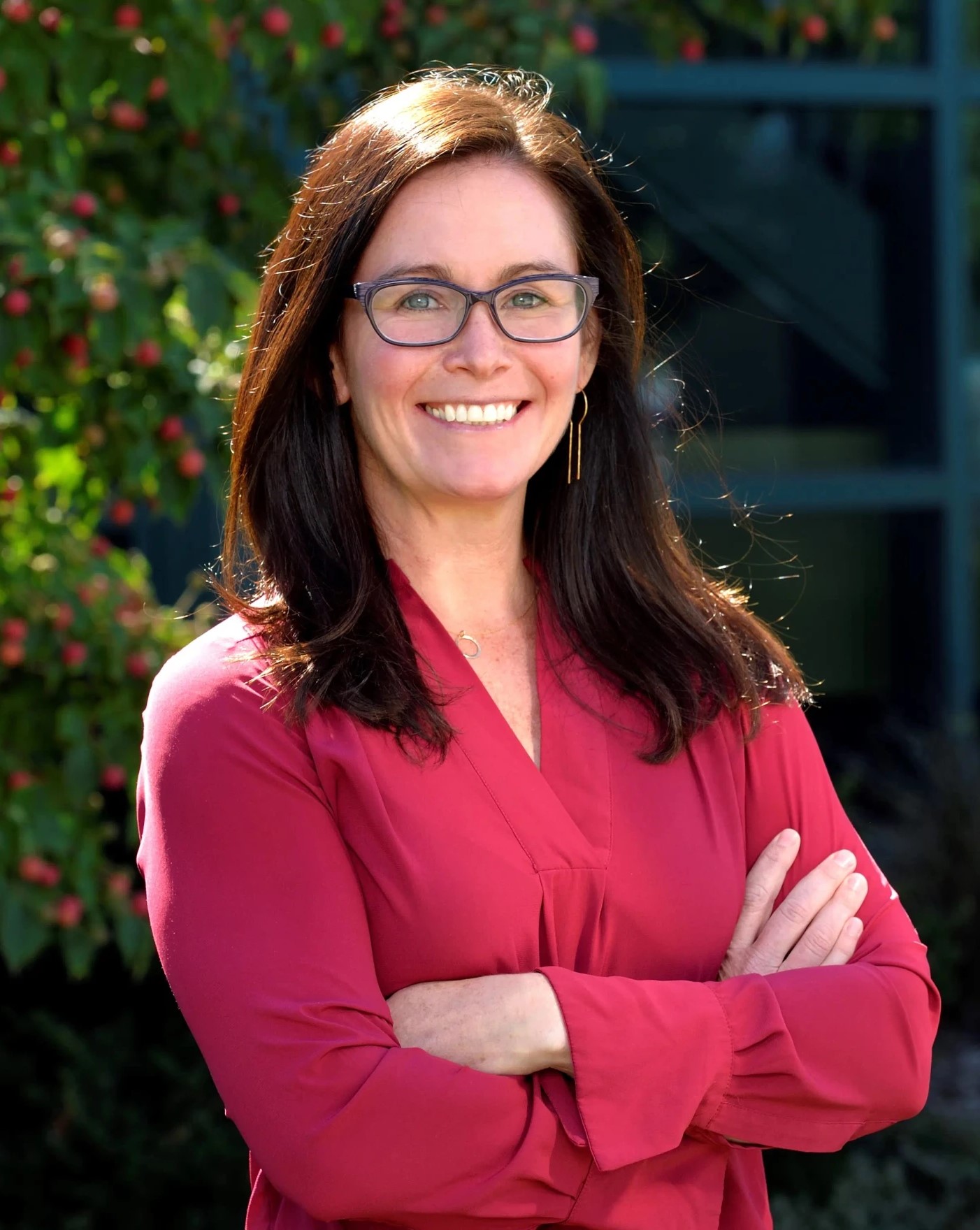
Shortly after becoming dean, Dodd was asked to serve on the university-wide Health Sciences Council, established by MSU President Kevin Guskiewicz to reenvision the future of health sciences at MSU.
The effort evolved into the current One Health Council, part of the MSU push to unite the university behind the concept of One Team, One Health. The initiative emphasizes the interrelated nature of human, animal, plant and environmental health.
Dodd serves as co-chair of the One Health Council, which has given her a holistic view of MSU’s full array of programs.
“I’ve been at MSU for four years, and since I arrived, I’ve heard about how MSU is incredibly unique,” Dodd said. “And it’s true. We have colleges of human and osteopathic medicine, veterinary medicine, agriculture, natural sciences and many more, in addition to AgBioResearch and MSU Extension. We have an amazing breadth of expertise and partnerships across the university. You couple that with our land-grant mission and external partnerships, and we’re uniquely poised to do significant work in the One Health space.”
Alongside the One Health Council are four taskforces, one of which is a research-specific group that includes MSU AgBioResearch Director George Smith.
“We’re so pleased to partner with CVM on One Health-related research as we do with units across campus, and it’s really something we’ve been doing for many years already,” Smith said. “Of course, preventing and managing infectious diseases is a major part of research, but it goes well beyond that. Nutrition is another huge element to this work, as well as the availability of food, which are issues related directly to agriculture.
“When you factor in the health of the environment, which affects humans, animals and plants, it’s this interaction of all those components that’s the foundation of One Health. It gets me really excited about the One Team, One Health initiative. Like we’re doing with CVM, I see so many opportunities through bringing the campus community together and creating novel, unique partnerships.”
Rapid response to an animal health crisis
Ties run deep between AgBioResearch and CVM, strengthened by the close partnership Smith and Dodd have forged. AgBioResearch supports several CVM researchers exploring challenges with human and animal health.
One of the most notable research efforts in recent years came during an ongoing outbreak of highly pathogenic avian influenza (HPAI) in Michigan that started in early 2022. As in previous outbreaks, the virus caused severe disease and high mortality in domestic poultry, prompting depopulation of infected flocks to prevent further spread.
Dodd said what makes this outbreak especially challenging, however, is the virus’s ability to infect multiple species. Wild birds have proven to be highly susceptible, and numerous mammalian scavengers — such as foxes, skunks, bobcats and even marine mammals — become infected after consuming birds with the disease.
The most unexpected development came in 2024 with the identification of HPAI in dairy cattle.
“At that time, I was talking with other virologists about an odd disease affecting dairy cattle in Texas, and we were tossing out possibilities,” Dodd said. “Not one of us thought that avian influenza was responsible. Once we discovered the connection, it created an extremely difficult situation.”
Dodd noted that while humans can contract HPAI, cases remain rare and have primarily occurred among people with close, prolonged exposure to infected poultry or cattle.
Given the effects on human and animal health, the circumstances presented a unique One Health challenge that required immediate action, something MSU leaders took to heart. Funding was quickly provided by AgBioResearch through the Michigan Alliance for Animal Agriculture — a partnership among MSU, Michigan animal agriculture industries, and the Michigan Department of Agriculture and Rural Development — and capacity funds through the U.S. Department of Agriculture's National Institute of Food and Agriculture.
“I’m really proud of the MSU and State of Michigan response to the outbreak,” Smith said. “Our faculty are often writing grants that can take months or years to procure, and that would have been too late. AgBioResearch provided rapid funding to CVM scientists, which allowed us to get on farms and start collecting data.”
Dodd cited the collaborative nature between MSU researchers and farmers across the state as one of the keys to managing the outbreak.
“When I worked for the U.S. Department of Agriculture (USDA), I had the opportunity to see dynamics in different states and have always been impressed by Michigan,” Dodd said. “We had the nation’s eyes on us because we were among the first states to see the disease in dairy cattle. There were so many questions about how it spreads within herds, from herd to herd, and the best sample types to test. But we were able to work directly with producers to formulate strategies on how to respond effectively. It's not just the funding but also the trust and support that’s already been established among MSU, state agencies and farmers that allowed us to do this research.”
A nationwide testing leader
The VDL has played an integral role in avian influenza detection once on-farm samples were collected. But its impact doesn’t stop there. The facility is a hub of One Health-related activities, serving as one of five USDA regional labs for identifying emerging infectious diseases.
Traditional diagnostic workflows rely on targeted tests for specific pathogens. But when all tests return negative, farmers may be left without answers. To close that gap, Dodd said, the VDL and partner labs have been developing sequencing-based approaches to detect any infectious agents present — whether familiar or newly emerging. This shift reflects a broader recognition that one-pathogen-at-a-time testing risks missing the next novel disease, and that advanced sequencing and bioinformatics tools are increasingly essential for early detection.
“Instead of having to know what you’re looking for and test one thing at a time, now we can effectively read through the entire sample and identify any potential causative agents,” Dodd said. “That’s a major effort we’ve had underway, and it was a focus of a recent on-campus symposium that had representatives from about 50 labs across the country. The goal was to think about how we as diagnostic labs can best position ourselves to play that critical role of detecting the next big disease before it becomes an epidemic or pandemic.”
Smith said infectious disease research and diagnostics are just a couple of the many areas in which CVM research is making a difference.
“CVM research supported by AgBioResearch is a shining example of how we use our resources to generate meaningful outcomes for agriculture, health and beyond,” Smith said. “To that point, in my role on the One Health research taskforce, I’m trying to cast a wide net to include as many potential collaborations as possible. There are so many things in the AgBioResearch portfolio that are based on the principles of One Health. Our work with CVM is a great model that demonstrates how combining our resources across campus can empower Team MSU to solve some of the biggest problems we’re facing today.”
Michigan State University AgBioResearch scientists discover dynamic solutions for food systems and the environment. More than 300 MSU faculty conduct leading-edge research on a variety of topics, from health and agriculture to natural resources. Originally formed in 1888 as the Michigan Agricultural Experiment Station, MSU AgBioResearch oversees numerous on-campus research facilities, as well as 15 outlying centers throughout Michigan. To learn more, visit agbioresearch.msu.edu.