MSU Extension and Institute of Water Research Advance Conservation Education Across the Western Lake Erie Basin
 Print
 Email
Field days and technical assistance training connect agricultural professionals with practical approaches to soil health, nutrient management, and water quality.
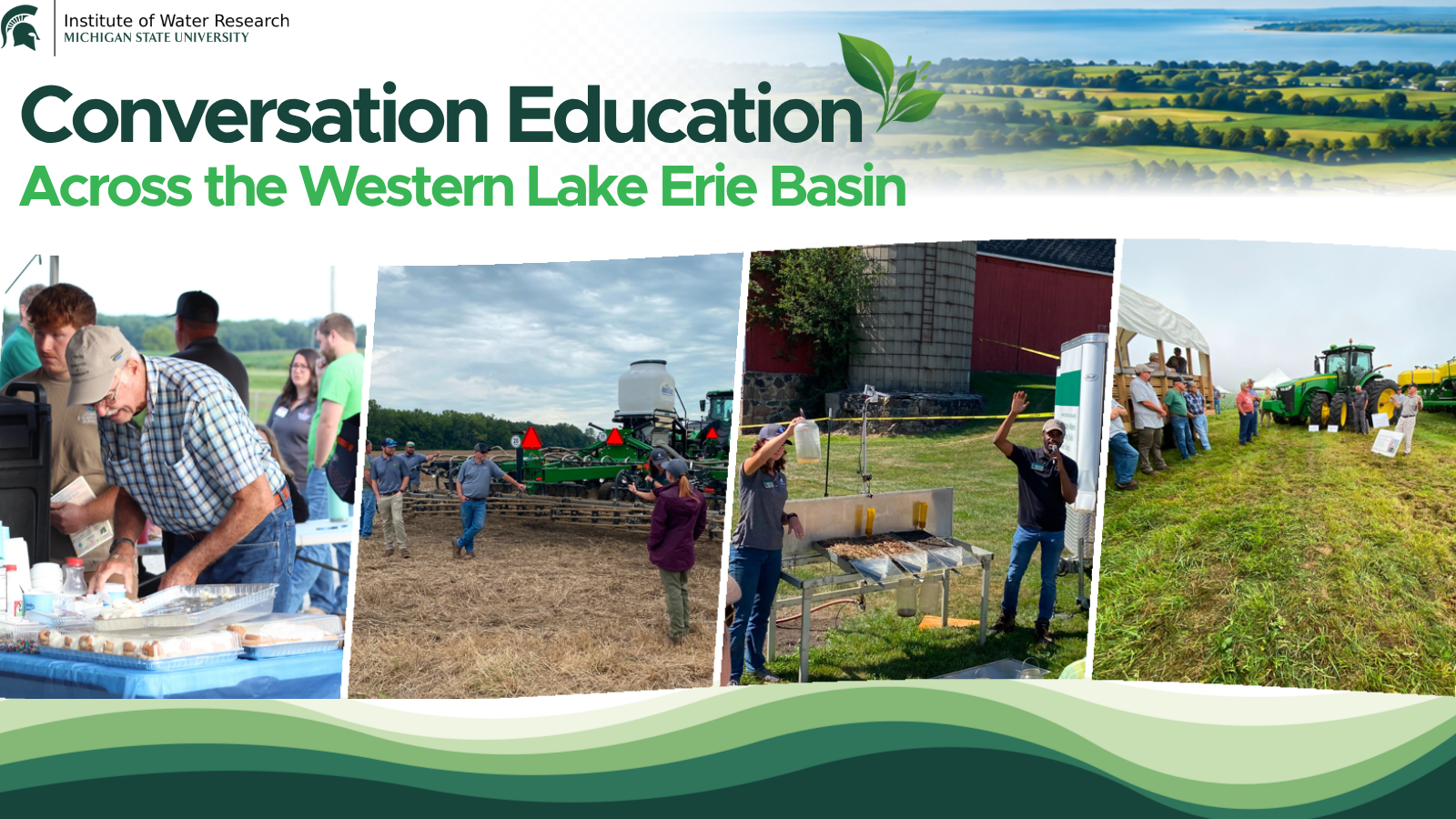
In August and September 2026, Michigan State University Extension (MSUE) and local Conservation
Districts hosted five field days across Michigan’s Western Lake Erie Basin (WLEB), with support from the Institute of Water Research (IWR). The events introduced farmers, crop advisers, and agricultural professionals to conservation practices that can improve soil management and help reduce phosphorus losses to waterways.
IWR leads the WLEB Performance-based Conservation Adoption Program, also known as Pay-for-Performance (PFP). The program connects on-farm conservation practices with payments tied to phosphorus-loss reductions.
Conservation Education in Action
Across the five events, participants explored conservation best management practices (BMP) through expert presentations, equipment demonstrations, and hands-on learning opportunities.
August 12 | Lenawee Center for Excellence Field Day
Marking the Center for Excellence field day’s 30th year, the program highlighted precision nutrient management, cover crops, and no-till systems for corn, soybeans, and wheat. A guided wagon tour stopped at filter strips, drainage water management, a water and sediment control basin (WASCOB), and a phosphorus removal system.
August 19 | Michigan Manure Spill Response Field Day
This MSUE event focused on responding to manure spills safely and effectively. Demonstrations and discussions covered emergency response, containment and cleanup, and proper notification procedures, reinforcing the importance of preparedness for farm safety and environmental protection.
August 20 | Hillsdale Nutrient Management Field Day
The Hillsdale event, hosted by Hillsdale and Fulton Conservation Districts, explored nutrient budgeting, fertilizer application, soil testing, and precision agriculture techniques. Tom Cotter, Minnesota’s 2025 Leopold Conservation Award recipient, served as keynote speaker, and the program included an IWR demonstration of soil moisture monitoring equipment.
August 28 | Washtenaw Conservation District Field Day
The Washtenaw event, hosted by Washtenaw Conservation District, emphasized interpreting soil health results, including Haney and BeCrop tests, to support informed nutrient management. Demonstrations included a rainfall simulator and drone application.
September 9 | Monroe Tillage and Soil Health Field Day
Hosted by MSUE in collaboration with the Monroe Conservation District, this event addressed long-term no-till trends, conservation drainage, manure and tillage management, and PFAS in cropping systems. Tillage equipment demonstrations and a soil pit provided practical learning opportunities.
Together, the events highlighted how research-based guidance and field-scale demonstrations can help agricultural professionals assess conservation options for their operations.
Connecting Field Education with Pay-for-Performance
The field-day topics align with the goals of the PfP led by IWR in partnership with MSUE, the Michigan Department of Agriculture and Rural Development, and regional conservation organizations.
The program offers eligible WLEB producers financial incentives based on reductions in phosphorus losses from their conservation practices. This performance-based approach is intended to encourage measurable water-quality benefits while giving producers flexibility to choose suitable practices. Enrollment began in 2026, with the initiative planned to continue through 2032.
Reducing phosphorus runoff is an important part of addressing the nutrient pollution that contributes to harmful algal blooms in Lake Erie.
Building Capacity Through TAP Training
Beyond the field days, IWR and MSUE collaborated on training videos and online courses for Technical Assistance Providers (TAPs) supporting the PfP program. These resources help TAPs understand program procedures, digital tools, and their role in helping producers participate.
TAPs connect conservation opportunities with on-farm decision-making. Training materials help TAPs guide farmers through program requirements, field evaluations, enrollment, and documentation of conservation practices.
By pairing MSUE’s field-based education with shared TAP training resources, the partners are helping build the technical capacity needed to support conservation across the region.
Supporting Long-Term Water Quality
The 2026 field days reflect the value of collaboration among MSUE, IWR, Conservation Districts, and agricultural partners to connect education with longer-term conservation opportunities. As the PfP program continues, these partnerships will remain important in helping producers explore practices that support productive farms, healthier soils, and improved water quality in the Western Lake Erie Basin.
Learn More
Western Lake Erie Basin Pay-for-Performance Program: https://iwr.msu.edu/pfp/ TAP training and certification: https://iwr.msu.edu/pfp/Home/GetStartedTAP
Program contacts: David DeYoung (deyoun59@msu.edu) and Jeremiah Asher (asherjer@msu.edu).